 Bellingham Siding
 Why Color Choice Matters More in a Climate Like Bellingham's
Picking a siding color is usually treated as the fun part of a remodel — something you settle by holding a few chips up against the roof and the landscaping. In Whatcom County, that's only half the decision. Bellingham sits on salt water, gets driving rain off the Strait of Georgia most of the fall and winter, and stays damp enough in the shoulder seasons that moss and algae find a foothold on almost any north-facing wall. All three of those conditions attack paint film. A color that looks great on a sunny showroom sample can chalk, fade unevenly, or start growing a green tint within a few years if the finish underneath it isn't built for this environment.
That's the real reason color and product durability are the same conversation on a Hardie job. The color you pick and the way it's applied to the board determine how long that color actually stays true.
How James Hardie's ColorPlus Technology Works
Factory-Baked, Not Site-Applied
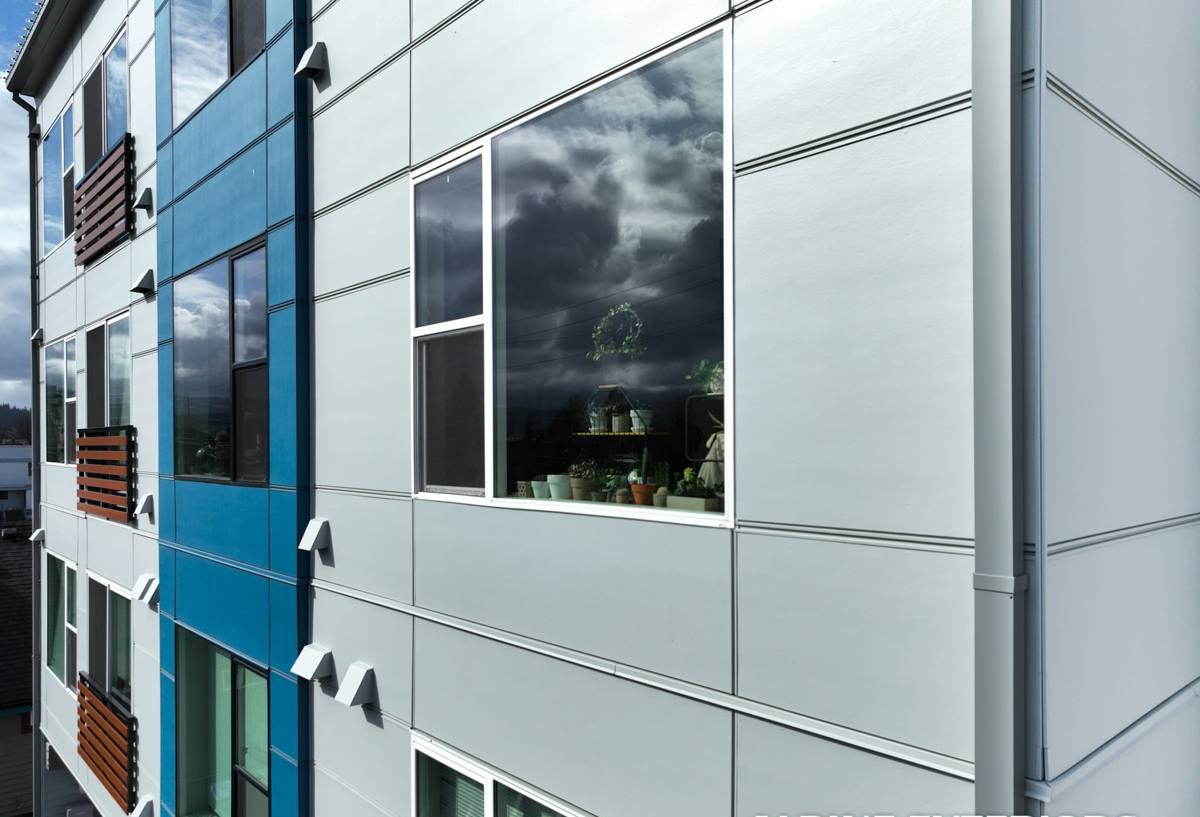
Most James Hardie siding sold with a factory finish uses what Hardie calls ColorPlus Technology. Instead of primer and paint going on after the boards are installed on your house, the color is baked onto the fiber cement in multiple coats under controlled factory conditions before it ever ships. That process produces a more even, more consistent film than anything achievable with a brush, roller, or sprayer on a job site — no thin spots at the edges, no lap marks, no variation from one crew's technique to the next.
What That Means for Touch-Ups
ColorPlus panels ship with color-matched touch-up kits and caulk specifically formulated for that finish, so nail heads, cut edges, and minor scuffs can be blended in rather than standing out. That's a meaningful difference from field-painted siding, where an exact color match years later is genuinely difficult.
The James Hardie Color Palette: What's Available
Hardie's ColorPlus lineup is a curated palette, not an unlimited swatch book, and that's intentional — it's built around colors that are proven to hold their pigment stability over time. Broadly, the lineup covers:
- Whites and off-whites, from crisp bright white to warmer creams
- Neutral grays, ranging from light warm gray to deep charcoal
- Earth tones — tans, browns, and warm neutrals that read well against wood accents and stone
- A small number of blues and greens, useful for coastal and Craftsman-style homes
- Deeper "statement" tones, including near-black and saturated colors, typically used on accent walls, shutters, or trim rather than full elevations
For homeowners who want a color genuinely outside that palette, Hardie also sells primed panels intended for field painting. That opens up any color a paint manufacturer offers, but it also means you're back to a site-applied finish with its own maintenance schedule — more on that trade-off below.
Choosing Colors That Work With Bellingham's Light and Landscape
Gray Skies Change How Color Reads
Bellingham gets a lot of overcast, diffuse light for much of the year. Bright whites and light warm neutrals tend to read cleaner under that kind of sky than they do in full sun, while deep charcoals and near-blacks can look almost purple or navy on a gray day and much truer to color on a clear one. It's worth looking at a sample panel outdoors, in shade and in direct light, before committing — indoor lighting and phone screens both distort this more than people expect.
Working With the Backdrop
Whatcom County's mix of evergreen tree cover, water views, and older brick and stone in Bellingham's core neighborhoods gives homeowners a lot to play off. Warm grays and greens tend to sit comfortably against a fir and cedar backdrop; classic whites and soft blues do well on homes closer to the water or with more open exposure. Darker statement colors read strongest on homes with generous roof overhangs and covered porches, where the wall itself gets some protection from constant direct rain.
Trim and Accent Combinations
Because ColorPlus is available in both lap siding and trim boards, most color schemes on a Hardie job pair a primary body color with a contrasting trim color and, often, a third accent tone on shutters, a front door surround, or a gable feature. Keeping the accent count to two or three colors total generally looks more intentional and ages better visually than a busier scheme.
ColorPlus vs. Field-Applied Paint: A Durability Comparison
This is the comparison that actually matters for a coastal Washington home, because it's the difference between a color that needs attention in year six and one that doesn't.
| Factor | ColorPlus Technology (Factory Finish) | Field-Applied Paint |
|---|---|---|
| Application method | Multiple coats, baked on under controlled conditions before installation | Primed on-site or at the mill, then painted after siding is up |
| Finish consistency | Uniform coverage across every board | Depends on the applicator, weather during application, and surface prep |
| Fade resistance | Formulated specifically for UV and moisture exposure, backed by a dedicated finish warranty | Varies by paint product; performance is only as good as the coating chosen |
| Repainting interval | Not typically needed for a decade or more under normal conditions | Commonly every 7-10 years in a wet coastal climate, sometimes sooner on sun- or rain-exposed walls |
| Touch-up matching | Manufacturer-supplied, color-matched touch-up product | Requires the original paint formula and batch to match well |
None of this means field-painted siding is a bad option in the abstract — it's a legitimate way to get an unlimited color choice. It just carries a real, recurring maintenance cost that a factory finish is built to avoid, and in a climate that rains as much as this one does, that difference compounds.
HZ5: Hardie's Climate-Engineered Line for the Pacific Northwest
James Hardie manufactures its fiber cement in formulations engineered for different climate zones across the country, marketed as HZ5 and HZ10 product lines. The HZ5 formulation is engineered for regions like ours — moderate temperatures, high humidity, and heavy annual rainfall rather than repeated hard freeze-thaw cycling. Choosing siding manufactured for the right climate zone isn't a color decision, but it's part of the same conversation, because the underlying board and the finish on top of it are meant to perform as a system. A correctly specified HZ5 board with a ColorPlus finish is engineered end-to-end for exactly the conditions Bellingham throws at a house.
Maintenance: Keeping Your Color Looking New in Whatcom County
ColorPlus siding is genuinely low-maintenance compared to painted alternatives, but "low" isn't "none." A few habits go a long way toward keeping the color looking like the day it was installed:
- Rinse the siding down once or twice a year with a garden hose and soft brush, focusing on north-facing walls and areas under trees where moss and mildew get a head start
- Avoid pressure washers on siding — they can force water behind panels and damage caulk joints, which causes far more trouble than the dirt they remove
- Keep gutters clean and downspouts directed away from walls; overflow staining is one of the most common complaints on any siding color, light or dark
- Trim back shrubs and tree limbs that keep a wall section shaded and damp longer than the rest of the house
- Recaulk and touch up around windows, trim, and penetrations as needed — small gaps are what let moisture and staining get started
- Check the color-matched touch-up kit that came with your installation before assuming you need a full repaint
Cost Factors in Color and Finish Decisions
Color choice itself doesn't usually change the price of the siding — ColorPlus colors within Hardie's standard palette are typically priced the same as one another. What does change cost is the finish path you choose and how much of the house you're accenting:
| Factor | How It Affects Cost |
|---|---|
| ColorPlus vs. primed-for-paint panels | ColorPlus carries a modest premium over primed board, offset by avoiding a paint job after install |
| Number of accent colors | Multiple trim/accent colors mean more cut boards and more careful sequencing during install, which adds labor |
| Custom (non-palette) colors | Requires primed panels plus a full professional paint job, adding both material and labor cost |
| Long-term maintenance | Factory finish avoids the recurring cost of repainting every 7-10 years that field-applied paint requires in this climate |
Why We Install Only James Hardie
We don't install vinyl, LP SmartSide, or other fiber cement brands, and color is a real part of why. A factory-baked finish backed by a manufacturer warranty is a fundamentally different product than paint applied on-site, or a color molded into vinyl that can't be touched up or refinished at all. When a homeowner asks us about a specific shade, we're not guessing how it'll hold up on a house facing Bellingham Bay — James Hardie's ColorPlus finishes and HZ5 formulation are built and warrantied for exactly this kind of coastal, high-rainfall climate. Standardizing on one manufacturer means our crews know the material, the fastening and caulking requirements, and the finish behavior cold, on every job, instead of relearning a new product's quirks each time.
If you're weighing colors for a new install or a full re-side, we're happy to bring actual ColorPlus samples out to your property so you can see them against your own roofline, trim, and landscaping in Bellingham's real light. Reach out for a free, no-pressure estimate — there's a short form below.