 Bellingham Siding
 Primed wood siding has a long history in the Pacific Northwest, and there's a reason it still shows up on remodeling estimates: it's affordable to buy, it's easy for a mill to run in almost any profile, and a freshly installed job looks sharp. But "looks sharp on install day" and "holds up through fifteen Bellingham winters" are two very different standards. After years of tear-offs, repairs, and repaint calls on primed wood siding jobs, we made a decision as a company: we don't install it anymore. This page explains why, honestly, without exaggerating what the product does wrong.
What Primed Wood Siding Actually Is
Primed wood siding is typically finger-jointed spruce, pine, or fir milled into lap or panel profiles, then coated at the factory with a single coat of primer before it ships. The primer is meant to seal the wood and give paint something to bond to — it is not a finish coat, and it is not a weather barrier on its own. The homeowner (or the contractor) is expected to apply a full paint system, including a topcoat, within a limited window after installation, and then maintain that paint film indefinitely.
That distinction matters more than most people realize when they're comparing price tags at the lumber yard. A primed board is a half-finished product. Everything that makes wood siding perform — or fail — happens after it's on the wall, in the paint and caulk work, and in how consistently that maintenance gets done year after year.
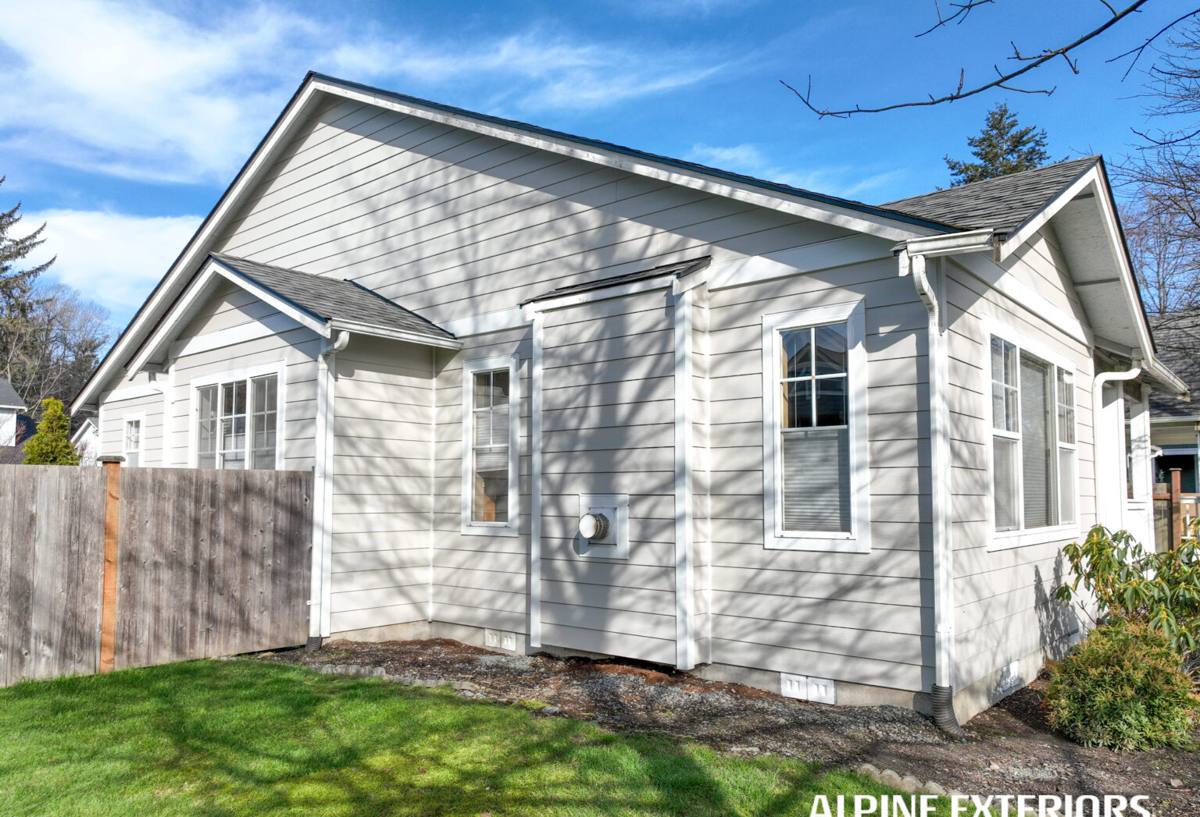
Where Primed Wood Siding Genuinely Gets It Right
We're not going to pretend this product has no upside, because it does.
- Familiar look. Wood grain and traditional lap profiles are what a lot of Bellingham's older neighborhoods were built with, and primed wood siding replicates that look closely because it is, in fact, real wood.
- Workability. It cuts, copes, and fits around trim details easily with standard carpentry tools.
- Lower material cost. Upfront material pricing is usually below fiber cement and can undercut engineered wood products too.
- Repairable in small sections. A damaged board can be cut out and spliced without matching a factory finish, since paint is applied on site.
If a homeowner wants that exact traditional wood look and is committed to real maintenance discipline, primed wood siding isn't a scam — it's a product with a demanding ownership cost. Our concern isn't the material itself; it's how that ownership cost plays out against Whatcom County's climate and against what most homeowners actually have time for.
Why Our Regional Climate Is the Real Problem
Bellingham and the rest of Whatcom County sit in a marine climate that is close to the worst-case scenario for painted wood siding. Three factors compound each other here:
Salt Air Off Bellingham Bay
Homes anywhere near the water — and a lot of Bellingham is within a few miles of Bellingham Bay or the Strait of Georgia — deal with salt-laden air that accelerates the breakdown of paint films and speeds corrosion on any exposed fasteners. Salt air pulls moisture into microscopic cracks in a paint coat faster than dry inland air does, which shortens the effective life of every repaint cycle.
Driving Rain and Wind-Driven Moisture
Whatcom County doesn't just get rain — it gets sideways rain, driven by wind off the water and funneled through valleys like the Nooksack. Wood siding depends entirely on its paint film and caulk joints to keep that moisture out. Once wind-driven rain finds a hairline crack at a butt joint, a nail head, or a bottom edge that wasn't back-primed, the wood behind the paint starts absorbing water — and wood that absorbs water repeatedly, without fully drying between storms, is exactly what starts the check-cracking and rot cycle.
A Long Moss and Mildew Season
Bellingham's damp, mild, overcast stretches — especially on north- and west-facing walls that don't get much direct sun — create ideal conditions for moss, algae, and mildew to colonize a painted wood surface for months at a time. That growth holds moisture against the wood, stains the paint film, and needs to be washed off regularly or it accelerates the very decay it's sitting on top of.
None of these three conditions is unique to our area, but the combination — salt exposure, driving rain, and an extended moss season — is a tough environment for a product whose entire performance depends on an unbroken paint film.
The Maintenance Reality Most Estimates Don't Mention
This is the core of why we stopped installing it. Primed wood siding is not a "paint it once and forget it" product in this climate. It's a recurring maintenance commitment, and the schedule is tighter than most homeowners expect when they're comparing sticker prices.
| Maintenance Task | Typical Interval Here | What Happens If Skipped |
|---|---|---|
| Full repaint / recoat | Every 5-8 years (often sooner on south/west exposures and near the bay) | Paint film chalks, cracks, and stops shedding water |
| Caulk joint inspection | Annually | Open joints let wind-driven rain behind the siding |
| Moss/algae wash-down | 1-2 times per year on shaded or north-facing walls | Growth traps moisture against the wood surface |
| Spot repair of damaged boards | As needed, usually discovered late | Localized rot spreads to adjacent boards and sheathing |
Every one of those tasks costs money and requires someone to actually schedule it. In our experience, the gap between "what the maintenance schedule requires" and "what actually happens" is where the real damage occurs — not in year one or two, but in year six or seven, when a missed repaint cycle lets water get behind the paint film and the rot starts from the inside out, invisible until a board is soft to the touch.
What Failure Actually Looks Like
When primed wood siding fails, it rarely fails all at once. It shows up as:
- Cupping or bowing boards where moisture has been absorbed unevenly
- Paint checking (fine cracking) that lets water in faster than it can dry out
- Soft or spongy spots near the bottom edges of boards, where splash-back and standing moisture concentrate
- Nail popping as the wood swells and shrinks through repeated wet-dry cycles
- Persistent moss and dark staining on shaded elevations even shortly after a repaint
By the time most of these signs are visible from the ground, there's often more damage underneath the paint than the surface suggests. Wood rot doesn't announce itself early, and once sheathing or framing behind the siding is involved, the repair scope — and cost — jumps well past what a repaint would have run.
Why We Standardized on James Hardie Instead
We install James Hardie fiber cement siding exclusively, and it's a direct response to the pattern above. Fiber cement doesn't have wood's grain structure, so it doesn't absorb and swell with moisture the same way, and it isn't a food source for the organic growth that thrives in our wet season. Hardie's ColorPlus finish is a factory-applied, baked-on coating engineered specifically to resist fading and cracking — it's a finish system, not a job-site paint job dependent on weather conditions and applicator skill on the day it goes up.
Hardie also builds region-specific product lines through its HZ5 engineering, which accounts for the freeze-thaw and moisture patterns of climates like ours in the Pacific Northwest. It's non-combustible, which matters for insurance and wildfire-adjacent building codes even in a wet climate like Whatcom County. And the warranty is structured around the product performing for decades with normal maintenance, not a repaint cycle every 5-8 years.
None of that makes fiber cement immune to bad installation — flashing details, joint treatment, and fastening still have to be done correctly regardless of the material. But it removes the single biggest variable that makes primed wood siding a gamble here: whether the paint film holds up between now and the next scheduled maintenance visit.
What This Means If You're Comparing Options
If you're set on the look of traditional painted wood siding and you're prepared to budget for repaints roughly every 5-8 years, plus annual caulk and moss maintenance, primed wood siding can still be installed correctly by contractors who work with it — that's a legitimate choice for the right homeowner. We simply won't be that contractor, because we've seen too many of these jobs come back to us as rot repairs instead of repaint calls, and we'd rather put a product on your home that we can stand behind for the long haul.
If your priority is lower lifetime maintenance, a finish that doesn't depend on catching every repaint cycle on schedule, and a product engineered for exactly the kind of driving rain and damp seasons Bellingham sees, that's the conversation where James Hardie fits.
Questions Worth Asking Before You Choose Wood Siding
- Who is doing the ongoing maintenance, and is that written into a real annual budget?
- Was every board back-primed on all six sides before installation, including cut ends?
- What's the plan for shaded, north-facing walls where moss and mildew are worst?
- Does the installer's warranty cover the wood itself, or only workmanship?
- How does the total cost compare over 20 years, not just at move-in?
We're happy to walk through your home's specific exposure — how close you are to the water, which walls get direct sun, how sheltered or exposed the site is — and give you a straight answer about what will actually hold up. If you'd like a free, no-pressure estimate for James Hardie siding on your Bellingham home, the form below gets you started.