 Bellingham Siding
 Siding in Sehome: A Neighborhood That Sits Right in the Weather
Sehome is one of Bellingham's older, established neighborhoods, and homes here run the gamut from mid-century ramblers to updated craftsman-style houses, many with mature trees overhanging the roofline and siding. That mix of age and tree cover matters more than most homeowners realize. Older siding systems were never engineered for the specific combination of conditions Whatcom County throws at them year after year, and mature landscaping means more shade, more standing moisture, and more organic debris collecting against exterior walls than a newer subdivision would see.
We've worked on homes throughout Bellingham and Whatcom County long enough to know that Sehome's siding problems aren't hypothetical. They show up as soft trim boards, dark streaking under eaves, and paint that won't hold past a few seasons. A siding system that can shed water, resist moisture intrusion, and hold its finish through repeated wet-dry cycles isn't a luxury here — it's the baseline requirement.
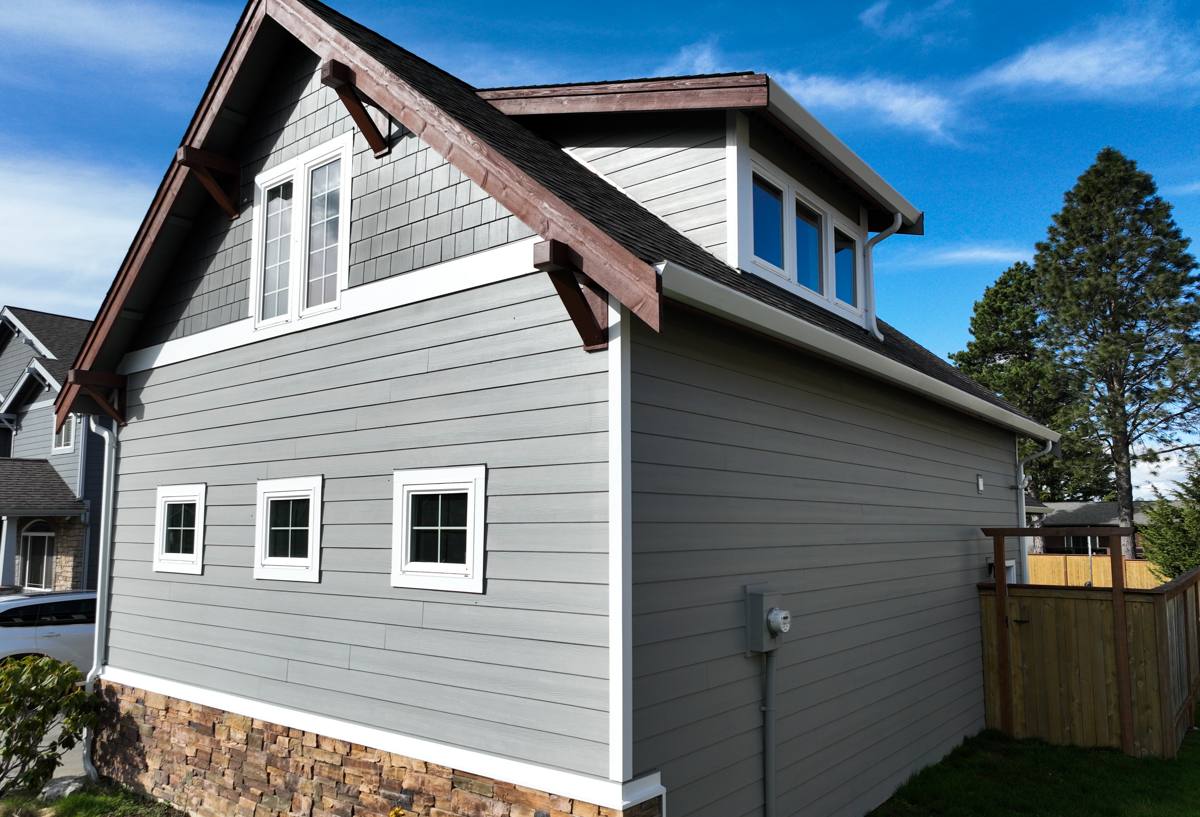
What the Local Climate Actually Does to Siding
Bellingham sits close enough to Bellingham Bay and the Salish Sea that salt-laden air is a real factor, not a coastal-town cliché. Salt air accelerates corrosion of fasteners and metal trim, and it also degrades certain paint and coating systems faster than inland weather would. Combine that with the Pacific Northwest's driving rain — often blown sideways by wind off the water — and you get moisture finding its way into every seam, lap joint, and fastener penetration that isn't detailed correctly.
Then there's moss. Whatcom County's long, mild, wet stretch from fall through spring gives moss and algae months of ideal growing conditions on any surface that stays damp and shaded. Siding facing north or tucked under tree canopy — common throughout Sehome's older lots — can stay damp for days after a storm passes. Over years, that constant moisture exposure is what breaks down wood-based and composite siding products from the inside out, long before the surface finish looks obviously bad.
The Three Stressors, Summarized
| Stressor | What It Does | Where It Shows Up |
|---|---|---|
| Salt air | Corrodes fasteners and trim, degrades some finishes faster | Fascia, trim edges, exposed metal flashing |
| Driving rain | Forces water into seams, laps, and penetrations | Window and door surrounds, butt joints, bottom courses |
| Moss and algae | Holds moisture against the surface for extended periods | North-facing walls, shaded elevations, under eaves |
Why We Install Only James Hardie Fiber Cement
We made a decision years ago to standardize on James Hardie fiber cement siding and stop installing everything else — vinyl, LP SmartSide, cedar, primed spruce, Cemplank, Allura. That's not a marketing position; it's a practical one based on what actually holds up under the conditions we just described.
Fiber cement is non-combustible, which matters increasingly in Washington given wildfire smoke and ember exposure concerns in recent fire seasons, even in a coastal county like Whatcom. More relevant to daily performance here, Hardie's HZ5 product line is engineered specifically for climates with high moisture exposure — freeze-thaw cycling, prolonged dampness, and coastal humidity. It resists moisture absorption far better than wood-based composites, it doesn't feed moss the way organic wood fiber can, and it holds its factory-applied ColorPlus finish for years without the repainting cycle that wood and some composite sidings demand.
We're not saying every alternative product is a bad product in every application. Vinyl has its place for budget-driven projects; cedar has genuine aesthetic appeal for people who accept the maintenance commitment; LP SmartSide performs reasonably in drier climates. But in a market where salt air, driving rain, and moss season are the norm rather than the exception, we've seen enough of what those products look like after ten or fifteen years on Whatcom County homes to know we don't want our name on that outcome. Hardie, installed correctly, is the product we're willing to stand behind.
What "Installed Correctly" Actually Means
- Proper rainscreen or drainage plane behind the siding, not direct-to-sheathing installation
- Correct fastener type and spacing per Hardie's published specifications for the HZ zone
- Flashing integrated at every window, door, and penetration before siding goes on, not caulked over afterward
- Minimum clearance maintained between the bottom siding course and grade, decks, or roof surfaces
- Factory-primed cut edges sealed in the field, since factory ColorPlus finish doesn't extend to a fresh cut
- Joints and laps sized to allow for expansion without trapping water
Most siding failures we're called out to inspect aren't failures of the material — they're failures of installation detail. That's true whether the original product was fiber cement, vinyl, or wood. It's why we treat the install process itself as seriously as the product choice.
Beyond Siding: Roofing, Windows, and Decks in Sehome
Siding doesn't work in isolation. A roof that's shedding granules or has failing flashing will send water down behind even well-installed siding. Windows with degraded seals let moisture track into the wall assembly around the rough opening. Decks attached to the house create a junction point where flashing and drainage details are easy to get wrong and expensive to fix later. We handle all four trades — siding, roofing, windows, and decks — because on a home in a climate like this, they're really one connected exterior envelope, not four separate projects.
For Sehome homeowners dealing with an aging roof alongside tired siding, it's usually worth sequencing both projects together. Replacing siding first and finding out the roof needs redone a year later (or vice versa) often means redoing flashing work that could have been done once, correctly, the first time.
What a Sehome Siding Project Typically Involves
Assessment and Scope
We start by walking the exterior with the homeowner, looking specifically at the areas most exposed to Bellingham's weather patterns: north and west-facing walls, anywhere moss has established, trim and fascia condition, and existing flashing at windows and doors. This tells us whether we're looking at a straightforward re-side or whether there's underlying sheathing or framing damage that needs to be addressed first.
Removal and Inspection
Once old siding comes off, we inspect the sheathing and framing underneath. In older Sehome homes, this step sometimes reveals moisture damage that wasn't visible from the exterior — a good reason not to skip this step or rush past it.
Weather Barrier and Drainage Plane
Correct installation means a proper water-resistive barrier and drainage gap behind the new siding, giving any moisture that does get past the surface a way to drain and dry out rather than sitting against the wall assembly.
Installation to Manufacturer Spec
Hardie siding, trim, and fasteners go in according to the manufacturer's published installation guide for our climate zone — not generic guidance, but the specific requirements that keep the product warranty intact and the assembly performing as engineered.
Cost Factors Homeowners Should Understand
| Factor | Why It Affects Price |
|---|---|
| Home size and elevation complexity | More corners, dormers, and trim details mean more labor and cutting |
| Existing sheathing condition | Rot or damage found during removal adds repair scope before siding goes on |
| Siding profile and color | Lap width, shingle-style panels, and ColorPlus color selection vary in material cost |
| Window and door count | Each opening requires flashing integration, adding labor time |
| Accessibility | Tree cover, tight lots, and multi-story walls affect scaffolding and staging needs |
Why a Local Crew Matters for This Kind of Work
A crew that only sees Bellingham and Whatcom County weather knows things a national or out-of-region contractor won't think to check: which elevations in a Sehome-type lot stay damp longest, how much clearance to leave near grade given how much rain the area gets, and how aggressive moss growth can get on a shaded wall if drainage details are even slightly off. That local pattern recognition shows up in the small decisions — flashing laps, fastener choice, where to add extra drainage capacity — that determine whether siding lasts fifteen years or fifty.
It also matters for warranty support. Hardie's product warranty is strong, but manufacturer warranties on labor and installation defects are only as good as the contractor standing behind them. A local company with a track record in this specific climate has both the incentive and the experience to get the installation right the first time.
Getting Started
If your Sehome home has siding that's showing its age — moss buildup that keeps coming back, peeling paint, soft spots near the bottom courses, or gaps around trim — it's worth getting a straightforward, no-pressure look at what's actually going on before deciding what to do next. We're happy to walk the exterior with you, explain what we see, and put together an honest estimate for siding, roofing, windows, or decks. Use the form below to request a free estimate.