 Bellingham Siding
 Why Bellingham's Climate Is Especially Tough on Siding
Siding in Bellingham works harder than siding almost anywhere else in the country. You've got the salt air rolling off Bellingham Bay and the Salish Sea, driving rain that comes in sideways off the water during fall and winter storms, and a moss season that can stretch from October clear through May on shaded, north-facing walls. Add in the tree cover that defines so many Whatcom County neighborhoods, and you have a recipe for siding that stays damp longer than it should, cycles through freeze-thaw more than homeowners expect for a "mild" climate, and takes on organic growth faster than siding in drier parts of the state.
None of that means your siding is doomed. It means the warning signs matter more here, and they show up sooner if the material or the installation wasn't built for this kind of exposure. Catching the signals early is the difference between a maintenance fix and a full tear-off. Here's what to watch for, wall by wall.
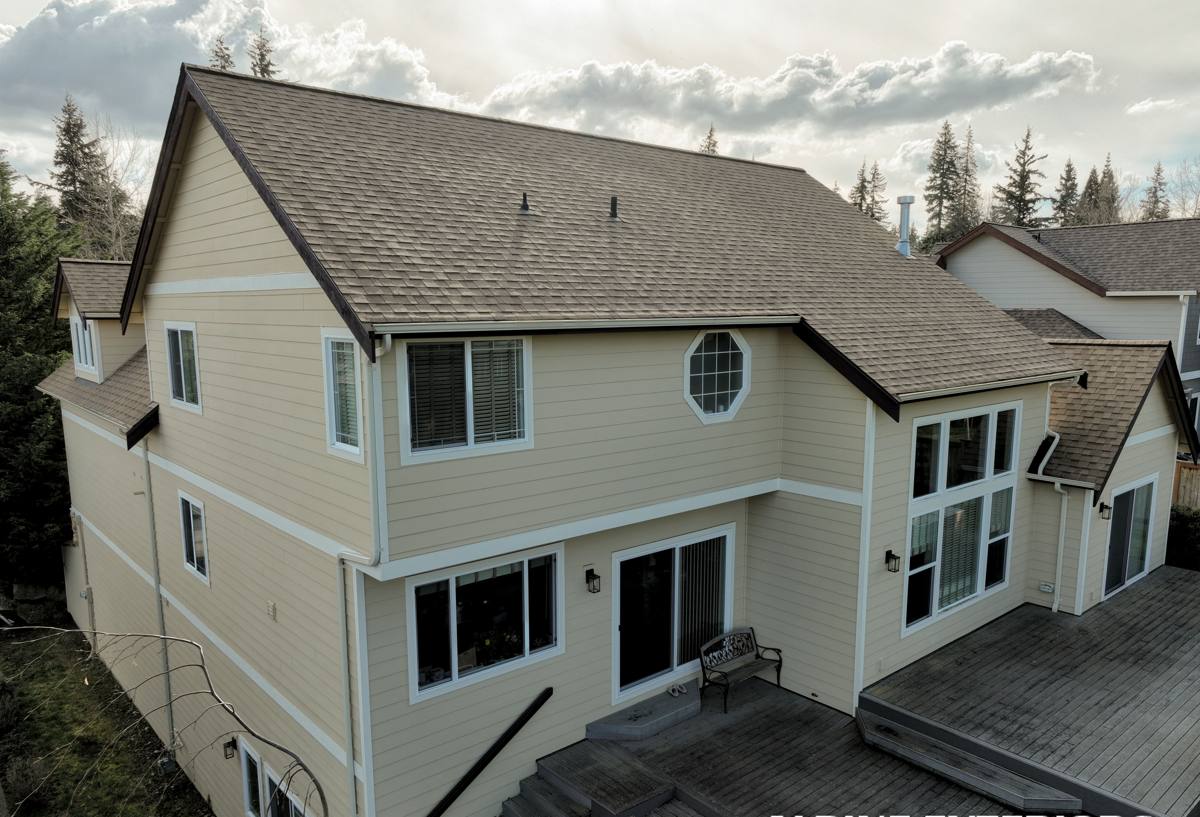
Warning Sign: Paint and Finish Failure
Paint that's bubbling, peeling in sheets, or chalking heavily is usually telling you something is happening underneath, not just that the paint is old. On wood and fiber cement siding that was field-painted rather than factory-finished, moisture gets trapped behind the paint film and has nowhere to go. In Bellingham's damp shoulder seasons, that trapped moisture doesn't dry out between rain events the way it might in a drier climate — it just keeps cycling.
A little chalking after ten-plus years is normal weathering. Paint that's failing in patches after only three or four years, especially on south- and west-facing walls that take the brunt of wind-driven rain, points to a coating or substrate problem worth investigating before it spreads.
Warning Sign: Soft, Spongy, or Crumbling Panels
This is the big one. Press a gloved hand or the flat of a screwdriver handle against your siding, especially near the ground, under windows, and around hose bibs. Wood-based products — cedar, primed spruce, and OSB-core engineered siding like LP SmartSide — can absorb water at cut edges, fastener holes, and seams if the factory or field sealing wasn't done perfectly. Once water gets into the wood fiber or OSB core, it doesn't evaporate quickly in our climate, and the material starts to swell, soften, and eventually rot from the inside out.
By the time you can see visible deterioration on the surface, the damage underneath is often further along than it looks. Soft spots are not a "keep an eye on it" issue — they're a "get it looked at this month" issue.
Warning Sign: Moss, Algae, and Persistent Staining
Some surface growth is inevitable on any exterior surface in Whatcom County. The distinction that matters is between light, easily-washed surface growth and moss that's established itself in seams, laps, and butt joints and keeps coming back within weeks of cleaning.
Why Moss Season Lasts So Long Here
Shaded lots, tree canopy, and our long stretch of overcast, drizzly weather mean moss spores have months of favorable conditions rather than a few weeks. On siding with poor water-shedding detail — tight overlaps, minimal ventilation gaps, or a finish that holds moisture — moss gets a foothold and actually helps trap more water against the surface, accelerating whatever's happening underneath. Recurring moss along the bottom courses or under eaves is often less about the siding being dirty and more about that section of wall staying wet longer than the rest of the house.
Warning Sign: Gaps, Warping, and Buckled Boards
Look down the length of each wall from an angle instead of straight-on. Boards that have started to bow, cup, or pull away from the wall in waves are usually reacting to moisture cycling — swelling when wet, shrinking when they briefly dry, and gradually losing their original shape. You'll often see this first at butt joints, where two pieces of siding meet, since that's where water intrusion is most likely to start.
Gaps opening up between boards or around trim are also worth noting. Even a small gap gives wind-driven rain — which Bellingham gets plenty of — a direct path behind the siding, where it can sit against the sheathing and building wrap for days at a time.
Warning Sign: Rot at Trim, Corners, and Bottom Courses
Corner boards, window and door trim, and the lowest courses of siding near grade are the first places real rot tends to show up, because they collect the most water and dry out the slowest. Soft, dark, or crumbling wood at these locations — even if the rest of the wall looks fine — is a sign that moisture has been getting in for a while, not a one-time event.
If you can push a small screwdriver into trim or corner boards with light pressure and it sinks in without resistance, that's active decay, not cosmetic weathering. It's worth checking these spots specifically, since they're easy to overlook from a normal walk-around.
Warning Sign: Rising Energy Bills and Drafty Rooms
Siding failure isn't always visible from the outside first. Gaps, rot, and compromised house wrap behind the siding let conditioned air escape and outside air in, which shows up as rooms that feel drafty near exterior walls or a heating bill that's crept up without an obvious cause. If you've ruled out windows, doors, and insulation and you're still seeing unexplained increases, it's worth having the siding and the water-resistive barrier behind it checked as part of the picture.
How Different Siding Materials Hold Up in Whatcom County
Not every siding material responds to Bellingham's climate the same way. Here's a general comparison of how common materials tend to perform against moisture, salt air, and moss over time when exposed to this kind of climate:
| Material | Moisture Sensitivity | Moss/Algae Resistance | Typical Maintenance |
|---|---|---|---|
| Primed spruce / cedar | High — wood fiber absorbs and swells | Low — organic surface feeds growth | Frequent repainting, caulking, spot repairs |
| LP SmartSide (OSB-based) | Moderate to high at cut edges and seams | Moderate | Regular inspection of seams and fastener sites |
| Vinyl siding | Low absorption, but traps moisture behind panels | Moderate — smooth but can stain | Periodic cleaning; limited repair options if cracked |
| Fiber cement (standard) | Low — cement-based core resists swelling | Moderate — depends on finish | Repainting needed if not factory-finished |
| James Hardie fiber cement (ColorPlus) | Low — engineered for wet climates, factory-sealed edges | Low to moderate with proper detailing | Occasional washing; no repainting for years |
This isn't about any one product being universally bad — it's about matching material and finish to the specific stresses of a marine climate. That's the standard we hold every installation to, which is why we build every project around James Hardie's fiber cement system rather than the wood, OSB, or vinyl alternatives.
What To Do When You Spot a Warning Sign
Not every issue means a full re-side. A lot of early-stage problems can be addressed with targeted repair, better flashing, or improved drainage detailing if they're caught soon enough. Use this checklist during a seasonal walk-around, ideally before and after Bellingham's wettest months:
- Walk the full perimeter and check bottom courses, corners, and trim for soft or discolored wood
- Look at butt joints and seams for gaps, warping, or separation
- Note any areas where moss or algae returns quickly after cleaning
- Check for paint that's peeling in sheets rather than gradual chalking
- Feel for drafts near exterior walls on a windy day
- Check caulking around windows, doors, and penetrations for cracking or gaps
- Look up under eaves and around roof-to-wall transitions, where water concentrates
If you find one or two of these signs isolated to a small area, a repair may be reasonable. If you're finding multiple signs across different walls, or the same problem keeps coming back after repair, that's usually a sign the underlying material or installation isn't holding up to the climate, and it's worth getting a full assessment rather than chasing individual spots.
Why We Standardized on James Hardie
We made the decision years ago to install only James Hardie fiber cement siding, and pages like this one are part of why: we'd rather explain our reasoning upfront than sell something we know struggles in a climate like ours. Hardie's HZ5 product line is engineered specifically for regions with heavy moisture exposure, the ColorPlus factory finish is baked on under controlled conditions rather than applied on-site where weather can compromise it, and the fiber cement core is non-combustible and doesn't absorb and swell with water the way wood-based products do. It's not that other materials can't work anywhere — it's that after years of doing exterior work in Whatcom County, this is the product we trust to hold up against salt air, driving rain, and a long moss season without the recurring problems we've described above.
If you're seeing any of these warning signs on your own home, or you just want a second set of eyes before a small issue becomes a big one, we're happy to take a look. Reach out for a free, no-pressure estimate — there's a short form below to get started.