 Bellingham Siding
 Siding in Cordata: A Neighborhood That's Still Growing Into Its Weather
Cordata is one of Bellingham's newer residential areas, built out largely from the 1990s onward along the north side of the city near I-5 and the airport. That newer housing stock means a lot of Cordata homes are still wearing their original siding, and a growing number are hitting the 15-to-25-year mark where the first real signs of wear show up. Whether your home has vinyl, engineered wood, or an older fiber cement product, Whatcom County's marine climate doesn't care how new the subdivision is. Wind-driven rain, long stretches of overcast damp, and heavy shade from mature landscaping all put steady pressure on exterior materials.
We work throughout Bellingham and Whatcom County, and Cordata's mix of newer construction, mature street trees, and proximity to open, wind-exposed corridors near the freeway and airport gives it its own particular set of exterior challenges. This page covers what we see on Cordata homes, how we approach siding work here, and why we've standardized on one product instead of offering the usual menu of options.
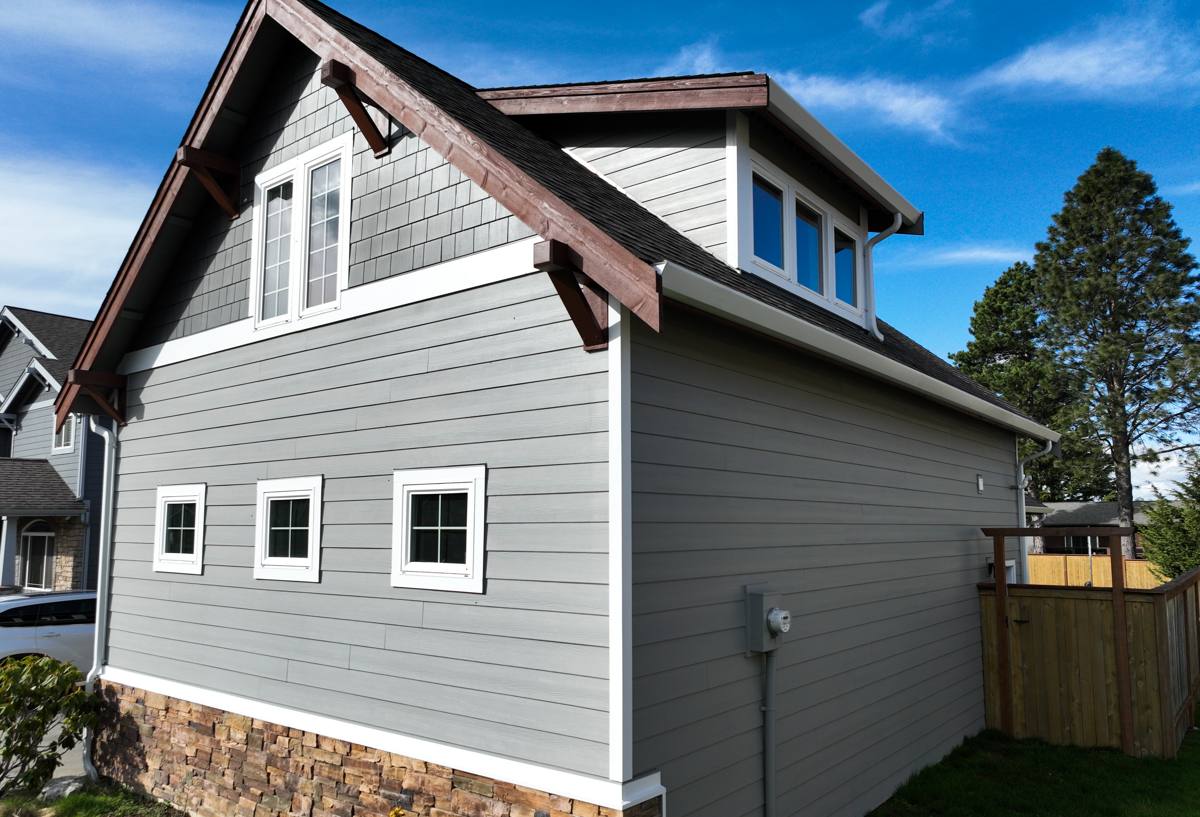
What Cordata Homes Are Up Against
Driving Rain and Wind Exposure
Cordata sits on more open, gently rolling terrain than some of Bellingham's tighter, tree-shrouded neighborhoods closer to the bay, which means homes here can catch more direct wind during winter storms. Wind-driven rain doesn't just wet a wall — it forces moisture into every seam, joint, and fastener point on a siding system. Materials that swell, delaminate, or absorb water at the edges take the worst of this over time.
Salt Air and Regional Moisture
Bellingham's whole exterior-building climate is shaped by its position on the Salish Sea. Even neighborhoods set back from the water, like much of Cordata, still deal with salt-tinged marine air carried in off Bellingham Bay and the Strait of Georgia. Combined with Whatcom County's famously long wet season, that salt air accelerates corrosion on fasteners and trim, and it keeps painted and coated surfaces working harder year-round than they would in a drier climate.
Moss, Shade, and the Long Wet Season
Newer developments in Cordata were often built with landscaping and street trees that have now matured, and many lots back up to greenbelt or wooded buffer areas. That shade is nice for a yard and murder on siding. Whatcom County's moss season runs long — often eight months or more of the right combination of moisture and low sun angle — and north-facing or heavily shaded wall sections are where you'll see the first green film, softening trim, and the telltale bubbling of paint that signals moisture is getting trapped underneath the surface material rather than shedding off it.
Why We Only Install James Hardie Fiber Cement
Most exterior contractors in this region will install whatever the homeowner picks — vinyl, LP SmartSide, primed wood, one of the other fiber cement brands. We don't. Every siding job we do uses James Hardie fiber cement, and that's a deliberate standard, not a lack of options.
Fiber cement as a category resists the two things that do the most damage in a climate like ours: sustained moisture and wind-driven impact. James Hardie specifically engineers regional product lines (their HZ5 formulation is built for climates like the Pacific Northwest) to handle freeze-thaw cycling and prolonged damp exposure better than a one-size-fits-all product. It's also non-combustible, which matters more each year as wildfire smoke and regional fire risk become a bigger part of Western Washington's summer conversation, even this far north.
How It Compares to What We Don't Install
| Material | How It Handles Cordata's Climate | Long-Term Consideration |
|---|---|---|
| Vinyl siding | Sheds rain well when intact, but seams and corners can let moisture behind the panel; can warp or crack in cold snaps | Lower upfront cost, shorter realistic lifespan, fading is common |
| LP SmartSide / engineered wood | Performs reasonably when perfectly sealed and maintained; edge moisture intrusion is the main failure point | Requires diligent caulking and paint upkeep to avoid swelling at cuts and seams |
| Primed cedar or spruce | Natural material, handles wet weather when maintained, but is the most maintenance-intensive option | Repainting/staining cycle every few years; rot risk if upkeep lapses |
| James Hardie fiber cement | Non-combustible, dimensionally stable, factory-cured to resist moisture absorption and swelling | Higher upfront cost; installation quality matters more than with lighter materials |
None of these products are junk — vinyl and engineered wood both have a legitimate place in the market. But we've made a professional judgment that the trade-offs aren't worth it for the wet, shaded, salt-touched conditions a lot of Cordata homes sit in. Hardie's factory-applied ColorPlus finish also means the color coat is baked on under controlled conditions rather than painted on-site, which holds up better against our long wet season and reduces how often a homeowner needs to think about repainting.
Installation Is Where Siding Actually Succeeds or Fails
Fiber cement is only as good as the install behind it. A huge share of the siding failures we get called out to inspect — regardless of brand — trace back to installation shortcuts, not the material itself. For a Cordata home, that means paying close attention to:
- Proper water-resistive barrier and flashing details behind every seam, window, and door opening
- Correct fastener spacing and type to prevent the corrosion that salt air accelerates
- Rain-screen gap where wall assemblies call for it, so moisture that does get behind the siding can drain and dry instead of sitting against sheathing
- Manufacturer-specified clearances at grade, decks, and roof lines to keep splash-back and ponding water away from the bottom courses
- Caulking and sealant only where James Hardie's install guide actually calls for it — over-caulking traps moisture just as badly as under-caulking lets it in
We install to James Hardie's published specifications, which is also what keeps their transferable warranty intact if you sell the home. A siding job that looks right on install day but skipped flashing details or rain-screen spacing can still fail in five to ten years — and by then it's the homeowner's problem, not the installer's.
More Than Siding: The Full Exterior Envelope
Siding doesn't work in isolation. We also handle roofing, windows, and decks, because the exterior of a house functions as one connected system in a climate like Bellingham's. A few examples of how that shows up on real jobs:
- Roofing: Roof edges, flashing, and gutter performance directly affect how much water runs down and across your siding. A roof that's shedding water poorly onto a wall will undermine even a well-installed siding job.
- Windows: Window flashing and siding installation have to be sequenced and detailed correctly together, or you get exactly the kind of hidden moisture path that shows up years later as rot around a window frame.
- Decks: Deck ledger boards attach directly to the house structure, and poor flashing at that connection is one of the most common sources of hidden rot we find in older Whatcom County homes.
When one crew handles all of it, these transition points get treated as part of one system instead of four separate contractors each assuming someone else covered the detail.
Signs a Cordata Home May Need Siding Work
- Green or black film on north- or west-facing walls, especially near mature trees or fence lines
- Paint that's bubbling, peeling, or chalking faster than the rest of the house
- Soft spots when you press on siding near the bottom courses, around window sills, or near deck ledgers
- Visible gaps, warping, or cupping in panel or board seams
- Rising energy bills with no other explanation, which can point to compromised wall assemblies
- Siding that's simply reaching 20+ years old, regardless of visible damage
What Drives the Cost of a Cordata Siding Project
| Factor | Why It Matters |
|---|---|
| Home size and wall complexity | More corners, gables, and dormers mean more cutting, flashing, and labor time |
| Current siding removal | Tear-off of old material and any hidden sheathing repair adds time and cost |
| Product line and profile | Lap width, texture, and trim choices within the James Hardie lineup affect material cost |
| Access and site conditions | Steep lots, tight setbacks, or heavy landscaping can add labor and staging time |
| Trim, window, and deck integration | Coordinating siding with window or deck work in the same project can save on mobilization costs versus doing them separately |
We don't publish blanket per-square-foot pricing because these factors swing the real number meaningfully from house to house — but we'll always walk you through exactly what's driving your estimate before any work starts.
Why a Local Crew Matters in a Neighborhood Like This
Cordata's mix of newer construction and mature landscaping means every house has slightly different sun exposure, wind exposure, and moisture history, even on the same block. A crew that works across Bellingham and Whatcom County day in and day out has seen how that plays out over years, not just on install day. We know what a north-facing wall under a stand of mature firs is going to deal with over the next winter, and we spec the job accordingly rather than treating every house the same way a national franchise crew passing through might.
If you're noticing early wear on your siding, planning ahead for a home update, or just want an honest read on where your exterior actually stands, we're glad to come take a look. Reach out for a free, no-pressure estimate using the form below — we'll walk the property, tell you what we see, and give you a straight answer, whether that means new siding now or a few more years of life in what you've got.