 Bellingham Siding
 Board & Batten in Birchwood: A Style That Has to Earn Its Keep
Board and batten has become one of the most requested looks for homes in and around Birchwood — the vertical lines read as modern farmhouse, they suit both new builds and older homes getting a facelift, and they give a house a taller, more custom feel than standard lap siding. But vertical siding isn't just a style choice. The way it's built changes how water moves down the wall, and in this part of Whatcom County, water is the thing every siding decision eventually comes back to.
We install board and batten siding as one specific system: James Hardie fiber cement, factory-finished, engineered for this climate. This page walks through what that means for a Birchwood home specifically, not siding in general.
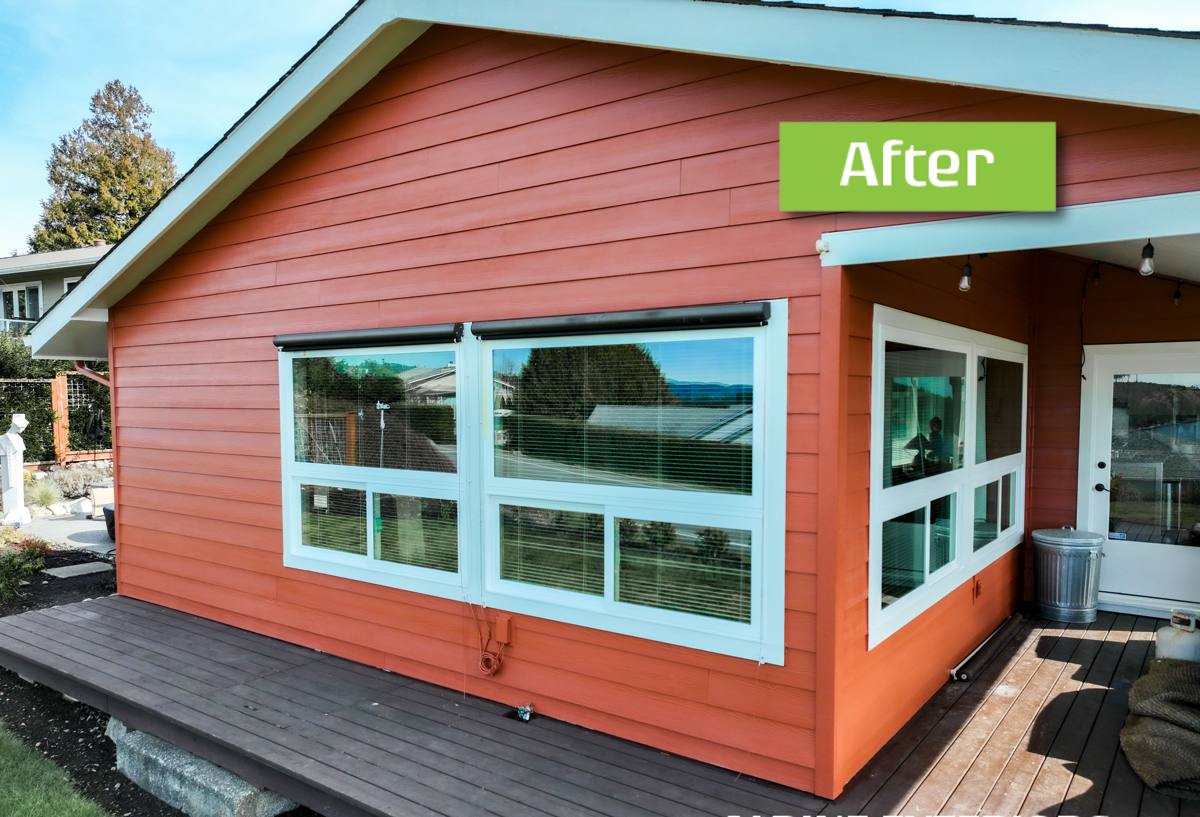
What Bellingham's Climate Actually Does to a Board and Batten Wall
Bellingham sits close enough to salt water and open exposure that homes here deal with a combination most siding products were never designed around: salt-laden air, long stretches of driving rain, and a moss season that can run most of the year on shaded or north-facing walls. Board and batten siding has more seams per square foot than lap siding — every batten strip is another joint, another fastener line, another place for water to find a way in if the assembly underneath isn't right.
Moisture at the Battens
The battens themselves aren't the risk — what's behind them is. If the vertical panels sit flat against the wall sheathing with no way for water to drain or air to move, any moisture that gets past a seam has nowhere to go. Over a Bellingham winter, that trapped moisture doesn't dry out between storms the way it might in a drier climate. It just accumulates.
Salt Air and Fastener Corrosion
Homes closer to the water deal with airborne salt that accelerates corrosion on unprotected metal — fasteners, flashing, and trim accessories included. The siding material matters less here than the hardware holding it up. Stainless or coated fasteners rated for coastal exposure aren't optional upgrades on a Birchwood job; they're the baseline.
Moss and Shaded Walls
Whatcom County's tree cover means a lot of Birchwood homes have at least one wall that rarely sees direct sun. Moss and algae take hold fastest on porous or textured surfaces that hold surface moisture. A factory-cured, dense fiber cement panel resists that growth far better than a wood-based or wood-look panel that absorbs moisture at the surface.
Why We Install This Only in James Hardie Fiber Cement
We don't offer board and batten in vinyl, LP SmartSide, primed spruce, cedar, or any of the other engineered wood or composite panels on the market. That's a standard, not a limitation we apologize for. Each of those alternatives asks a homeowner to accept a trade-off — moisture absorption at cut edges, more frequent repainting, shorter warranty coverage, or performance that depends heavily on perfect installation and perfect maintenance every year after. In a climate that gives you driving rain for months at a stretch, we'd rather not build a wall assembly that depends on nothing ever going wrong.
The System We Use
For board and batten, that means James Hardie's vertical panel siding paired with Hardie trim battens, specified in the HZ5 product line engineered for the wetter, more humid conditions found in the Pacific Northwest. The panels carry a factory-applied ColorPlus finish, which is baked on under controlled conditions rather than field-painted, so the color coat is more consistent and holds up longer against UV and moisture cycling than a job-site paint job would.
What We Don't Install, and Why We're Upfront About It
Vinyl board and batten is lightweight and inexpensive, but it expands and contracts with temperature swings and can warp or fade over time, especially with direct sun exposure on south- and west-facing walls. Engineered wood panels perform reasonably well when the finish stays intact, but any breach — a woodpecker hole, a missed caulk joint, a cracked corner — lets moisture into a wood-based core, and that's a slower, quieter kind of damage that's expensive to catch early. Fiber cement doesn't remove risk from a project entirely, but it removes that specific failure mode.
What a Correct Board and Batten Installation Actually Involves
Board and batten looks simple from the curb — vertical panels, battens over the seams — but the assembly behind it is more demanding than lap siding, and it's where most of the corners get cut on lower-bid jobs.
- A drainage plane (weather-resistant barrier) installed correctly over the sheathing, with proper laps and no punctures left unsealed
- A rainscreen air gap behind the panels so any incidental moisture can drain and the wall can dry rather than staying saturated
- Correct fastener spacing and type, rated for coastal/high-moisture exposure, driven to manufacturer specification rather than overdriven or underdriven
- Flashing at every horizontal transition — window heads, roof lines, deck ledgers — installed to shed water outward, not into the wall
- Battens set with the gap and fastening pattern James Hardie specifies, not eyeballed for looks alone
- Factory-cut and factory-primed edges preserved wherever possible; any field cuts sealed per manufacturer instruction
- Proper clearance at grade, decks, and patios so the bottom edge of the siding never sits in standing water or snow load
Skip any one of those steps and the panels themselves can be flawless while the wall behind them still fails. This is the part of the job that doesn't show up in a driveway photo, which is exactly why it matters who's doing the work.
What Actually Drives Cost on a Board and Batten Job
Board and batten typically costs more per square foot than lap siding of the same material, mainly because of the extra batten strips and labor for a second layer of fastening and detail work. The table below covers the factors that move the price on a Birchwood project specifically.
| Cost Factor | Why It Matters Here |
|---|---|
| Full re-side vs. accent wall | Many Birchwood homes use board and batten as a gable or accent feature over lap siding elsewhere, which narrows scope and cost considerably |
| Tear-off vs. overlay | Existing moisture damage under old siding is common enough in this climate that we plan for sheathing repair as a possibility, not an afterthought |
| Wall height and access | Multi-story sections and steep-lot homes common around Whatcom County add scaffolding and labor time |
| Trim and corner detail | Board and batten shows every corner and window transition clearly, so trim work carries more visual weight and more labor than on lap siding |
| Existing moisture or rot | Damaged sheathing found during tear-off has to be replaced before any new siding goes on — this is the most common source of a revised estimate |
How We Run a Birchwood Project
The steps don't change from house to house, but the judgment calls do, and that's where local experience actually pays off.
- On-site assessment of the existing wall assembly, moisture readings where relevant, and an honest look at whether board and batten fits the home's exposure
- A written scope covering tear-off, sheathing condition contingencies, drainage plane and rainscreen approach, and the specific James Hardie products and colors
- Careful tear-off with immediate coverage of exposed sheathing — we don't leave a wall open to weather overnight in this area
- Installation to manufacturer spec: drainage plane, rainscreen, flashing, fastening, and batten layout
- A final walkthrough before we consider the job finished, not just before we invoice it
Why It Matters That We Already Work in Birchwood
A crew that already works this area knows which walls take the worst of the weather off Bellingham Bay, which lots hold shade and moss longest, and what permitting through the City of Bellingham or Whatcom County actually requires before work starts. That's not a marketing point — it changes real decisions on site, like where to add extra flashing attention or which wall needs a closer look at the sheathing before anyone commits to a final scope.
It also means we're not learning on your house. The failure points on a board and batten install in this climate are well understood by anyone who's done a handful of them here — and equally well hidden from anyone who hasn't.
Living With Board and Batten Once It's Up
One of the practical advantages of the ColorPlus finish is how little maintenance it asks for. There's no repainting cycle to plan around the way there is with field-painted wood or engineered panels. What it does need is the same as any exterior surface here: an occasional gentle wash to keep moss and algae from establishing on shaded walls, and a visual check of caulk joints and flashing every year or two, especially after a hard winter. None of that requires a specialist — it's the same upkeep a homeowner would do for any well-built exterior.
If you're weighing board and batten for a home in Birchwood, we're glad to come take a look, walk the exterior with you, and give you a straight answer on what it would take — no pressure, no obligation. A free estimate is a good next step whether you're ready to move forward this season or just want to understand your options.