 Bellingham Siding
 Why Happy Valley Homes Go Through Siding Faster Than You'd Think
Happy Valley sits close enough to Bellingham Bay that salt-laden air is a daily fact of life for the homes here, not an occasional nuisance. Combine that with Whatcom County's long, wet fall-through-spring stretch and you get a climate that's genuinely hard on exterior materials. It's not dramatic weather — no hurricanes, no hail the size of golf balls — it's the slow, patient kind of wear that adds up over a decade: driving rain that gets pushed sideways into seams and laps, months of shade and moisture that never fully dry out, and salt air that accelerates corrosion on fasteners and finishes that weren't built to handle it.
We see the results in the same places over and over: siding that looked fine from the street but was soft, delaminating, or growing moss underneath by the time a homeowner called us. A lot of that damage traces back to one thing — the wrong siding material, or the right material installed without the moisture management a Pacific Northwest home actually needs.
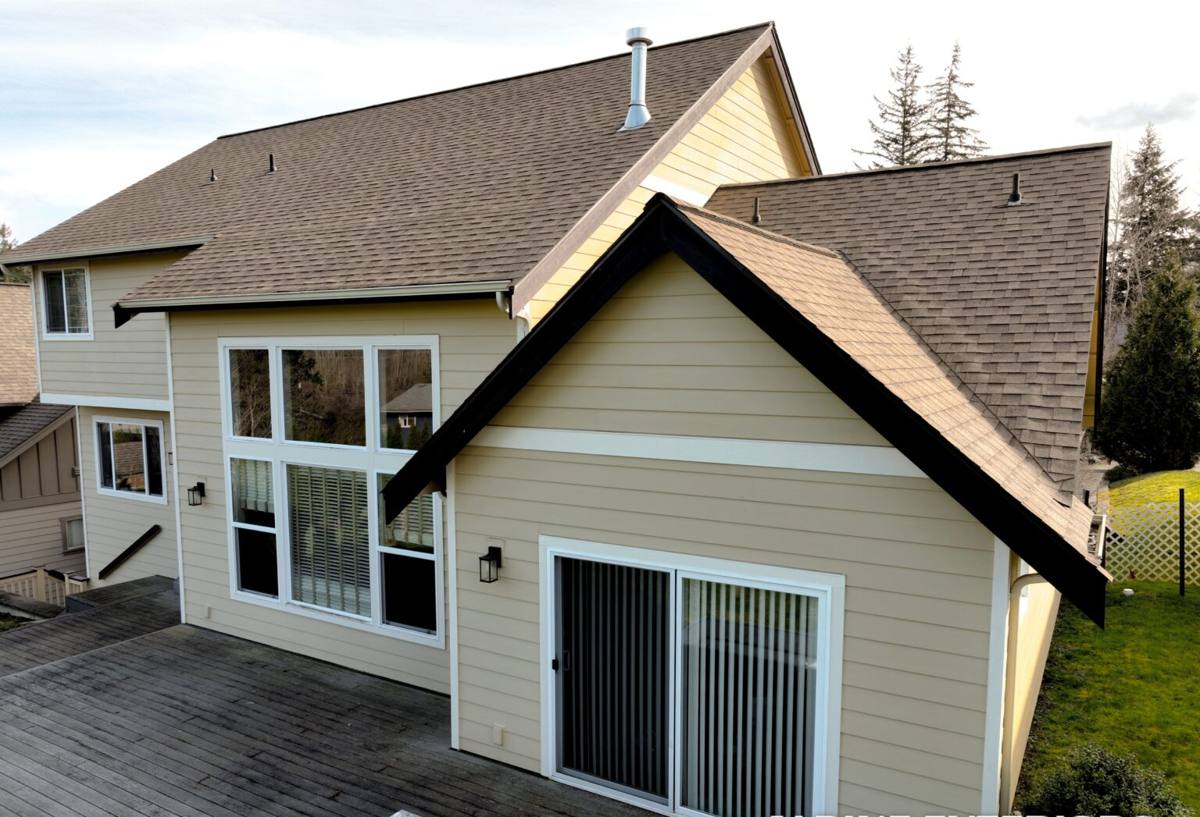
Signs a Happy Valley Home Needs Replacement, Not Just Repair
Not every siding problem means a full tear-off. But there's a point where patching keeps costing money without solving anything. Here's how we tell the difference on a walk-through:
- Soft or spongy spots when you press on the siding, especially near the bottom courses and around windows
- Persistent moss or algae growth that comes back within weeks of cleaning
- Visible warping, buckling, or panels that have pulled away from the wall plane
- Paint that won't hold — bubbling, peeling, or needing repainting every 2-3 years instead of holding for a decade or more
- Rot at butt joints, corners, or anywhere trim meets siding
- A musty smell or visible staining on interior walls that back up to exterior siding
If you're only seeing one or two of these in an isolated spot, a repair might genuinely be enough. If you're seeing several of them across the house, or the siding is original and past 20-25 years old, replacement is almost always the more honest recommendation — repairs on failing siding tend to become a recurring bill rather than a fix.
What a Correct Siding Replacement Actually Involves
It Starts Underneath the Siding, Not With It
The siding itself is the part homeowners see, but the work that determines whether it lasts happens underneath. A proper replacement in a wet, marine-influenced climate like Bellingham's means removing the old siding down to the sheathing, inspecting for hidden rot or moisture damage, and repairing or replacing any compromised framing before anything new goes up. Skipping this step is the single most common reason siding fails early — new material over a wet or damaged wall just hides the problem for a few more years.
Weather-Resistive Barrier and Flashing
Next comes a properly lapped weather-resistive barrier, correctly integrated flashing at every window, door, and roofline intersection, and rainscreen or drainage detailing where it's appropriate. This is the layer that actually keeps driving rain out of the wall assembly — the siding sheds most of the water, but the barrier and flashing handle what gets past it. In a neighborhood that sees this much wind-driven rain, getting this layer wrong is what turns a 30-year siding job into a 10-year one.
Correct Fastening and Clearances
Fastener spacing, nail penetration depth, and ground clearance all matter more here than in drier climates. Siding installed too close to grade, decks, or roof lines stays wet longer and is the first place we see failure on older homes. We follow manufacturer installation specs to the letter, because that's also what keeps a warranty valid if something ever does go wrong.
Why We Only Install James Hardie Fiber Cement
We don't install vinyl, LP SmartSide, or other engineered wood or composite siding products, and we're upfront about why. In a climate defined by prolonged moisture exposure, the materials that hold up longest with the least maintenance are non-combustible fiber cement products — and James Hardie is the manufacturer whose HZ product lines are specifically engineered for regions like ours, with moisture and climate performance built into the formulation rather than added on.
Vinyl siding is affordable and low-maintenance in mild, dry climates, but it can warp or become brittle with temperature swings and doesn't offer the same fire resistance or dent resistance as fiber cement. Wood-based composite products like LP SmartSide perform reasonably well when installation and caulking are perfect and stay perfect for decades — a hard standard to guarantee on a house that will see forty or fifty inches of rain a year for the rest of its life. Hardie's fiber cement composition simply doesn't have the same moisture-absorption failure mode, and its factory-applied ColorPlus finish is baked on and warrantied against fading, chipping, and peeling in a way field-applied paint can't match.
This is a professional standard we hold ourselves to, not a claim that every other product is unusable everywhere. It's why, when a Happy Valley homeowner asks us to install something other than Hardie, we'll explain why we don't and what we'd put on the house instead.
Our Process for a Happy Valley Siding Replacement
- On-site assessment. We walk the exterior, check for soft spots and moisture intrusion, and look at how the house is exposed to prevailing wind and rain.
- Written scope and estimate. You get a clear breakdown of what's being removed, what's being repaired underneath, and exactly which Hardie products and colors are being installed.
- Tear-off and sheathing inspection. Old siding comes off, and any rotted or compromised sheathing and framing gets addressed before anything new goes up.
- Weather barrier and flashing installation. This is the step that protects the investment for the next 30+ years, and we don't rush it.
- Hardie siding installation to manufacturer spec. Correct fastening, clearances, and joint treatment, done by a crew that installs this product regularly.
- Final walk-through. We go over the finished work with you and make sure everything meets both our standards and yours.
Cost Factors for Siding Replacement in This Area
Every house is different, but the cost of a siding replacement in Happy Valley generally comes down to a handful of variables. Here's how they typically break down:
| Factor | Why It Matters Here |
|---|---|
| Extent of hidden damage | Long-term moisture exposure common in this area often means more sheathing or framing repair than the surface suggests |
| House size and complexity | More corners, dormers, and roof intersections mean more flashing detail work, which takes time to do right |
| Siding profile and accessories | Lap width, trim style, and corner details affect both material cost and labor |
| Access and site conditions | Sloped lots and tight setbacks, common in hillier parts of Bellingham, can affect staging and scaffolding needs |
| Existing paint or coatings | Lead-safe practices add time and cost on homes built before 1978 |
We don't quote a number without seeing the house first — anything else is a guess, and guesses are how homeowners end up with surprise costs mid-project.
Choosing a Contractor Who Actually Works This Neighborhood
Happy Valley's mix of older homes and newer construction, its terrain, and its exposure to weather off the bay mean that generic siding experience isn't quite the same as local experience. Before hiring anyone for a siding replacement here, it's worth asking a few direct questions:
- Do you carry current liability insurance and workers' comp, and can you provide proof?
- Are you a certified or factory-trained installer for the siding product you're proposing?
- Will you inspect and repair sheathing and framing if it's found to be damaged, or just re-side over it?
- What's included in your written estimate — is flashing and weather barrier work itemized, or bundled vaguely?
- What warranty applies to labor, separate from the manufacturer's material warranty?
- Can you walk me through how you handle a house with this much rain exposure specifically?
A contractor who's done real work in this part of Whatcom County will have straightforward answers to all of these without hesitation.
What to Expect After Replacement
Correctly installed James Hardie siding is genuinely low-maintenance, but "low-maintenance" isn't "no-maintenance" in a climate like this. A yearly rinse-down to keep moss and grime from building up, prompt attention to any caulking that separates around trim, and keeping gutters clear so water isn't sheeting down the wall face will go a long way toward getting the full lifespan out of the investment. ColorPlus finishes hold their color far longer than field-applied paint, but even factory finishes benefit from an occasional gentle wash rather than years of neglect followed by pressure washing.
Get a Straight Answer for Your Home
If your Happy Valley home is showing soft spots, chronic moss, peeling paint, or siding that's simply past its service life, it's worth getting an honest, no-pressure look before deciding between repair and replacement. We'll tell you what we actually see — not just what sells a job. Use the form below to request a free estimate, and we'll walk the property with you and lay out exactly what your home needs.