 Bellingham Siding
 Barkley's Climate Is Harder on Siding Than Most Homeowners Realize
Barkley sits inside Bellingham, Whatcom County, which means it gets the full package of Pacific Northwest marine weather: salt-tinged air drifting off Bellingham Bay, long stretches of driving rain in fall and winter, and enough shade and moisture to keep moss and algae growing on exterior surfaces for most of the year. None of that is unusual for this part of Washington, but it adds up over the life of a siding system. Salt air accelerates corrosion on fasteners and trim. Driving rain — rain pushed sideways by wind rather than falling straight down — finds gaps in flashing and house wrap that a calmer climate would never expose. And moss doesn't just look bad; it holds moisture against the siding surface for weeks at a time, which is exactly the condition that causes rot, paint failure, and swelling in moisture-sensitive materials.
A siding product and installation that would hold up fine in a dry inland climate can fail early here. That's the lens we use on every Barkley job: not "what's the cheapest option" but "what actually survives this specific climate for decades without turning into a maintenance project."
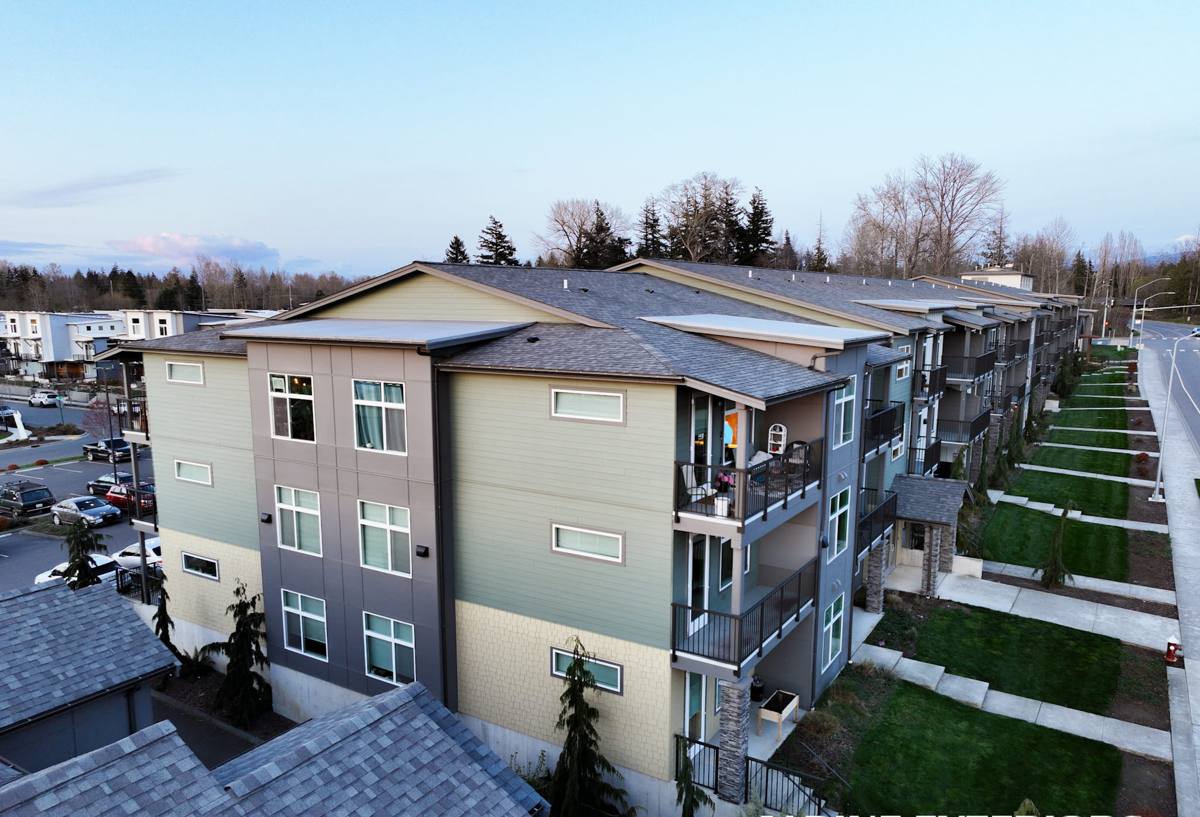
Why James Hardie Fiber Cement Is What We Install
We install James Hardie siding exclusively. We don't offer vinyl, LP SmartSide, Cemplank, Allura, primed spruce, or cedar, and that's a deliberate standard, not a lack of options. Fiber cement — Hardie's core material — is made from cement, sand, and cellulose fibers. It doesn't absorb water the way wood-based products can, it doesn't soften or swell in prolonged wet conditions, and it's non-combustible, which matters both for insurance considerations and for straightforward peace of mind. In a climate that stays damp for months at a stretch, a siding material that isn't fundamentally a wood product is a real advantage, not a marketing point.
Hardie also finishes its boards with a factory-applied finish called ColorPlus, which is baked on under controlled conditions rather than field-painted after installation. That matters in a rainy climate because field-applied paint needs a real dry-weather window to cure properly, and Bellingham doesn't always cooperate. A factory finish sidesteps that problem entirely and holds color more consistently over time.
Climate-Engineered Product Lines (HZ5 and HZ10)
James Hardie doesn't make one product for the whole country — it engineers specific formulations for specific climate zones. Products in the HZ5 line are built for regions with freeze-thaw cycles and consistent moisture, which fits western Washington. The board composition and moisture-management engineering are matched to the conditions Barkley homes actually face, rather than being a generic product installed everywhere regardless of climate.
What a Correct Installation Actually Involves
Fiber cement siding performs exactly as well as its installation. Hardie's own product warranty depends on installation following their specifications, and in a wet climate, the details that get skipped on a rushed job are the ones that cause problems in year three or four, not year one.
Moisture Management Behind the Siding
The siding itself is only one layer of the wall system. Correct installation means a continuous weather-resistive barrier (house wrap) installed with proper overlaps, correctly integrated window and door flashing so water is directed out and away from the sheathing, and a drainage plane that lets any moisture that does get behind the siding find its way back out instead of sitting against the wall.
Fastening and Clearances
Fasteners need to be the corrosion-resistant type Hardie specifies — this matters more in a salt-air environment than it would inland — driven at the correct depth and spacing. Board clearances from grade, roofing, decks, and other transitions need to meet Hardie's minimums so water doesn't wick up into the bottom edge of the siding. These are the kinds of details that are invisible once the job looks finished, but they're the difference between siding that lasts thirty-plus years and siding that needs attention in five.
Joints, Caulking, and Trim
Butt joints, corners, and trim transitions are where poorly installed siding fails first. Correct technique uses the right joint treatment and sealant compatible with ColorPlus finishes, not just whatever caulk is on the truck that day.
Our Process on a Barkley Job
- Walkthrough and assessment — we look at your current siding, sheathing condition where accessible, moisture or moss patterns, and trouble spots like window flashing and deck ledger connections.
- Written estimate — a clear scope covering product line, house wrap and flashing details, trim, and cleanup, so there's no ambiguity about what's included.
- Prep and removal — old siding comes off, sheathing gets inspected and repaired where needed, and any moisture damage found underneath gets addressed before new siding goes on top of it.
- House wrap and flashing installation — the moisture-management layer goes in correctly the first time, since it's the part you won't see again once siding is up.
- Hardie siding installation — installed to manufacturer spec on fastening, clearances, and joint treatment.
- Final walkthrough — we go over the finished job with you before calling it done.
How James Hardie Compares to Other Siding Materials in This Climate
| Material | Moisture Behavior | Moss/Algae Resistance | Typical Maintenance | Fire Rating |
|---|---|---|---|---|
| James Hardie Fiber Cement | Doesn't absorb or swell with moisture | Factory finish resists staining well | Periodic washing; no repainting for the life of the finish | Non-combustible |
| Vinyl | Doesn't absorb water, but seams and panels can warp or gap over time | Prone to algae staining, especially in shaded areas | Regular washing; panels can crack in impacts and are hard to color-match when replaced | Combustible, can deform in heat |
| LP SmartSide (wood-strand) | Engineered wood; performs well when maintained but is moisture-sensitive at cut edges and joints | Can support moss/mildew growth if finish is compromised | Field-applied or re-applied finish over time; edge sealing is critical | Combustible |
| Cedar | Natural wood; absorbs and releases moisture, prone to cupping and rot without diligent upkeep | Moss and mildew grow readily on shaded, damp cedar | Regular refinishing, staining, and moisture monitoring | Combustible |
This isn't a claim that the other materials are poorly made — LP SmartSide and cedar both have real strengths, and plenty of homes around Bellingham wear them fine when they're maintained closely. It's a statement of our own standard: given the moisture load and moss pressure Barkley homes deal with, we'd rather install a material that doesn't depend on a perfect maintenance schedule to hold up.
Living With Siding in a Moss-Prone, Salt-Air Climate
Even the right siding benefits from some basic upkeep in this environment. Moss and algae growth is mostly a function of shade and moisture retention, not a defect in the siding itself, so homes with heavier tree cover — common in and around Barkley — will need more frequent attention than homes in full sun.
- Rinse siding annually with a garden hose and soft brush on shaded or north-facing walls where moss tends to establish first
- Keep gutters clear so overflow doesn't run down the siding face and stay wet longer than it should
- Trim back vegetation and tree limbs that keep sections of the wall in constant shade
- Check caulking at trim joints and penetrations every couple of years and re-seal if it's cracked or pulling away
- Watch for any soft spots, staining, or bubbling near the base of the wall, deck ledgers, or window sills — early signs of a flashing or drainage issue, not a siding material issue
Why a Crew That Already Works in Barkley Matters
Installation quality is the biggest variable in how long siding lasts, and that quality comes down to a crew's familiarity with the specific conditions they're building for. A contractor who regularly works Bellingham neighborhoods like Barkley already accounts for the local wind-driven rain patterns, the moss and shade issues common to this area's tree cover, and the salt-air exposure that comes with living near Bellingham Bay. That's different from a crew that installs the same way everywhere and treats climate as an afterthought. It also means faster, more accurate estimates, since local conditions and typical home construction in the area are already familiar rather than something we're assessing for the first time.
What This Costs
Siding costs depend on the size of the home, the condition of the existing wall system, how much sheathing repair is needed, trim complexity, and the specific Hardie product and color chosen. Rather than quote a number that won't reflect your actual home, we provide a written estimate after seeing the property, so you know exactly what's included before any work starts.
If you're weighing a siding replacement or repair for a home in Barkley, we're happy to take a look and walk you through what correct James Hardie installation looks like for your specific property — no pressure, no obligation. A free estimate is a straightforward way to find out what your project actually involves.