 Bellingham Siding
 Why Cordata Homes Take a Different Kind of Beating
Cordata sits close enough to the water and low enough in tree cover that its homes deal with a specific combination of weather stress: salt-tinged air moving in off the Salish Sea, long stretches of driving, wind-blown rain, and a moss season that can run from fall through spring. None of that is exotic for Whatcom County, but it adds up differently on siding than it does on a roof or a deck. Siding on a Cordata home is exposed to constant moisture cycling, not just occasional storms, and the north- and west-facing walls in particular rarely get enough sun or airflow to dry out fast between rain events.
That matters because siding failure in this climate is almost never sudden. It is slow: trapped moisture behind a wall, a fastener that let go, caulking that shrank and cracked, a paint film that couldn't keep pace with the freeze-thaw and wet-dry cycling. By the time a homeowner notices soft trim or a stain bleeding through paint, the damage has usually been building for a couple of seasons. The right siding product and the right installation details are what determine whether a home shrugs that cycle off for decades or starts showing problems inside ten years.
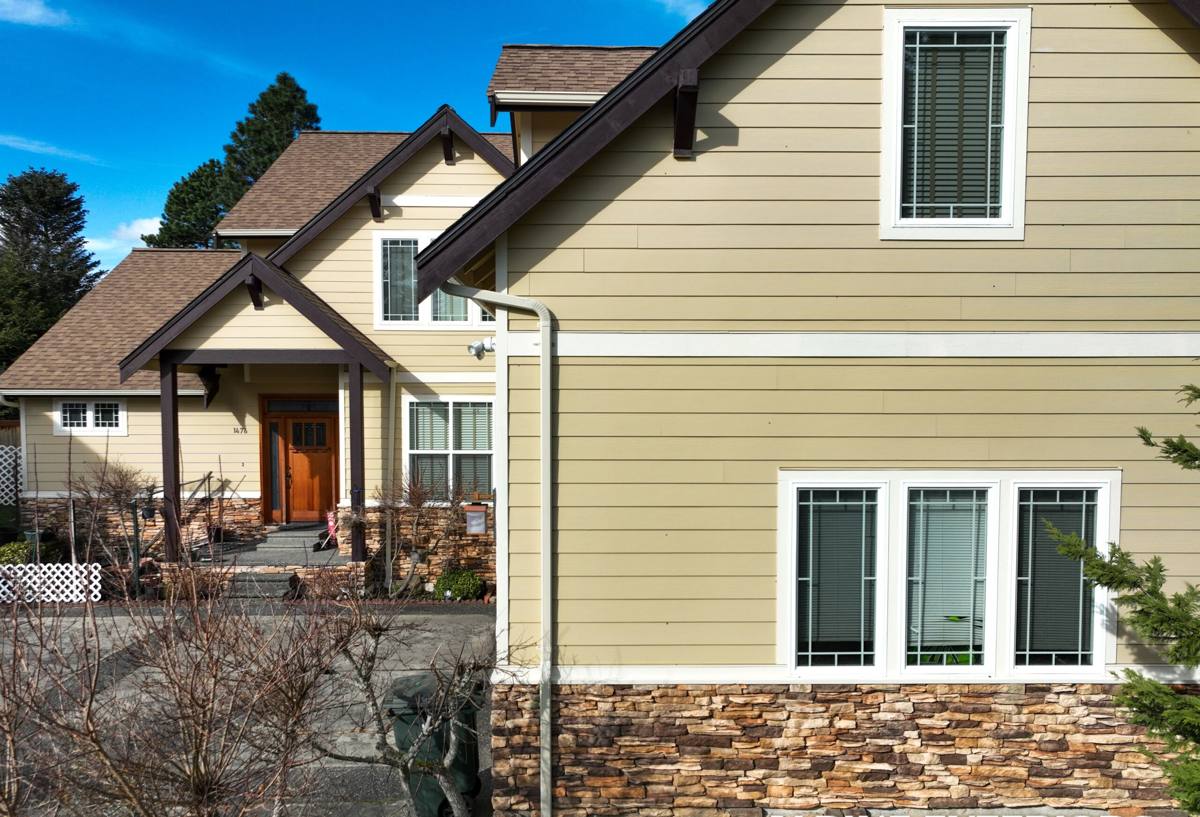
What James Hardie Fiber Cement Brings to a Cordata Home
We install James Hardie fiber cement siding exclusively, and in a climate like Bellingham's, the reasons are practical rather than promotional.
A non-combustible, moisture-stable core
Hardie siding is made from cement, sand, and cellulose fiber. It doesn't absorb water the way wood-based products can, it won't rot, and it isn't a food source for the moss, algae, and mildew that thrive in a wet, low-sun environment like Cordata's. That's a meaningful difference in a neighborhood where a shaded north wall might stay damp for days after a storm passes.
A factory-applied finish built for this weather
ColorPlus Technology bakes the color into a durable finish at the factory, under controlled conditions, rather than relying on paint applied on-site over a raw substrate. That finish resists fading and holds up to repeated wet-dry cycling far better than a field-applied coat, and it's backed by its own finish warranty separate from the product warranty.
Engineered for the Pacific Northwest specifically
James Hardie makes climate-specific HZ product lines, and the versions specified for our region are engineered around exactly the conditions Cordata sees: sustained moisture exposure, temperature swings, and coastal air. That's not a generic siding product adapted after the fact; it's built for this weather from the start.
Why We Don't Install Vinyl, LP SmartSide, or Cedar Here
Homeowners in Cordata sometimes ask why we don't offer other siding options. It's a fair question, and the honest answer is that we looked at how each of these products actually performs under the moisture load this area gets, not just how they perform on a spec sheet.
Vinyl is inexpensive and low-maintenance in the sense that it doesn't need painting, but it's a thin plastic product that expands and contracts with temperature and can warp, crack, or blow off in wind-driven storms. It also doesn't offer the same fire resistance as fiber cement. LP SmartSide and cedar are wood-based products, which means their long-term performance depends heavily on the wood staying dry, a difficult ask on a wall that faces Cordata's rain patterns for months at a stretch. Both can perform fine for a while with diligent maintenance, but the maintenance burden and the consequences of a missed re-coat or a small water intrusion are real and recurring.
| Factor | Vinyl Siding | Wood / LP SmartSide / Cedar | James Hardie Fiber Cement |
|---|---|---|---|
| Moisture tolerance | Doesn't rot, but seams and gaps let water behind panels | Vulnerable to swelling, rot, and delamination if finish fails | Cement-based core resists moisture damage |
| Fire resistance | Combustible plastic | Combustible wood-based material | Non-combustible |
| Finish longevity | Molded-in color can fade and chalk | Needs periodic repainting or re-coating | Factory-baked ColorPlus finish, separately warrantied |
| Moss / algae resistance | Can host growth in seams | Organic material is a food source for growth | Cement core doesn't feed organic growth |
| Typical lifespan when properly installed | 20-30 years | Varies widely with maintenance, often 15-25 years | Multiple decades with routine care |
We're not saying these products can't be installed well or that every installation fails. We're saying that after weighing moisture behavior, maintenance demands, and long-term cost against what Cordata's climate actually does to a wall, fiber cement is what we're willing to put our name behind.
What a Correct Installation Actually Involves
The siding product is only half the equation. Most siding problems we get called out to inspect in Whatcom County trace back to installation shortcuts, not the material itself.
Drainage plane and rainscreen detailing
Hardie siding should be installed over a properly lapped weather-resistive barrier, with attention paid to how water is meant to drain and dry behind the cladding rather than just sit against the sheathing. In a climate with as much sustained rain as Cordata sees, giving water somewhere to go is not optional.
Flashing before caulk
Windows, doors, and any wall penetration need flashing that directs water outward and downward. Caulk is a backup, not the primary defense. A bead of sealant covering a flashing mistake will fail eventually; it's a matter of when, not if.
Fastening and clearances to manufacturer spec
James Hardie publishes specific fastener types, spacing, and minimum clearances from grade, decks, and roof lines. Skipping these, nailing through factory-primed edges without sealing them, or setting siding too close to a walkway or planting bed, is one of the most common ways an otherwise good product starts failing early.
How We Approach a Cordata Project
- On-site inspection of the existing walls, sheathing, and any moisture or rot already present before quoting anything
- A written scope that specifies the exact Hardie product, profile, and ColorPlus color for the home
- Removal of old siding and inspection of sheathing, with repairs made before anything new goes up
- Weather-resistive barrier and flashing installed to spec, with attention to every window, door, and penetration
- Hardie siding installed to manufacturer fastening and clearance requirements
- Final walkthrough covering trim, caulking joints, and touch-up work before we consider the job done
Skipping straight to "install the siding" without the earlier steps is how problems get sealed up behind a brand-new wall instead of fixed.
Signs a Cordata Home's Siding Needs a Closer Look
- Paint or finish that's peeling, bubbling, or chalking faster than it should for its age
- Soft or spongy spots when you press on the siding, especially near the bottom courses or around windows
- Visible moss or algae buildup that keeps returning shortly after cleaning
- Gaps, warping, or panels that have pulled away slightly from the wall
- Staining or discoloration streaking down from seams, trim, or fastener locations
- A musty smell or visible moisture inside on an exterior wall
Any one of these on its own isn't necessarily an emergency, but they're worth having looked at before the next wet season rather than after.
Living With It: Maintenance in a Salt Air, High-Moss Climate
Fiber cement is low-maintenance compared to wood siding, but "low-maintenance" doesn't mean "no maintenance," especially this close to the water and under this much tree cover. A yearly rinse-down to clear moss spores and organic buildup before they take hold, keeping gutters clear so water isn't sheeting down the siding, and trimming back vegetation that keeps a wall shaded and damp all go a long way. Caulking at trim joints should be checked periodically, since sealant is the one component of the assembly that does wear out and needs occasional renewal, even on a correctly installed job.
Cost Factors for James Hardie Siding in Cordata
Every home is different, but the variables that actually move the price on a Cordata project are fairly consistent:
| Factor | How It Affects Cost |
|---|---|
| Home size and wall complexity | More square footage, corners, and roof lines mean more material and labor |
| Condition of existing sheathing | Rot or water damage found during tear-off adds repair cost before new siding goes up |
| Product line and profile chosen | Lap width, texture, and panel type all affect material pricing |
| Trim and accessory scope | Full trim replacement costs more than reusing sound existing trim |
| Site access | Tight lots, second stories, or landscaping obstacles can add labor time |
We won't quote a number without seeing the home, but we'll always walk you through which of these factors apply to your project and why.
Why Hiring a Crew That Already Works in Cordata Matters
Siding crews that only occasionally work this area can miss things that are second nature to a crew that's on Cordata streets regularly: how much shade a particular lot layout creates, which wall orientations take the worst of the driving rain, how aggressively moss establishes itself on a given exposure. That local familiarity shows up in small decisions during a project, like where extra flashing attention is warranted, which walls need a closer look at the sheathing before covering it back up, and what maintenance schedule actually makes sense for the property. It's not a substitute for correct installation practice, but paired with it, local experience is what keeps a siding job performing the way it's supposed to for decades instead of just looking good on install day.
If you're weighing a siding replacement or repair for a Cordata home, we're happy to take a look and give you a straight, no-pressure assessment of what your walls actually need. Use the form below to request a free estimate.