 Bellingham Siding
 Fairhaven sits close enough to Bellingham Bay that its homes take a different kind of weather beating than houses further inland in Whatcom County. Salt-laden air off the water, wind-driven rain that gets pushed sideways into wall assemblies, and a moss season that can run eight or nine months out of the year all work against siding that isn't built for a marine climate. We install James Hardie fiber cement siding in Fairhaven because it's one of the few products that holds up to all three of those conditions at once, and because doing the installation correctly matters just as much as the product itself.
What Fairhaven's Climate Actually Does to Siding
Homes near Bellingham Bay deal with airborne salt that settles on exterior surfaces and accelerates corrosion on fasteners, trim, and any siding material that isn't dimensionally stable. Combine that with the driving rain that comes through the Strait of Georgia and Puget Sound weather systems, and you get moisture pushed horizontally into seams, laps, and butt joints that would stay dry in a calmer climate. Add Whatcom County's long, damp shoulder seasons — where surfaces rarely get a full dry-out between rain events — and you have ideal conditions for moss, algae, and mildew to take hold on anything with texture or porosity.
Wood-based siding products swell, checks, and eventually rots faster under this combination. Vinyl can hold its shape but doesn't stop moss and algae from colonizing its surface, and it doesn't handle wind-driven rain intrusion at the wall assembly the way a rigid, properly flashed material does. Fiber cement, installed correctly, resists all three: it doesn't rot, it holds paint and color far longer than wood, and its density gives moss less to grip onto than porous or textured alternatives.
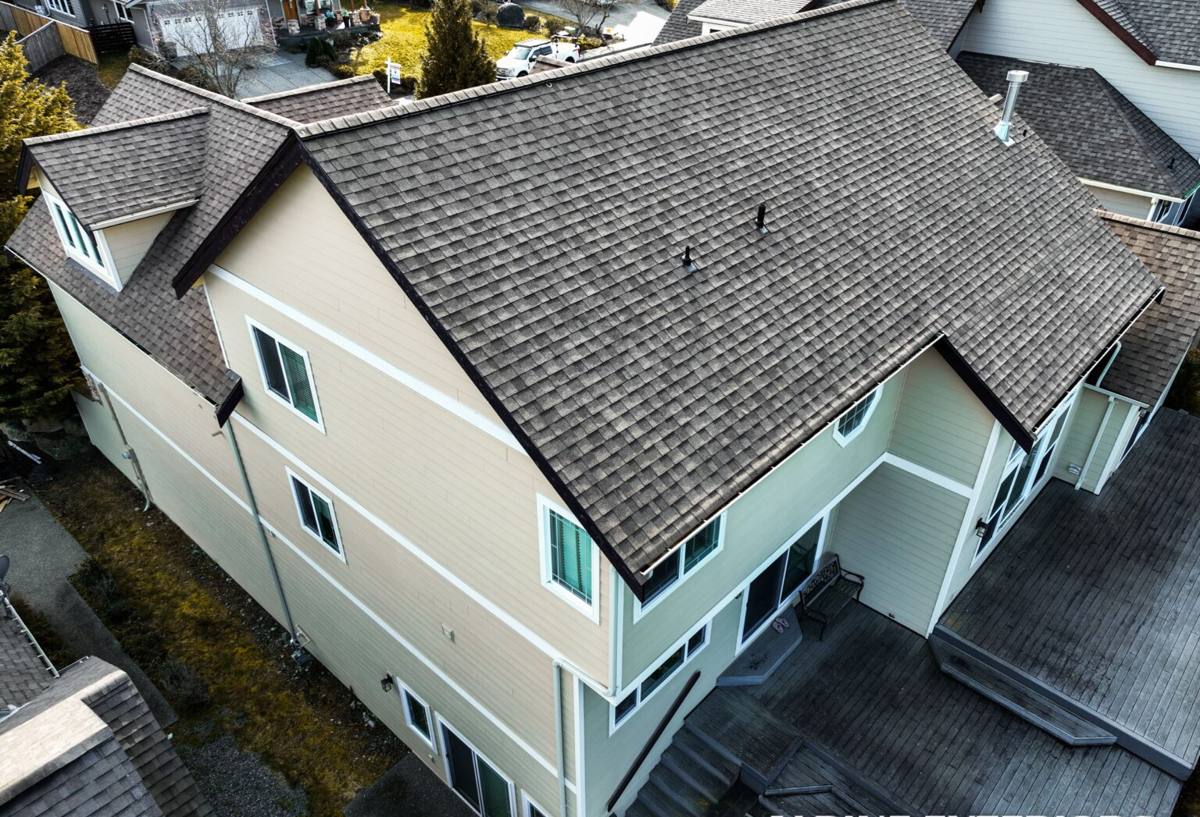
Why We Only Install James Hardie Fiber Cement
We don't install every brand of fiber cement siding, and we don't install LP SmartSide, vinyl, primed spruce, or cedar at all. That's a deliberate standard, not a sales pitch. James Hardie is the manufacturer we trust to perform in a marine climate like Fairhaven's, for a few specific reasons:
- Climate-engineered formulations. Hardie manufactures different product formulations for different climate zones. The Pacific Northwest falls into their HZ5 zone, engineered for regions with significant moisture exposure and freeze-thaw cycling — which describes Bellingham's winters accurately.
- ColorPlus factory finish. Rather than relying on field-applied paint that has to cure correctly on-site (a real risk in a climate where it rains more days than it doesn't), ColorPlus siding is baked on in a controlled factory environment, which gives it better adhesion and a longer color life before repainting is needed.
- Non-combustible material. Fiber cement doesn't burn, which matters increasingly for wildfire-adjacent insurance considerations even on the wetter west side of the state.
- A transferable warranty backed by a large, established manufacturer. That matters when a product is expected to last decades on a house exposed to salt air and rain.
Other fiber cement brands exist, and some of them are reasonable products. We standardized on Hardie because it's the one we're confident in warranting our installation work against, and because the supply chain, technical support, and installation documentation are the most mature in the industry.
What a Correct Fiber Cement Installation Involves
Fiber cement siding fails prematurely almost exclusively because of installation mistakes, not because the material itself gave out. In a climate like Fairhaven's, those mistakes show up faster than they would in a drier region. A correct install includes:
Proper Clearances and Flashing
Hardie's specifications call for minimum clearances between the bottom of the siding and grade, roof lines, decks, and other horizontal surfaces. Skipping these clearances is one of the most common shortcuts we see, and in a wet climate it's also one of the most damaging — it traps moisture against the bottom edge of the boards and against the wall assembly behind them.
Water-Resistive Barrier and Drainage Plane
Behind the siding, a correctly installed water-resistive barrier and drainage plane give any moisture that does get past the cladding a path to drain and dry out, rather than sitting against the sheathing. This step is invisible once the job is done, which is exactly why it's the step most often rushed by crews that don't specialize in this material.
Fastening Pattern and Fastener Selection
Hardie specifies fastener type, spacing, and embedment depth. In a salt-air environment, fastener corrosion resistance matters more than it would inland — the wrong fastener can rust and streak the siding, or lose holding power over time.
Joint and Seam Treatment
Butt joints, corners, and penetrations (hose bibs, vents, light fixtures) are where wind-driven rain finds its way in. Correctly treated and sealed joints, along with proper caulking at penetrations, are what keep Fairhaven's sideways rain out of the wall.
Fiber Cement Compared to Other Siding Options
Homeowners in Fairhaven often ask how fiber cement stacks up against the other materials they see around Bellingham. Here's an honest comparison focused on how each performs in a marine, moss-prone climate:
| Material | Moisture/Rot Resistance | Moss & Algae Resistance | Salt Air Durability | Repaint/Refinish Interval |
|---|---|---|---|---|
| James Hardie Fiber Cement | Excellent — does not rot | Good; dense surface limits moss grip | Excellent | 15+ years with ColorPlus finish |
| Vinyl | Good on its own, poor at flashing/seams | Fair; textured surfaces collect debris | Fair; can become brittle over time | Not paintable in most cases |
| Wood-based (LP SmartSide, cedar) | Fair to poor; requires consistent maintenance | Poor; organic material feeds growth | Fair; accelerated wear near salt air | 5-8 years |
| Primed Spruce/Engineered Wood | Poor if maintenance lapses | Poor | Poor | 3-6 years |
This isn't a knock on every homeowner who has wood-based or vinyl siding on their Fairhaven home today — those products can perform reasonably well with diligent upkeep. It's why, when we're asked to replace siding, fiber cement is what we recommend and the only material we put our installation warranty behind.
Our Process for a Fairhaven Siding Project
Every project starts with an on-site assessment specific to the house, not a generic estimate. That's especially important in Fairhaven, where homes range from older construction with original wall assemblies to newer builds, and where proximity to the water changes exposure levels even from one property to the next.
- Assessment and moisture check. We look at existing siding condition, sheathing, and any signs of past water intrusion before quoting the job.
- Tear-off and inspection. Once old siding comes off, we inspect the sheathing and framing underneath for hidden rot or damage that needs to be addressed before new siding goes on.
- Water-resistive barrier installation. A correctly lapped and sealed barrier goes on before any siding, giving the wall assembly a drainage plane.
- Trim and flashing. Window, door, and roofline flashing is installed or corrected to direct water away from the wall, not into it.
- Fiber cement installation. Boards are installed to Hardie's fastening and clearance specifications, with attention to butt joints and penetrations.
- Final detailing and cleanup. Caulking, touch-up, and site cleanup close out the job.
Cost Factors for a Fairhaven Fiber Cement Project
Every home is different, so we don't publish flat per-square-foot pricing — but the factors that move a quote up or down are consistent. This gives you a realistic sense of what to expect before we walk your property:
| Factor | Why It Affects Cost |
|---|---|
| Existing siding removal | Tear-off and disposal of old material adds labor, especially with multiple layers or hazardous materials like old paint |
| Sheathing/framing repair | Hidden moisture damage found during tear-off has to be repaired before new siding goes on |
| Home size and wall complexity | More corners, dormers, and roof intersections mean more cutting, flashing, and labor time |
| Siding profile and trim style | Lap width, shingle-style accents, and trim detail all affect material and labor cost |
| Access and site conditions | Tight lots, slopes, or limited staging area near the water can add setup time |
| Color and finish selection | Factory ColorPlus finishes vs. field-applied paint carry different material costs |
Maintaining Fiber Cement Siding in a Marine, Moss-Prone Climate
Fiber cement asks for far less upkeep than wood-based siding, but "low maintenance" doesn't mean "no maintenance" — especially this close to the water. A simple annual routine keeps it performing the way it's supposed to:
- Rinse siding annually with a garden hose to remove salt residue and airborne debris before it builds up
- Trim back vegetation and tree cover that keeps siding shaded and damp, which encourages moss growth
- Check and clear gutters each fall so overflow doesn't run down the wall face during heavy rain
- Inspect caulking at trim, corners, and penetrations every couple of years and re-caulk where it's cracked or pulled away
- Watch for moss or algae buildup at ground-level courses, where splashback and shade combine, and address it early with a gentle wash rather than pressure washing directly into seams
Why Local Experience in Fairhaven Matters
A crew that has worked on homes throughout Bellingham and the surrounding Whatcom County waterfront knows what a house this close to the bay is actually dealing with — not in theory, but from having pulled old siding off similar homes and seen exactly where moisture had been getting in. That local pattern recognition shows up in decisions like where to add extra flashing attention, which wall orientations take the worst of the driving rain, and how much clearance to leave at grade given how wet the ground stays through the winter. It also means familiarity with permitting and any neighborhood-specific considerations that come with working in an established, older part of Bellingham. Hiring a crew without that local track record means you're the one absorbing the learning curve.
If you're weighing a siding replacement on a Fairhaven home, we're happy to walk the property, look at what your current siding is telling us, and give you a straightforward, no-pressure estimate for a James Hardie fiber cement installation built for this climate.