 Bellingham Siding
 Why Fairhaven Siding Wears Differently Than Siding Ten Miles Inland
Fairhaven sits close enough to Bellingham Bay that salt-laden air is a daily fact of life for anything nailed to the outside of a house. Add Whatcom County's long wet season, driving rain off the water, and the deep shade that many Fairhaven lots get from mature evergreens, and you have a climate that is genuinely harder on exterior materials than a typical inland neighborhood. Siding that would coast along for decades in a drier part of the state can show cupping, soft spots, or moss staining here years ahead of schedule.
That's not a knock on any particular product — it's just physics. Wood fibers absorb moisture. Paint films crack and let water behind them. Foam-backed panels trap condensation. And once moisture gets behind siding in a marine climate, it doesn't dry out quickly, because the air around it stays damp for weeks at a stretch. Repair work in Fairhaven has to account for all of that, not just patch the visible damage and move on.
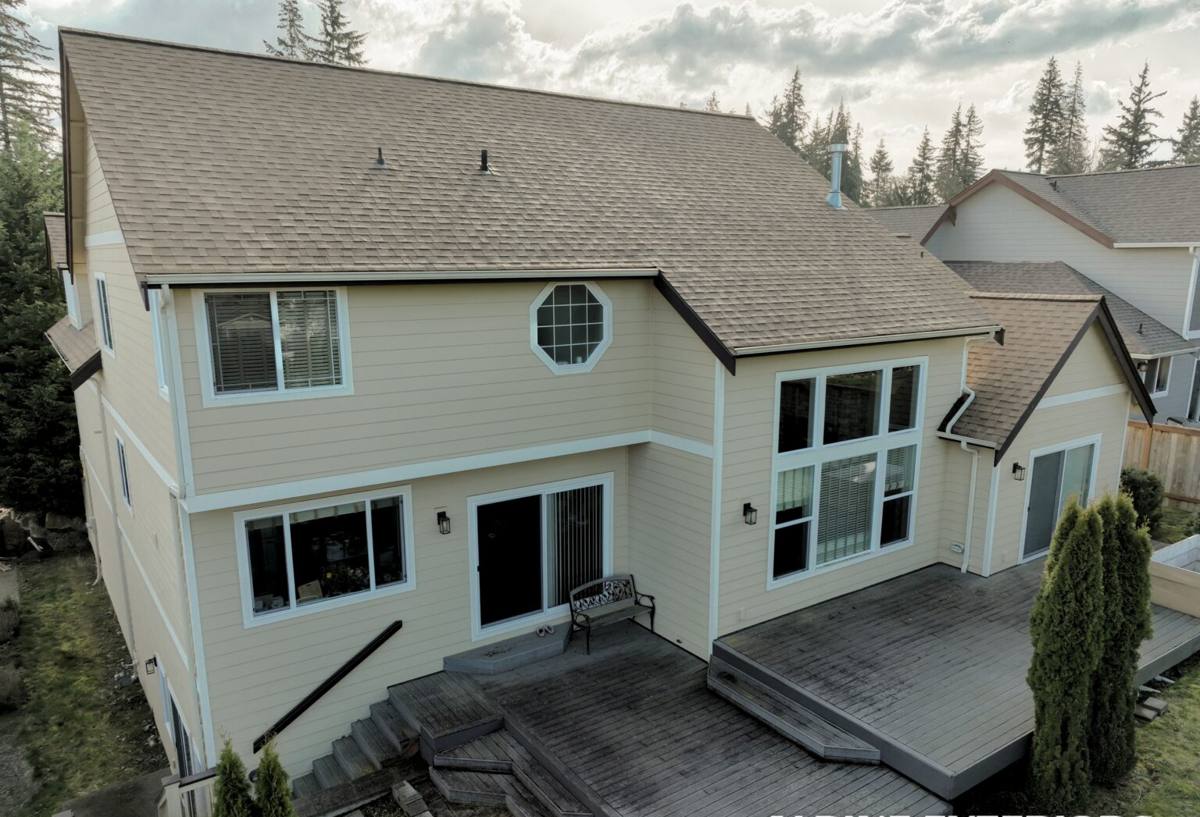
What Salt Air, Rain, and Moss Actually Do to Siding
Salt Air
Airborne salt from the bay accelerates corrosion on fasteners, flashing, and any exposed metal trim. When nails or staples corrode, they lose their grip on siding panels, which is one of the most common reasons we find boards that have worked loose or started to bow outward even though the siding material itself looks fine.
Driving Rain
Storms coming off the water don't just fall straight down — wind-driven rain gets pushed sideways into seams, laps, and butt joints that were never designed to handle water hitting them at an angle. Over time this finds every weak point in the caulking, flashing, and overlap details.
Moss and Organic Growth
Shaded, damp siding in Whatcom County grows moss and algae far faster than siding in full sun. Moss holds moisture directly against the surface for long stretches, which is exactly the condition that causes rot in wood-based products and staining or degradation in less moisture-tolerant materials. Left alone, moss also works into seams and lap joints, prying them open a little more with every wet-dry cycle.
Signs a Fairhaven Home Needs Siding Repair, Not Just a Wash
- Soft or spongy spots when you press on the siding, especially near the bottom courses and around window sills
- Persistent moss or black streaking that comes back within weeks of cleaning
- Visible gaps, cracks, or separation at seams and corner trim
- Bubbling, peeling, or flaking paint that keeps recurring in the same spots
- Nails or fasteners that have backed out, or panels that flex when touched
- Musty smell or visible staining on interior walls that back up to exterior siding
- Warping, cupping, or panels that no longer sit flat against the wall
Any one of these can be a localized fix. Several at once, especially on the same wall, usually means moisture has been getting behind the siding for a while and the repair needs to address the water path, not just the surface symptom.
What a Correct Repair Actually Involves
A repair that only replaces what's visibly damaged and skips the underlying cause tends to fail again within a season or two in this climate. We approach every repair in Fairhaven the same way:
- Diagnose the water path first. Before touching a single board, we figure out how moisture is getting in — a failed seam, missing flashing, a gap at a penetration (vents, hose bibs, light fixtures), or grade/drainage issues pushing splashback onto the wall.
- Check what's underneath. We pull back damaged siding to inspect the water-resistive barrier (house wrap) and sheathing. If either is compromised, replacing siding over it just hides the problem.
- Repair or replace the barrier and flashing. Any torn house wrap, missing kick-out flashing, or improperly lapped flashing gets corrected — this is the layer that actually keeps water out of the wall assembly.
- Replace damaged material with matching product. On homes we've worked on before or that already carry James Hardie fiber cement, this is straightforward color and profile matching. On homes with other siding types, we'll be upfront about whether a true match is realistic or whether a broader repair section makes more sense.
- Reseal and refasten correctly. Corrosion-resistant fasteners, proper caulking at seams and trim, and correct nailing patterns — done to spec, not just "close enough."
- Final inspection for drainage. We make sure water sheds away from the repaired section rather than pooling or wicking back toward the house.
Repair vs. Replace: How We Help You Decide
| Factor | Repair usually makes sense | Replacement is worth considering |
|---|---|---|
| Extent of damage | Isolated to one wall or a few boards | Recurring damage across multiple walls |
| Underlying barrier | House wrap and sheathing are sound | Rot or wrap failure found in more than one spot |
| Siding age | Under 15-20 years, otherwise in good shape | Original siding nearing or past its expected life |
| Material match | Matching material is available | Discontinued product with no reasonable match |
| Root cause | One-time or localized failure (a bad seam, a missed flashing detail) | Systemic moisture issues tied to the product itself |
We'll give you an honest read on which category your home falls into. There's no benefit to us talking a homeowner into a full replacement when a proper repair will hold up — and there's no benefit to patching a wall that's going to need the same fix again in two years.
Why We Only Repair With and Replace Into James Hardie Fiber Cement
When a repair section needs new material, we use James Hardie fiber cement — it's the only siding product we install, and there's a reason for that standard, especially in a climate like Fairhaven's. Fiber cement is non-combustible, doesn't absorb moisture the way wood-based products do, and holds its factory-applied ColorPlus finish far longer than field-painted materials, which matters when salt air and UV are working against paint film year-round. Hardie also engineers specific HZ product lines for high-moisture, marine-influenced climates like ours in the Pacific Northwest.
We won't tell you that other siding materials are worthless — many perform reasonably well in the right conditions. But we've made a professional decision not to install vinyl, LP SmartSide, primed spruce, cedar, or other fiber cement brands, because in a climate with this much sustained moisture exposure, the trade-offs (moisture sensitivity, maintenance burden, warranty structure, or long-term appearance) aren't ones we're willing to put our name behind. If your existing siding is one of these materials and needs repair, we'll still assess and repair it honestly — we just won't recommend replacing damaged sections with the same product if we don't think it'll hold up.
Why a Crew That Already Works Fairhaven Matters
Siding repair isn't just carpentry — it's diagnosing how water moves around a specific wall, roofline, and exposure. A crew that regularly works Fairhaven and the rest of Bellingham has already seen how houses in this immediate area behave: which exposures take the worst wind-driven rain, where moss builds up fastest under tree cover, and which older construction details (flashing, kick-outs, trim) tend to fail first in homes built to older Whatcom County standards.
That local pattern recognition shortens the diagnosis and reduces the chance of a repair that misses the real cause. It also means we're not guessing at material behavior in this climate — salt air and moss aren't hypothetical to a Bellingham-based crew, they're what we deal with on repair calls throughout the year.
Maintenance Between Repairs: What Actually Helps
- Rinse siding (especially shaded, moss-prone walls) once or twice a year with a garden hose — avoid high-pressure washing, which can force water behind seams
- Keep gutters clear so overflow doesn't run down the siding face
- Trim back vegetation and tree limbs that keep siding shaded and damp
- Re-caulk visibly cracked seams promptly rather than waiting for a full repair visit
- Walk the exterior after major storms and note any new gaps, staining, or soft spots
None of this replaces a professional inspection when you're seeing real warning signs, but it does slow down how fast moss and moisture find their way back in between visits.
Get a Straight Answer on Your Fairhaven Siding
If you're seeing soft spots, recurring moss, gaps at the seams, or paint that won't stop peeling, it's worth having someone look before the next wet season makes it worse. We'll walk your home, tell you honestly whether you're looking at a targeted repair or something more, and explain exactly what we'd do and why. Reach out for a free, no-pressure estimate — there's no obligation, just a clear read on where your siding actually stands.