 Bellingham Siding
 Why Ferndale Siding Wears Differently Than Siding Inland
Ferndale sits close enough to Bellingham Bay and the Strait of Georgia that homes here deal with a combination of stresses that inland Whatcom County properties don't face nearly as hard: salt-laden air, wind-driven rain that hits siding at an angle instead of just falling straight down, and a long, damp shoulder season where moss and algae get a real foothold on north- and west-facing walls. None of these problems are dramatic on their own. What they do is work slowly, over years, on whatever material is on the wall — and the material matters more here than it does in a drier, more sheltered climate.
If you're looking into siding replacement in Ferndale, the question isn't just "what's wrong with my current siding" — it's "what's going to actually hold up to another twenty winters of this specific weather." That's the lens we use on every estimate.
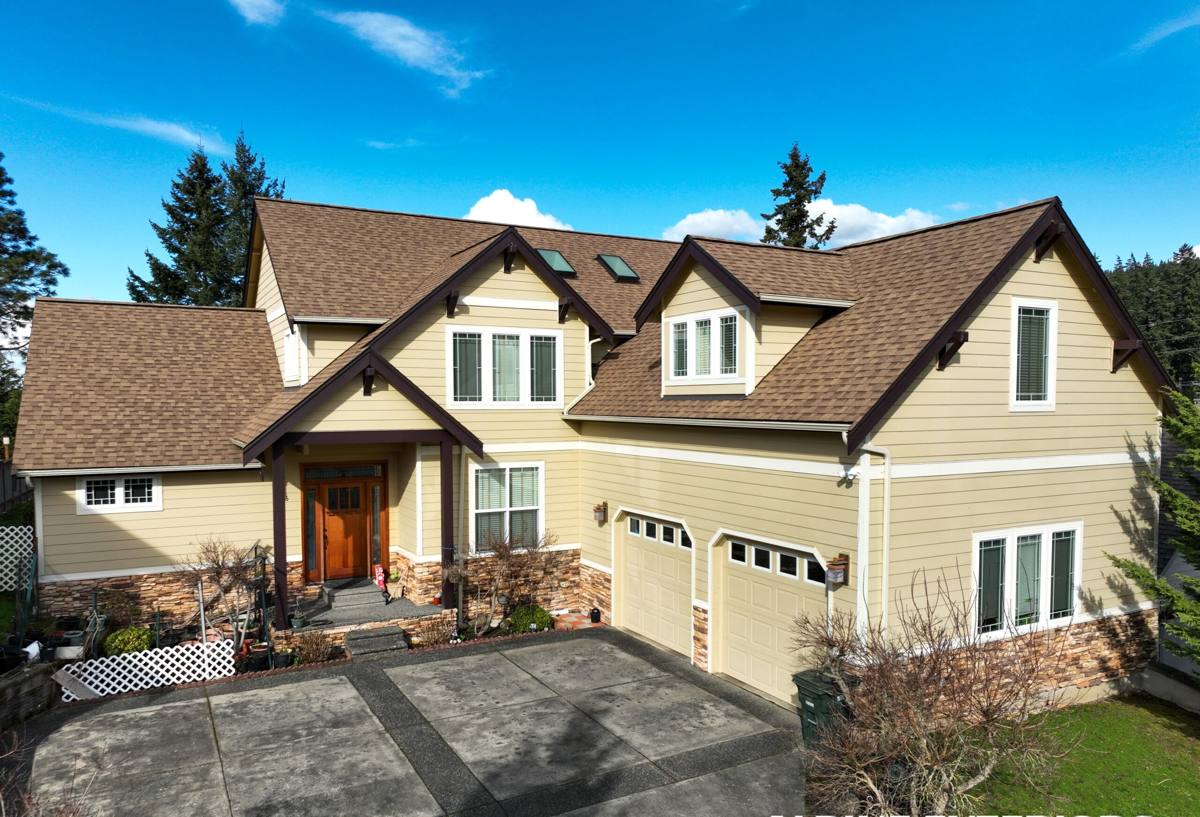
What Salt Air, Driving Rain, and Moss Actually Do to Siding
Salt Air
Airborne salt from the Strait doesn't need to be a heavy coastal spray to cause damage. Fine salt particles settle on siding surfaces and fasteners over time, and on materials that aren't engineered to resist it, that means accelerated corrosion of nails and trim fasteners, and gradual breakdown of paint films and less durable substrates. It's a slow-motion problem — homeowners rarely connect a decade of salt exposure to why their siding looks tired earlier than it should.
Driving Rain
Ferndale gets weather systems that push in off the water with real wind behind them, which means rain doesn't just run down a wall — it gets driven into laps, seams, and butt joints. Any siding product with a lap or panel system depends on correct overlap, flashing, and gapping to shed that water. Get the installation details wrong, or use a product that swells or wicks moisture at the joints, and driving rain will find the weak point eventually.
Moss and Algae Season
Shaded, north-facing walls and anything near tree cover stay damp for extended stretches in fall, winter, and early spring. That moisture-and-shade combination is exactly what moss and algae need. On some siding materials, that greenish film is just a cosmetic nuisance you can wash off. On others, sustained moisture at the surface contributes to rot, delamination, or coating failure underneath.
Why We Only Install James Hardie Fiber Cement
We don't install LP SmartSide, vinyl, Cemplank, Allura, primed spruce, or cedar. That's not a marketing angle — it's a standard we hold because of what we've seen these coastal Whatcom conditions do to sidewalls over time, and because fiber cement from James Hardie is engineered specifically to resist the combination of moisture, cold, and organic growth that a place like Ferndale delivers.
- Non-combustible core — fiber cement doesn't feed a fire the way wood-based products can
- Moisture-resistant composition — engineered to resist swelling, warping, and moisture-driven rot far better than wood-based or wood-composite sidings
- ColorPlus factory finish — a baked-on finish that holds color and resists fading and chipping better than field-applied paint, which matters when salt air is working on every painted surface year-round
- HZ5 climate-engineered product line — Hardie's HZ5 formulation is built for colder, wetter regions like the Pacific Northwest, not a generic national product
- Strong transferable warranty — backed by a manufacturer warranty that survives a change of ownership, which matters for resale
Products like LP SmartSide use engineered wood — real wood fiber with resin binders. It performs reasonably well when installed and maintained perfectly, but wood fiber is still wood fiber, and in a climate with this much sustained moisture exposure, we've decided we're not willing to install a wood-based product and hope every homeowner keeps up with caulk touch-ups and paint maintenance forever. Vinyl siding is inexpensive and low-maintenance, but it's a thin plastic product that can crack in cold snaps, fade in UV exposure, and it doesn't offer the fire resistance or resale value that fiber cement does. Cemplank and Allura are also fiber cement, and they're not bad products — but we've standardized our crews, our fastening schedules, and our warranty relationship entirely around James Hardie, and mixing systems means mixing installation specs, which is how mistakes happen. Primed spruce and raw cedar are honest, attractive materials, but they require an ongoing maintenance commitment — recoating, caulking, moisture monitoring — that most homeowners don't sign up for once and then follow through on for fifteen years straight.
What Correct Siding Replacement Looks Like Here
Tear-Off and Inspection
We remove the existing siding down to the sheathing and actually look at what's underneath — rim joists, window trim, sheathing edges — before anything new goes up. In a wet climate, hidden moisture damage behind old siding is common enough that skipping this step is how new siding ends up covering an old problem instead of fixing it.
Water-Resistive Barrier and Flashing
A correctly installed weather-resistive barrier, properly lapped and taped, with correct flashing at every window, door, and roofline intersection, is what actually keeps driving rain out of the wall assembly. The siding itself is the visible layer; the barrier and flashing underneath do most of the real work against wind-driven rain.
Fastening to Hardie's Specification
James Hardie publishes specific fastener types, spacing, and placement requirements, and those specs change depending on exposure and wind zone. Corrosion-resistant fasteners matter more in a salt-air environment than they do inland — using the wrong fastener is the kind of shortcut that doesn't show up as a problem for a few years, and then shows up as rust streaking and loosening panels.
Proper Gapping and Caulking
Hardie panels and lap siding require specific gaps at butt joints and trim intersections to allow for expansion and to let water drain rather than pool. Under-caulked or over-caulked joints are one of the most common installation mistakes we see when correcting other contractors' work, and it's directly related to how quickly moisture problems show up later.
Comparing the Options Homeowners in Ferndale Consider
| Material | Moisture Behavior | Salt Air Durability | Maintenance Burden | Our Position |
|---|---|---|---|---|
| James Hardie Fiber Cement (HZ5) | Engineered to resist moisture-driven rot and swelling | Strong; factory finish resists salt-related fading and chipping | Low; occasional washing | What we install |
| Vinyl | Doesn't rot, but can warp or crack under stress | Fades and becomes brittle over time in UV and salt exposure | Low, but limited lifespan | Not installed |
| LP SmartSide (Engineered Wood) | Vulnerable at cut edges and joints if maintenance lapses | Moderate; depends heavily on coating upkeep | Higher; ongoing caulk/paint maintenance | Not installed |
| Cedar / Primed Spruce | Requires consistent sealing to resist moisture | Moderate; salt accelerates coating breakdown | High; regular recoating required | Not installed |
| Cemplank / Allura (Fiber Cement) | Comparable base material to Hardie | Comparable base material to Hardie | Low | Not our installed system |
Signs Ferndale Homeowners Should Watch For
- Persistent green or black staining on north- or west-facing walls that returns quickly after washing
- Soft or spongy spots when you press on siding near the bottom edges or around window trim
- Visible rust streaking below nail heads or trim fasteners
- Paint that's chalking, peeling, or fading unevenly, especially on walls facing the water
- Gaps opening up at butt joints or trim corners that weren't there a few years ago
- A musty smell near exterior walls, which can point to moisture getting behind the siding
What the Replacement Process Involves
A straightforward siding replacement estimate starts with a walk-around of the home to assess current siding condition, sheathing access points, and any problem areas — particularly on the sides of the house exposed to prevailing wind and rain. From there we talk through Hardie product lines and profiles that fit the home's style, and put together a written scope covering tear-off, any sheathing repair needed, water-resistive barrier installation, flashing details, and the Hardie installation itself. Timelines depend on the size of the home and weather windows, since fiber cement installation goes best in dry conditions — we plan around Whatcom County's wetter stretches rather than fighting them.
Why a Crew That Already Works Ferndale Matters
Siding installation specs aren't one-size-fits-all across a state, let alone a country. A crew that works Ferndale and the surrounding Whatcom County coastline regularly already knows which walls take the worst of the driving rain, which exposures need extra attention to fastener corrosion resistance, and where moss tends to establish itself first. That's not something you get from a general contractor who does a few siding jobs a year between other trades — it comes from doing this work, in this exact climate, repeatedly. It shows up in the small decisions: where to add extra flashing, which gap spacing to use on a particularly exposed gable, how to sequence the job around a wet forecast instead of rushing it.
Cost Factors for Ferndale Siding Replacement
| Factor | Why It Affects Cost |
|---|---|
| Home size and wall complexity | More square footage and more corners, gables, and trim details mean more material and labor |
| Current siding removal | Tear-off and disposal of existing material adds labor, and multiple layers add more |
| Sheathing condition | Moisture-damaged sheathing found during tear-off may need repair before new siding goes on |
| Hardie product line and profile | Lap, panel, and shingle profiles, plus ColorPlus vs. field-painted finish, price differently |
| Trim and detail work | Windows, corners, and roofline intersections require additional flashing and finish labor |
| Access and site conditions | Multi-story sections, tight lot lines, or limited staging area affect labor time |
Exact numbers depend entirely on the specifics of your home, which is why a written estimate after an in-person walkthrough is the only honest way to price a job.
If your Ferndale home's siding is showing its age — moss that keeps coming back, paint that's fading faster than it should, or fastener rust along the trim — we're happy to take a look and put together a straightforward, no-pressure estimate for a James Hardie replacement built for this exact stretch of coastline. Use the form below to get started.