 Bellingham Siding
 Fiber Cement Siding, Built for How Happy Valley Actually Weathers
Happy Valley is one of Bellingham's older, more established residential neighborhoods, with a mix of home ages, generous tree cover on many lots, and the kind of rolling terrain that shapes how sun, shade, and moisture move across a property. It sits inside the same Whatcom County climate that affects every home in this part of Washington: salt-tinged marine air drifting in off Bellingham Bay, rain that arrives sideways as often as it falls straight down, and a moss and mildew season that can run most of the year on shaded walls. None of that is unique to Happy Valley on its own, but the neighborhood's tree canopy and lot layout tend to concentrate the moisture problem in specific, predictable spots on a house.
This page is about one service in one place: James Hardie fiber cement siding, installed on Happy Valley homes. Not a general overview of siding options, and not a citywide pitch. If you own a home in this neighborhood and you're thinking about a re-side, this is what we think you actually need to know before you decide.
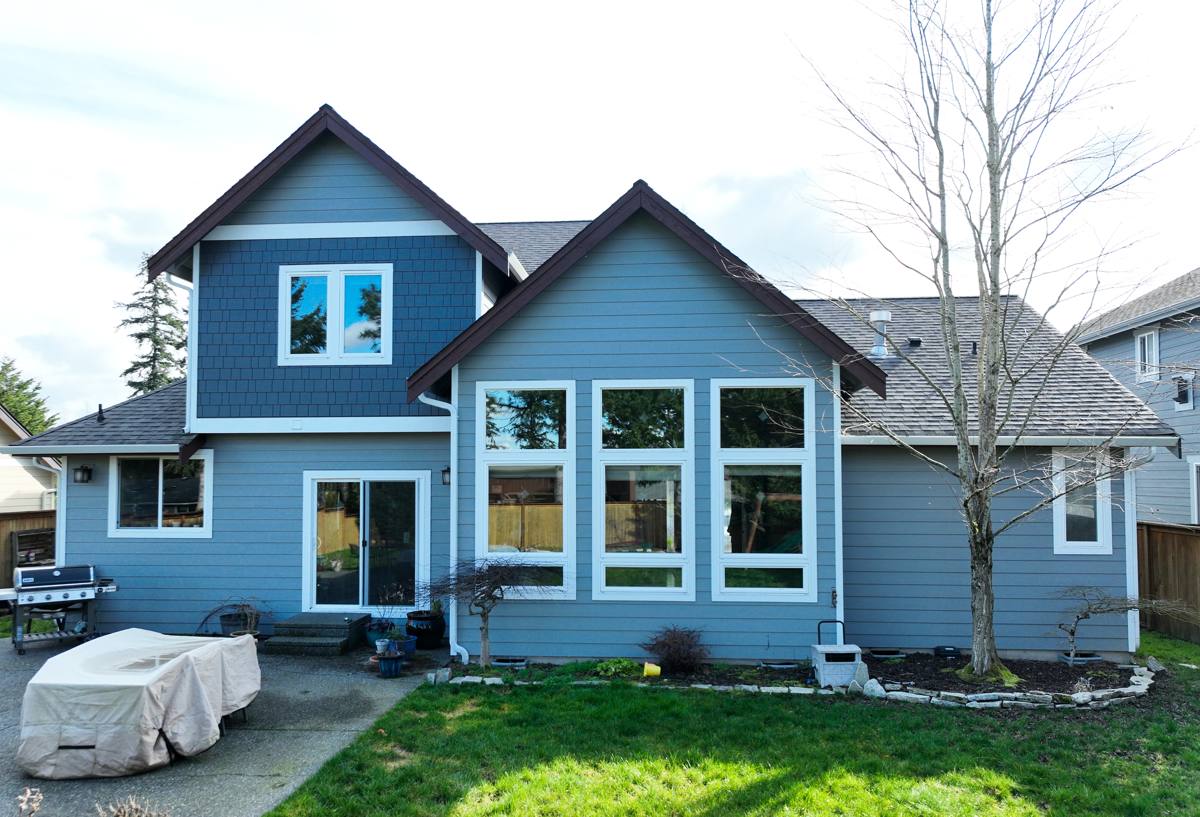
What Happy Valley's Conditions Ask of a Siding System
Salt Air and Marine Moisture
Bellingham's bayfront setting means salt-laden air moves through the whole city, Happy Valley included, even on days without an obvious storm rolling through. That kind of steady, low-grade exposure is harder on fasteners, trim hardware, and lower-grade finishes than most homeowners expect. It's not a dramatic kind of damage. It's slow, it's quiet, and it usually isn't obvious until a finish has already started breaking down at the seams.
Wind-Driven Rain
Rain in this part of Whatcom County rarely falls straight down. Wind off the water pushes it sideways, which means it finds its way into lap joints, window and door trim, and any small gap in a wall assembly that a purely vertical rainfall model wouldn't account for. A siding system that would perform fine in a calmer, drier climate can still let water in here, specifically because of the angle the rain is coming from.
A Long Moss and Mildew Season
Happy Valley's tree cover is part of what makes it an appealing neighborhood to live in, but shade and consistent dampness are exactly the combination that grows moss and mildew across most of the calendar year. Any siding surface that holds moisture against the substrate instead of shedding it becomes a growth surface over time, and it tends to show up first on north-facing walls, under eaves, and behind landscaping well before it's visible from the street or the driveway.
Why We Install Only James Hardie Fiber Cement
We don't offer a menu of siding brands for a homeowner to pick based on price. We install James Hardie fiber cement, and the reasoning comes directly from what we consistently see on tear-offs and repair calls in this exact climate, not from a sales script.
- Non-combustible core: Fiber cement's cement, sand, and cellulose fiber composition doesn't feed a fire the way wood-based siding can, which matters for household safety and can matter for insurance conversations as well.
- Factory-applied ColorPlus finish: The color coat is cured under controlled factory conditions rather than brushed on at the job site, so it holds up against fading and moisture intrusion far longer than field-applied paint, especially with salt air working against it.
- Climate-engineered HZ product lines: Hardie's HZ5 formulation is built specifically for regions with heavy, sustained moisture and freeze-thaw cycling, a better match for coastal Whatcom County than a generic national siding spec.
- Dimensional stability: The inorganic core doesn't swell, cup, or warp the way engineered wood products can after repeated wet-season moisture cycles.
- A strong, transferable warranty: Hardie backs its products with one of the more substantial warranty structures in the industry, provided the installation follows manufacturer spec.
What We Won't Install, and the Honest Trade-Offs
We don't install LP SmartSide, vinyl siding, Cemplank, Allura, primed spruce, or cedar. Every one of those is a legitimate product, and other contractors install them competently. Our decision not to is a professional standard, not a claim that any of them is a bad product in general.
LP SmartSide and similar engineered wood products use a resin-treated wood-strand core that performs fine in drier regions, but in a marine climate with this much rain, exposed cut edges and fastener penetrations are more sensitive to moisture intrusion than fiber cement's inorganic core. Vinyl is affordable and low-maintenance in a general sense, but it can warp under direct sun exposure and trap moisture behind the panel if house wrap and flashing aren't detailed carefully, something that's easy to get wrong and hard to spot from outside once the panels are up. Cemplank and Allura are also fiber cement products, so the core material argument doesn't apply the same way, but we've standardized on Hardie's specific formulations, factory finish process, and warranty structure rather than splitting our installation expertise and service commitments across multiple fiber cement brands. Cedar and primed spruce are attractive, genuinely traditional materials, but they require ongoing painting or sealing to keep moisture out, and in a climate this wet, that maintenance schedule tends to slip in a way that shortens the material's real-world lifespan well below its theoretical one.
What a Correct Fiber Cement Installation Actually Involves
Buying the right material is only half the job. James Hardie siding performs the way it's engineered to only when a specific set of installation details are followed exactly, not approximated.
- Proper fastening pattern and fastener type, matched to the specific Hardie product and substrate.
- Correct clearance from grade, roofline, and any horizontal surface where water can pool or splash back against the bottom edge of the siding.
- Joints lapped and sealed to manufacturer spec, not just butted and caulked as a shortcut.
- House wrap and flashing integrated as one continuous water-management system, not installed as separate steps that don't actually tie together.
- Correct field-cutting and sealing at every penetration, since an unsealed cut edge is a moisture entry point even on a material that resists absorption as well as fiber cement does.
Skipped or rushed installation steps are one of the most common reasons a genuinely good siding product develops problems on an actual house. We treat installation detail with the same seriousness as the material decision itself, because the two only work together.
Common Issues on Older Happy Valley Homes
A good number of Happy Valley homes are old enough that they've already been through at least one prior siding job, sometimes more than one. On re-sides, we regularly find moisture that's been tracking behind an older wall assembly for years without any visible sign from the outside, especially on shaded, tree-covered elevations where a home's original builder may not have detailed flashing as tightly as current best practice calls for. That's not a defect specific to Happy Valley. It's what happens to any older home in a wet marine climate over enough decades, and it's exactly why tear-off, rather than an overlay, matters more here than it might in a drier region.
Our Process on a Happy Valley Project
- On-site assessment: We walk the property, look at the current siding's actual condition, and check for signs of trapped moisture, soft substrate, or prior repair patches before we talk numbers.
- Tear-off vs. overlay decision: Given how often older siding here is hiding moisture damage, we're direct about when a tear-off is the right call versus when a simpler approach genuinely makes sense.
- Substrate repair: Any rot or compromised sheathing found during tear-off gets repaired before new siding goes on. Siding installed over a damaged substrate fails regardless of the material's quality.
- House wrap and flashing installation: This step gets done as an integrated water-management system, not a checklist item, since it's the layer that actually protects the wall assembly long-term.
- Hardie installation to manufacturer spec: Fastening, clearances, joint lapping, and sealing follow James Hardie's published installation requirements, which is also what keeps the warranty valid.
- Final walk-through: We go over the finished work with you directly rather than leaving you to discover issues after the crew has left.
Repair vs. Full Re-Side
Not every siding problem in Happy Valley means a full tear-off. Isolated impact damage, a section that's failed around a window or door, or trim that's come loose can often be repaired and matched into existing Hardie siding without redoing the whole house. But when moisture has clearly been tracking behind the wall assembly for a while, or the existing siding is a different, older product that's simply reached the end of its service life, a patch usually just delays a bigger job and adds cost rather than saving it. We'll tell you plainly which situation you're actually in after we've looked at the house, not before.
Fiber Cement vs. the Alternatives: A Quick Reference
| Factor | James Hardie Fiber Cement | Vinyl / Engineered Wood / Untreated Wood |
|---|---|---|
| Core material | Cement, sand, cellulose fiber (inorganic) | PVC, resin-treated wood strand, or solid wood, depending on product |
| Moisture response in wind-driven rain | Dimensionally stable; doesn't swell or warp | Varies; wood-based products are moisture-sensitive at cut edges |
| Combustibility | Non-combustible | Combustible (wood-based products); vinyl can deform under heat |
| Finish durability against salt air | Factory-baked ColorPlus finish | Field-applied paint or factory coatings of varying durability |
| Maintenance in a long moss season | Low; inorganic core resists organic growth | Higher on wood-based products; regular cleaning and resealing needed |
| Typical warranty | Long-term, often transferable when installed to spec | Varies widely by product and manufacturer |
Cost Factors for a Happy Valley Fiber Cement Project
| Factor | What It Affects | Why It Matters Here |
|---|---|---|
| Home size and wall complexity | Total material and labor | Older Happy Valley homes often have more trim, dormers, and roof intersections where wind-driven rain finds a way in |
| Tear-off vs. overlay | Labor scope and substrate access | Tear-off is often the honest recommendation once hidden moisture damage is common under older siding |
| Substrate condition | Repair costs before new siding goes on | Years of trapped moisture behind failing siding can rot sheathing and framing that isn't visible until tear-off |
| Tree cover and site access | Labor time, staging, and equipment needs | Mature trees common in the neighborhood can limit access and require extra care around landscaping |
| Trim and finish selection | Material cost and finish longevity | Factory ColorPlus finishes hold up longer against salt air and UV than field-applied paint |
Exact numbers depend on the specific home, its age, and its current siding condition, which is why we walk the property in person before giving a real estimate instead of quoting off a generic price sheet.
Why Hiring a Crew That Already Works in Happy Valley Matters
A neighborhood like Happy Valley has its own pattern of housing stock, tree cover, and terrain, and a crew that already works this part of Bellingham has seen that pattern enough times to know what to check for before the tear-off even starts. That includes knowing which elevations tend to hide moisture damage on homes of a certain age, how to stage a job around mature landscaping without damaging it, and what Bellingham's permitting and inspection process expects for an exterior re-side. None of that replaces a proper on-site assessment of your specific home, but it does mean fewer surprises once the old siding actually comes off the wall.
Questions to Ask Any Contractor Before You Hire
- Ask which specific siding products they install and why, not just what's cheapest to bid on your job.
- Ask how they handle cut edges, joints, and fastener penetrations, since that's where moisture problems usually start.
- Ask what the manufacturer's warranty actually requires to stay valid, including specific installation and maintenance conditions.
- Ask how they'd handle it if tear-off reveals rot or moisture damage behind your existing siding, and how that gets priced.
- Ask whether they're licensed and bonded in Washington, and confirm it directly rather than taking their word for it.
Get a Free, No-Pressure Estimate
If you're weighing a siding project for a Happy Valley home, we're glad to walk the property, take an honest look at what's actually happening on your walls, and tell you straight what we'd recommend and why. Use the form below to schedule a free estimate, no pressure and no upsell script.