 Bellingham Siding
 Storm Damage Roofing in Fairhaven: A Different Set of Conditions
Fairhaven sits close to Bellingham Bay, which means roofs here deal with a combination that inland neighborhoods don't get as hard: salt-laden air off the water, wind that funnels along the shoreline during winter storms, and driving rain that comes in sideways rather than straight down. Add Whatcom County's long, wet moss season, and you have a roof environment that ages differently than a roof twenty miles east in the foothills. None of this means Fairhaven roofs fail faster — it means the damage patterns are different, and repairs need to account for that.
When we get called out to Fairhaven after a windstorm or a hard rain event, we're usually looking for a specific set of problems: wind-lifted shingle tabs, water intrusion at flashing points that salt air has slowly corroded, and moss mats that trapped moisture against the roof deck long before the storm ever hit. A storm rarely creates damage out of nothing — it usually finds the weak point that was already there and makes it visible.
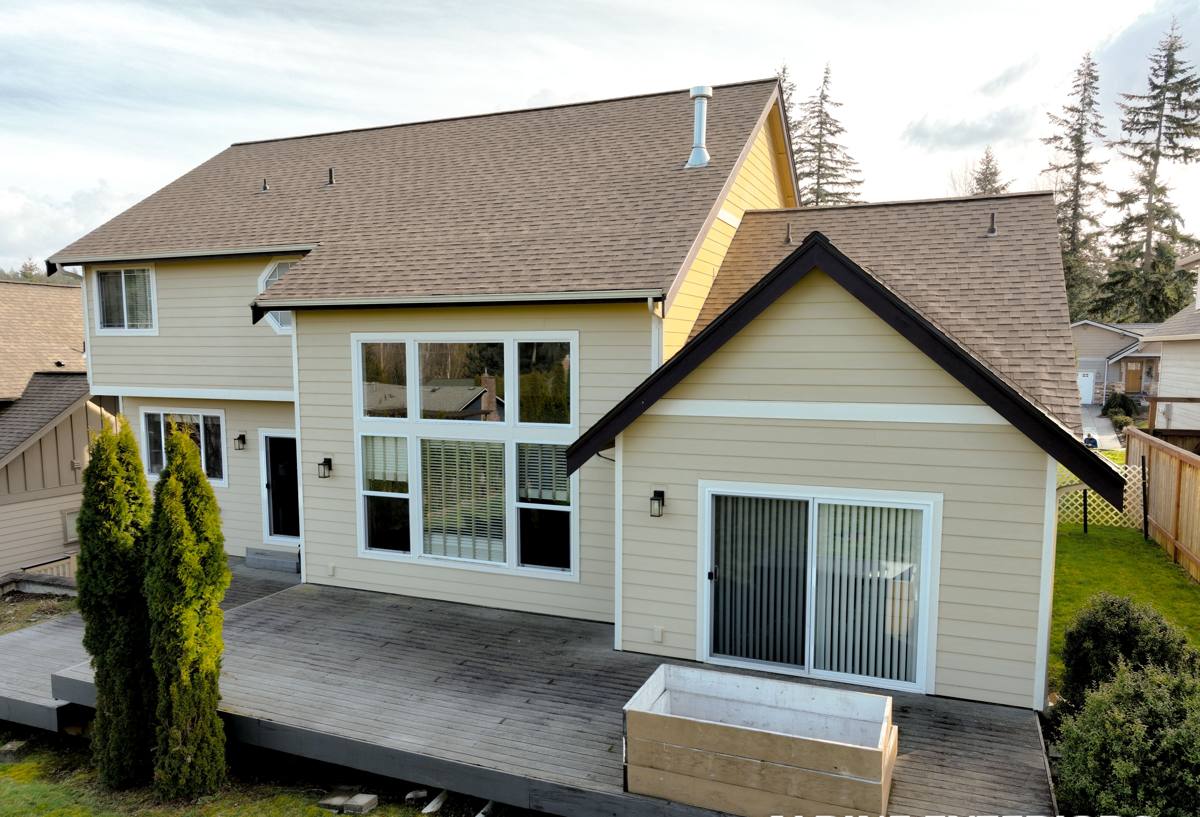
What Actually Counts as Storm Damage
Homeowners often picture storm damage as a tree branch through the roof, but most of what we repair after Whatcom County storms is less dramatic and easier to miss:
- Wind-lifted or creased shingle tabs, especially on roof edges and ridge lines facing the bay
- Torn or missing shingles where wind gusts caught a leading edge
- Flashing pulled loose or corroded around chimneys, vent pipes, and skylights
- Water intrusion under shingles where wind-driven rain got pushed uphill against the natural water flow
- Granule loss from hail or wind abrasion, which shows up as bald patches
- Debris strikes from tree limbs, which can bruise or puncture shingles without an obvious hole
Some of this damage leaks right away. A lot of it doesn't leak for months, which is exactly why a post-storm inspection matters even when the ceiling looks dry.
Why Wind-Driven Rain Is the Real Culprit
Standard roofing is designed to shed water moving downhill with gravity. When wind pushes rain sideways or even slightly uphill under a shingle edge, water can get past a roof system that would otherwise be fine in a normal downpour. This is a bigger factor in Fairhaven than in more sheltered parts of Bellingham, simply because there's less terrain and fewer windbreaks between the neighborhood and open water.
Signs Your Roof May Have Storm Damage
After a significant wind event or heavy rain, it's worth doing a quick check from the ground and inside the attic if you have access. Look for:
- Shingle pieces or granules in gutters, downspouts, or on the ground around the foundation
- Shingles that look curled, lifted, or out of alignment from the street
- New or worsening stains on ceilings or in attic rafters, particularly near exterior walls
- Visible daylight through the roof deck when viewed from inside the attic
- Soft or discolored spots on interior drywall near the roofline
- Moss buildup that looks disturbed, lifted, or washed into clumps after heavy rain
- Flashing that looks bent, separated, or rusted at chimneys and vents
If you see any of these, the safest move is a professional inspection before the next storm arrives — not after a second or third leak has already caused interior damage.
What a Correct Storm Repair Actually Involves
Assessment Before Any Work Starts
A proper repair starts with identifying every point of entry, not just the spot where water showed up inside. Water often travels along rafters or sheathing before it drips somewhere visible, so the leak point and the stain point are frequently not in the same place. We check the full roof plane, not just the area above the stain.
Matching Materials, Not Guessing
Patching storm damage with mismatched shingles or the wrong underlayment creates a repair that looks fine for a season and then fails again. We match shingle type, profile, and where reasonably possible, color, so the repair blends in and performs the same as the surrounding roof rather than becoming a new weak point.
Flashing and Underlayment Get Real Attention
Because salt air accelerates corrosion on exposed metal, storm repairs in Fairhaven are a good opportunity to inspect flashing condition, not just replace what's obviously broken. Underlayment that's been wet or compromised gets replaced under the repaired section rather than left in place and covered back over — reusing damaged underlayment is one of the most common shortcuts that leads to a repeat leak.
Moss and Debris Removal Is Part of the Job, Not an Add-On
If moss contributed to the original weak point, clearing it and treating the area is part of a proper repair, not a separate upsell. Leaving moss in place around a fresh repair just sets up the same failure again next wet season.
Our Process, Start to Finish
1. Inspection and Honest Assessment
We walk the roof (or use a ladder and camera where roof access isn't safe) and document what we find, including areas that aren't leaking yet but show early wear.
2. A Clear Explanation of What's Needed
We explain what's damaged, what's simply aged, and what's still fine. Not everything found during a storm inspection needs to be fixed immediately, and we'll say so.
3. A Written Estimate Before Any Work
You get a clear scope of work and price range before we touch the roof — no verbal estimates that turn into surprises on the invoice.
4. The Repair
We remove and replace only the damaged material, tie in matching shingles, correct flashing and underlayment as needed, and clean the work area, including removing storm debris we generate.
5. Final Check
We confirm the repair is watertight and walk you through what was done, including anything worth monitoring going forward.
Repair or Replace: How We Decide
Not every storm event means a new roof, and not every roof is worth repairing indefinitely. The decision usually comes down to a few factors:
| Factor | Repair Is Usually the Right Call | Replacement Is Worth Discussing |
|---|---|---|
| Age of roof | Under roughly 15 years, in otherwise good condition | Nearing or past typical lifespan for its material |
| Extent of damage | Isolated to one or two roof sections | Damage spread across multiple planes or slopes |
| Underlying condition | Deck and structure are sound under the damaged area | Soft or rotted decking found during inspection |
| Moss and moisture history | Minor, surface-level, hasn't reached the deck | Long-term trapped moisture affecting multiple areas |
| Frequency of repairs | First or occasional issue | Repeat leaks in different spots each season |
We'll always give you the repair option first if it's a sound long-term fix. We only recommend replacement when a repair would be a temporary patch on a roof that's genuinely past its useful life.
Materials We Use for Storm Repairs in This Climate
Given the salt air and rain exposure around the bay, a few material choices matter more here than they would inland:
- Corrosion-resistant flashing at chimneys, vents, and valleys, since standard flashing near open water degrades faster than the same material further inland
- Synthetic underlayment in place of older felt products where a full section is being opened up, for better water resistance during the repair window itself
- Ice-and-water shield at eaves and valleys, which resists wind-driven rain intrusion far better than standard underlayment alone
- Matched shingle products from the same manufacturer line already on the roof, to preserve warranty coverage where possible
We don't push upgrades that aren't needed. If the existing materials on your roof are sound and simply need a targeted repair, that's what we recommend.
Insurance and Documentation Considerations
Storm damage repairs sometimes involve a homeowner's insurance claim. We're not insurance adjusters and don't handle claims on your behalf, but we can provide photo documentation and a written scope of the damage and repair, which is typically what an adjuster asks for. If you're planning to file a claim, it's worth having that documentation done before repairs begin, since some damage is harder to verify once it's already fixed.
Why Local Experience in Fairhaven Actually Matters
A crew that only occasionally works this close to the water can miss things that are obvious to someone who repairs roofs here regularly — how far salt air corrosion typically travels inland from the bay, which roof orientations take the worst of winter wind, and how aggressively moss returns in this specific microclimate compared to drier parts of Whatcom County. That local pattern recognition is the difference between a repair that solves the actual problem and one that just covers the symptom until the next storm season.
We work in and around Bellingham regularly, including Fairhaven, so we're not learning the neighborhood's roofing quirks on your project. That matters when the goal is a repair that holds up through the next few winters, not just through the next dry week.
If your roof took a hit in a recent storm, or you just want an honest look before the next one rolls in, we're happy to come take a look. The estimate is free, there's no pressure to move forward, and you'll get a straight answer about whether you need a repair, a bigger fix, or nothing at all right now.