 Bellingham Siding
 Lynden's Roofs Work Harder Than Most
Lynden sits out in the flat farmland of Whatcom County, close enough to the Salish Sea to pick up salt-laden air on the west winds, and far enough inland to trap the damp, still conditions that keep roofs wet for days after a storm passes. Add in Bellingham's long, grey stretch of fall-through-spring rain and the mild temperatures that never quite dry things out, and you get a climate that's brutal on asphalt shingles in ways that don't show up right away. It's not one big storm that wrecks a roof out here — it's years of moisture sitting in valleys, moss creeping under tabs, and granule loss nobody notices until a ceiling stain shows up.
We've replaced and repaired enough roofs in and around Lynden to know the failure patterns are consistent: north-facing slopes that never see direct sun and stay damp longest, valleys and low-slope sections where water sits instead of shedding, and attics that trap humidity because the ventilation was never sized right in the first place. A roofing job done for a drier climate, or done by a crew unfamiliar with this specific corner of Whatcom County, tends to miss these details. That's the gap we try to close.
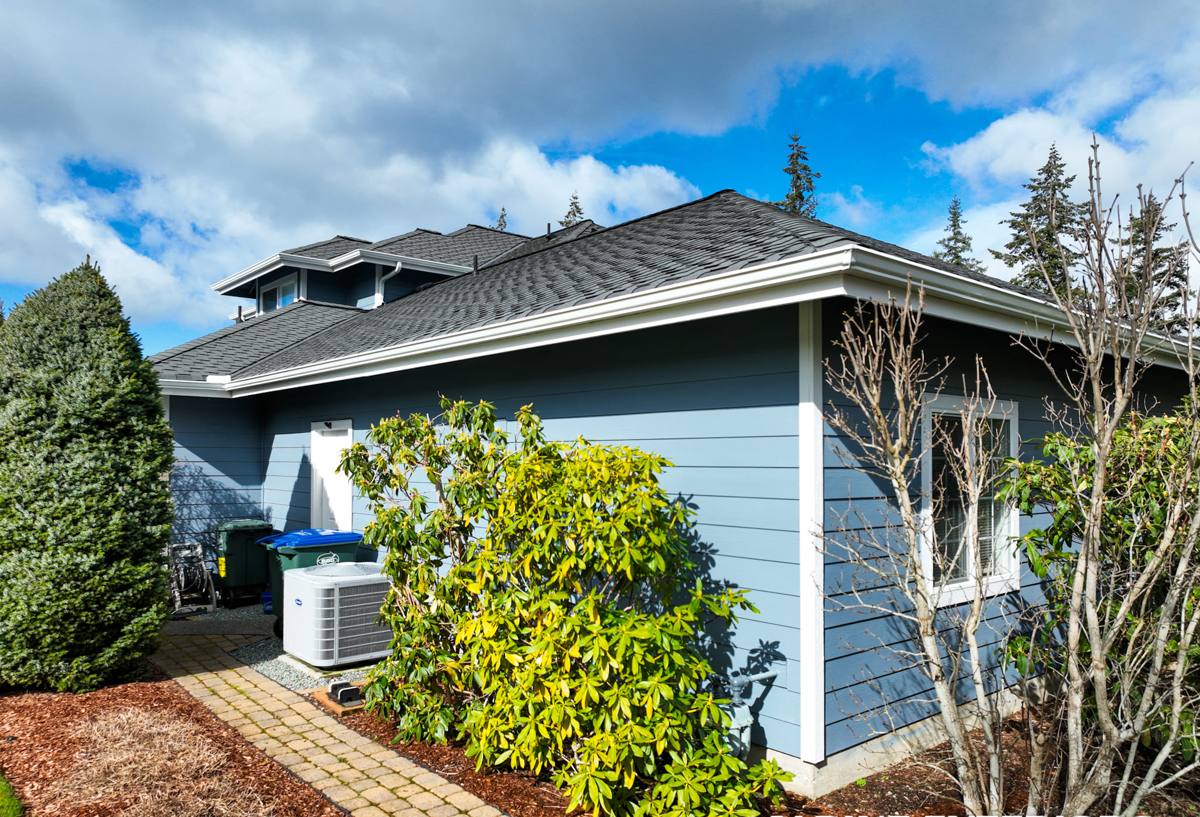
What a Correct Asphalt Shingle Roof Job Actually Involves
"Reroofing" gets treated like a simple swap — old shingles off, new shingles on. In a climate like ours, that's how you end up replacing a roof again in twelve years instead of twenty-five. A correct job has several layers that matter more here than in dry-climate installations:
- Full tear-off, not an overlay. Layering new shingles over old traps moisture and voids most manufacturer warranties. It also hides deck problems until they're serious.
- Deck inspection and repair. Once the old shingles are off, we check the sheathing for soft spots, delamination, or rot — common wherever moisture has been getting in slowly for years. Any bad sections get replaced before anything new goes down.
- Ice and water shield at vulnerable points. Eaves, valleys, and roof-to-wall transitions get self-adhering waterproof membrane, not just felt. These are the spots where wind-driven rain backs up under shingles.
- Synthetic underlayment across the field. More tear-resistant and more water-resistant than old-style felt, and it holds up better during the install window if weather turns before the shingles go on.
- New flashing, not reused flashing. Chimneys, skylights, sidewalls, and vent penetrations get new step and counter-flashing. Reusing old flashing is a common shortcut that fails first.
- Proper nailing pattern. Every shingle nailed per the manufacturer's pattern and nail count, not just enough to hold it down. Under-nailing is invisible until a windstorm proves it.
- Ridge and intake ventilation balanced together. Covered in more detail below — this is the piece most often overlooked entirely.
Choosing the Right Shingle for Lynden's Conditions
Not every asphalt shingle handles constant damp and moss pressure the same way. We walk homeowners through the realistic trade-offs rather than pushing the most expensive option by default.
| Shingle Type | Typical Lifespan Here | Moss/Algae Resistance | Best Fit |
|---|---|---|---|
| 3-tab (standard) | 15–20 years | Low unless algae-resistant granules specified | Budget-conscious rentals or outbuildings |
| Architectural / laminate | 25–30 years | Good with algae-resistant (AR) granules | Most Lynden homes — best balance of cost and durability |
| Impact-resistant (Class 4) | 30+ years | Good with AR granules | Homes prioritizing longevity and potential insurance discounts |
For our climate, we default to recommending architectural shingles with algae-resistant (AR) granules — copper- or zinc-infused granules that slow the growth of the black and green algae streaking that shows up on north-facing roofs across Whatcom County within a few years otherwise. It's a modest upcharge that pays for itself in appearance and reduced cleaning.
Color and Heat Considerations
Darker shingles hide moss and algae staining somewhat longer visually, but they don't grow moss any slower — moss cares about moisture and shade, not color. Lighter shingles show streaking sooner but often read as a better match for the region's overcast light. This is a preference call, not a performance one, and we're upfront about that.
Ventilation and Moisture: The Part Homeowners Don't See
An asphalt shingle roof isn't just the layer you see from the street — it's part of a system that includes the attic underneath. In damp coastal climates like ours, poor attic ventilation is one of the single biggest reasons roofs fail early and moss takes hold fast. Warm, moist air from inside the house rises into the attic. Without balanced intake (soffit vents) and exhaust (ridge vents), that moisture condenses on the underside of the deck, saturates the sheathing from below, and keeps the whole roof assembly damp longer after every rain. A damp deck under damp shingles is exactly what moss and algae need to establish.
Before we quote a reroof, we look at the existing ventilation setup — whether soffit vents are actually open and unobstructed by insulation, whether the ridge vent (if there is one) is sized to the square footage, and whether bathroom or kitchen exhaust fans are dumping moist air into the attic instead of outside. Fixing ventilation during a reroof is far cheaper than fixing it later, and it's often the difference between a shingle warranty that means something and one that gets voided by trapped heat and moisture.
Moss, Algae, and the Ongoing Maintenance Reality
No shingle roof in Whatcom County is entirely moss-proof — the goal is slowing it down and keeping it from doing structural damage. A few things actually move the needle:
- Algae-resistant (AR) shingles with copper or zinc granules, which release trace metal ions that inhibit growth over time.
- Zinc or copper strips installed near the ridge, which do the same thing passively across the whole roof as rain washes over them.
- Keeping overhanging tree limbs trimmed back so roof sections get more light and dry out faster between rains.
- Gentle, low-pressure cleaning on a reasonable schedule — never pressure-washing shingles, which strips granules and shortens roof life faster than the moss it removes.
We treat moss control as an ongoing relationship, not a one-time fix. A roof installed correctly with good ventilation and AR shingles will still need occasional attention out here — that's just the trade-off of living this close to the water.
Signs a Lynden Roof Needs a Closer Look
Because damage develops slowly in this climate, homeowners often don't realize a roof is failing until there's an interior leak. Worth checking for, or asking us to check for:
- Granules collecting in gutters or at downspout outlets
- Shingles that look cupped, curled at the edges, or cracked
- Thick moss mats, especially on north-facing slopes or under tree cover
- Dark streaking that's spread significantly over the last year or two
- Soft or spongy spots when walking the roof (we check this, not something to do yourself)
- Daylight visible through the attic roof deck, or damp insulation below it
- Flashing around chimneys or vents that's visibly rusted, lifted, or gapped
Any one of these on its own isn't necessarily an emergency, but it's worth a professional look before the next wet season rather than after a leak shows up on a ceiling.
Our Process, Start to Finish
- Free on-site inspection. We walk the roof (weather permitting) and the attic, check ventilation, and note deck condition, flashing points, and problem areas specific to your property.
- Straightforward written estimate. Shingle options, ventilation recommendations if needed, and a clear price — no vague allowances or surprise add-ons sprung mid-job.
- Scheduling around the weather. We work Bellingham and Whatcom County year-round, but we schedule tear-offs to minimize how long your deck sits exposed, and we don't start a full tear-off if the forecast doesn't give us a safe window to dry-in the same day.
- Tear-off and deck inspection. Old material removed, deck checked and repaired as needed, with any rot or soft sheathing addressed before anything else happens.
- Underlayment, flashing, and shingle installation per manufacturer specification, with ridge and intake ventilation corrected if the inspection flagged it.
- Final walkthrough. We go over the finished roof, the gutters and downspouts are checked for debris from the job, and you get the paperwork for any manufacturer warranty registration.
What Affects the Price
We don't quote roofs over the phone, because too many variables change the number. Broadly, here's what moves the cost of an asphalt shingle roof up or down for a typical Lynden home:
| Factor | Effect on Cost |
|---|---|
| Roof size and number of stories | More square footage and steeper access raise labor cost |
| Roof pitch and complexity (valleys, dormers, chimneys) | More cuts, flashing, and labor time |
| Number of existing layers to remove | Multiple tear-off layers add disposal and labor cost |
| Deck condition | Rot or soft sheathing found during tear-off adds repair cost |
| Shingle grade chosen | 3-tab is least expensive; architectural and impact-resistant cost more upfront but last longer |
| Ventilation upgrades | Adding or correcting soffit/ridge ventilation adds modest cost, saves money long-term |
We'd rather walk through these factors on your specific roof than quote a number that doesn't hold up once we're up there.
Why a Crew That Already Works Lynden Matters
Roofing looks similar everywhere from a distance, but the details that make a roof last in Whatcom County aren't universal. A crew that mostly works drier inland climates may not default to AR shingles, may not flag ventilation as a priority, or may schedule tear-offs without accounting for how quickly weather turns off the water. We work Bellingham, Lynden, and the surrounding county regularly enough that these aren't special considerations we have to think through each time — they're just how we build a roof here. That includes knowing which local suppliers stock the materials we need without a delay, and building in realistic weather buffers so your home isn't sitting open to the sky longer than necessary.
Familiarity with local permitting and inspection expectations also keeps a project moving instead of stalling on paperwork. None of this replaces careful workmanship, but it means fewer surprises and fewer delays on a job that already has enough variables working against a strict schedule.
Get a Straightforward Look at Your Roof
If your Lynden home's roof is showing granule loss, moss buildup, or you just haven't had it looked at in a while, we're glad to come take a look. There's no cost and no pressure to move forward — just an honest read on where things stand and what your options are. Use the form below to request a free estimate.