 Bellingham Siding
 Why Fairhaven's Climate Is Hard on a Roof
Fairhaven sits close to Bellingham Bay, which means homes here deal with something most of Whatcom County doesn't have to think about as much: salt-laden air moving off the water. Combine that with our long stretch of driving rain from fall through spring, and a moss season that can run eight or nine months out of the year, and you've got a roofing environment that punishes anything installed halfway. Fasteners corrode faster near the water. Wood-based roofing holds moisture longer under our marine layer. Moss finds a foothold on anything with texture or shade, and once it does, it works its way under roofing material and starts lifting edges.
Metal roofing isn't a cure-all, but it's one of the few roofing systems that, installed correctly, actually works with these conditions instead of fighting them. This page is about what that looks like specifically for Fairhaven — not a generic rundown of metal roofing benefits, but what matters for a house a few blocks from saltwater, under a canopy of Douglas fir and bigleaf maple, in a Bellingham winter.
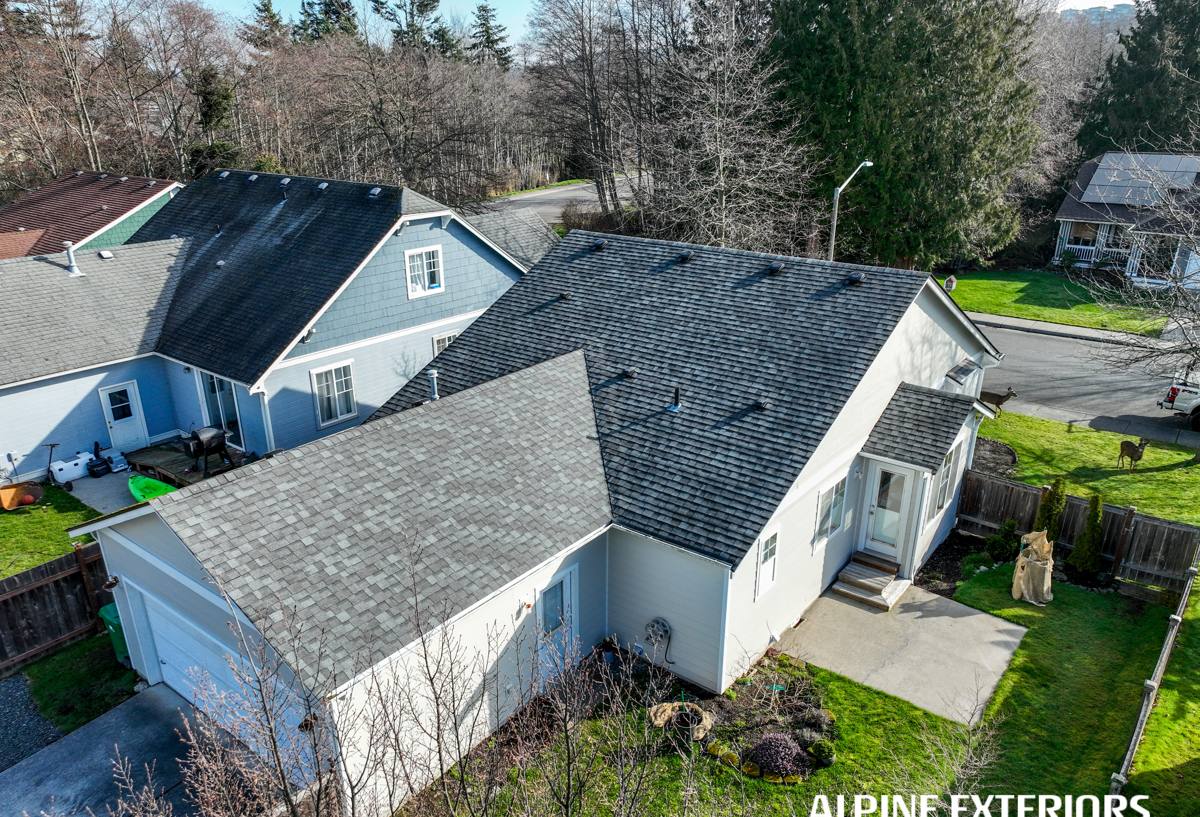
What Metal Roofing Needs to Do in a Coastal Neighborhood
A metal roof in Fairhaven has three jobs that a metal roof in, say, eastern Washington doesn't have to worry about as much: shed water fast without pooling, resist corrosion from salt exposure, and stay clean enough that moss and organic debris don't get a chance to build up. Get any one of these wrong and you end up with problems that don't show up for a few years — which is exactly why the installation details matter more than the marketing material.
Standing Seam vs. Exposed Fastener Panels
The two common panel styles behave very differently in a salt-air environment:
- Standing seam panels use concealed clips and interlocking seams, so there are no exposed screw heads for salt spray and rain to attack over time. This is usually our recommendation for homes closer to the water or with more open exposure.
- Exposed fastener panels (corrugated or ribbed styles) cost less up front but rely on gasketed screws driven through the face of the panel. Those gaskets do wear out — usually well before the metal itself does — and in a salt-air setting that timeline shortens. It's not that this system fails; it's that it asks for maintenance and eventual fastener replacement that some homeowners don't want to sign up for.
We install both, but we'll tell you honestly which one fits your situation, your budget, and how close your home sits to the bay.
Material and Coating Options
Not all metal roofing is the same metal, and the coating matters as much as the base material when salt air is part of the equation. Here's how the common options compare for a Fairhaven install:
| Material | Salt-Air Performance | Typical Trade-Offs |
|---|---|---|
| Galvanized steel | Good with a quality paint finish; the zinc coating protects the steel, but scratches and cut edges need proper sealing | Lower cost than aluminum; heavier; needs careful edge treatment during install |
| Galvalume steel | Strong corrosion resistance from the aluminum-zinc coating, a common choice for coastal PNW homes | Slightly more expensive than plain galvanized; still steel, so cut edges need sealant |
| Aluminum | Naturally corrosion-resistant even in direct salt exposure — doesn't rust | Higher material cost; softer metal, more prone to denting from debris or hail |
| Copper | Excellent longevity, develops a natural patina, handles salt air well | Significant upfront cost; usually reserved for accents or smaller roof sections |
For most Fairhaven homes, we're recommending Galvalume steel or aluminum depending on how exposed the home is and what look the homeowner wants. We'll walk through the trade-offs on-site rather than push one option across every job.
What a Correct Installation Actually Involves
The material is only part of the equation. Most metal roof problems we get called out to inspect trace back to installation shortcuts, not the panel itself. A correct job on a Fairhaven roof includes:
- A properly ventilated deck — trapped moisture under metal panels causes condensation issues that have nothing to do with the roof leaking from above
- Ice-and-water or synthetic underlayment at eaves, valleys, and penetrations, since this is where driving rain finds its way in first
- Compatible fasteners and flashing metal — mixing dissimilar metals (like galvanized flashing against aluminum panels) causes galvanic corrosion, which shows up as pitting and staining within a few years
- Sealed and properly lapped panel edges, especially any field-cut edges where the protective coating has been cut through
- Flashing details at chimneys, vents, and wall transitions built for wind-driven rain, not just vertical rainfall
None of this is exotic. It's just detail work that takes time, and it's the difference between a metal roof that goes 40-plus years without issue and one that develops corrosion or leaks at year eight because a shortcut got taken somewhere a homeowner would never see.
Fastener and Flashing Compatibility
This deserves its own mention because it's the most common mistake we see on re-roofs and repairs in this area: using the wrong fastener or flashing metal against the panel material. Near saltwater, galvanic corrosion between mismatched metals accelerates. We match fasteners and flashing to the panel material on every job — it's a small line item that prevents a real problem down the road.
Moss, Debris, and Bellingham's Wet Season
Fairhaven's tree cover is part of what makes the neighborhood what it is, but it also means roofs deal with needle drop, leaf litter, and shade that keeps things damp longer after rain. Metal roofing doesn't feed moss the way organic shingle materials do — there's no cellulose for it to root into — but that doesn't mean a metal roof is moss-proof. Debris still collects in valleys and against ridge caps, and moss can grow on top of accumulated grime even on a metal surface.
The practical difference is maintenance: keeping a metal roof clear of debris is a simple rinse-and-clear job, not a scrape-and-treat job. We recommend a seasonal check of valleys and any low-slope sections, particularly after the fall leaf drop and before the heaviest winter rain sets in.
Our Process
We keep the process straightforward because homeowners have usually already dealt with enough back-and-forth by the time they call us:
- On-site assessment — we look at your existing roof, deck condition, ventilation, and exposure to wind and salt air before recommending anything
- Straight-talk estimate — material options, what they cost, and why, with no pressure to upsell to the most expensive system if it's not the right fit
- Tear-off and deck check — we don't install over a compromised deck; if there's rot or inadequate ventilation, we address it before panels go on
- Installation — underlayment, flashing, and panels installed to manufacturer spec and matched to your home's exposure
- Final walkthrough — we go over the finished roof with you, including what maintenance (if any) it needs going forward
Cost Factors for a Fairhaven Metal Roof
Metal roofing costs more upfront than asphalt shingles — that's an honest trade-off, not a surprise we spring on you later. What it buys is a roof that typically outlasts two or three shingle roofs and needs far less maintenance in a wet coastal climate. The main variables that move the price on a given job:
- Roof size and number of planes, valleys, and penetrations
- Panel style — standing seam runs higher than exposed fastener panels
- Material choice — aluminum and copper cost more than steel
- Deck condition — repairs or added ventilation add to the scope
- Access — steep pitches or limited staging area affect labor time
- Tear-off requirements if removing multiple layers of existing roofing
We give you real numbers based on your actual roof, not a rough per-square estimate pulled from a phone call.
Why a Crew That Works Fairhaven Regularly Matters
A lot of roofing problems in this neighborhood are exposure problems — how close a house sits to the water, which direction it faces, how much tree cover it has, how the wind moves across a given lot. A crew that works Bellingham and Whatcom County regularly has already seen how these variables play out on real roofs, not just in a manufacturer's spec sheet. That matters when we're deciding between panel styles, choosing coatings, or figuring out where a roof needs extra flashing attention because of how rain moves across it in a Fairhaven winter.
It also means we're accountable locally. If something needs a second look after the job is done, we're not driving in from out of the area to handle it.
If you're weighing a metal roof for a Fairhaven home, we're glad to come take a look and give you a straightforward, no-pressure estimate — what it would take, what it would cost, and whether metal is actually the right fit for your roof. Use the form below to get started.