 Bellingham Siding
 Metal Roofing for Lynden's Weather and Property Types
Lynden sits a little differently than most of the towns we work in. It's more rural and agricultural in character than Bellingham proper, with bigger lots, more outbuildings, and often steeper or larger roof spans on barns, shops, and detached garages in addition to the house itself. That changes what a roof needs to do. A metal roof on a Lynden property is frequently covering more square footage per building, exposed to open farmland wind, and expected to shed water fast during the long wet stretch that runs from fall through spring across Whatcom County.
Even though Lynden sits further inland than the waterfront neighborhoods of Bellingham, the marine air off the Salish Sea still pushes up the valley, carrying moisture and a faint salt influence that shows up as corrosion over time on unprotected metal, fasteners, and flashing. Combine that with driving rain that comes in sideways during winter storms and a moss season that can run most of the year in shaded, north-facing sections of a roof, and you've got conditions that reward a roofing system built for water shedding and low maintenance — which is exactly what metal roofing does well when it's installed correctly.
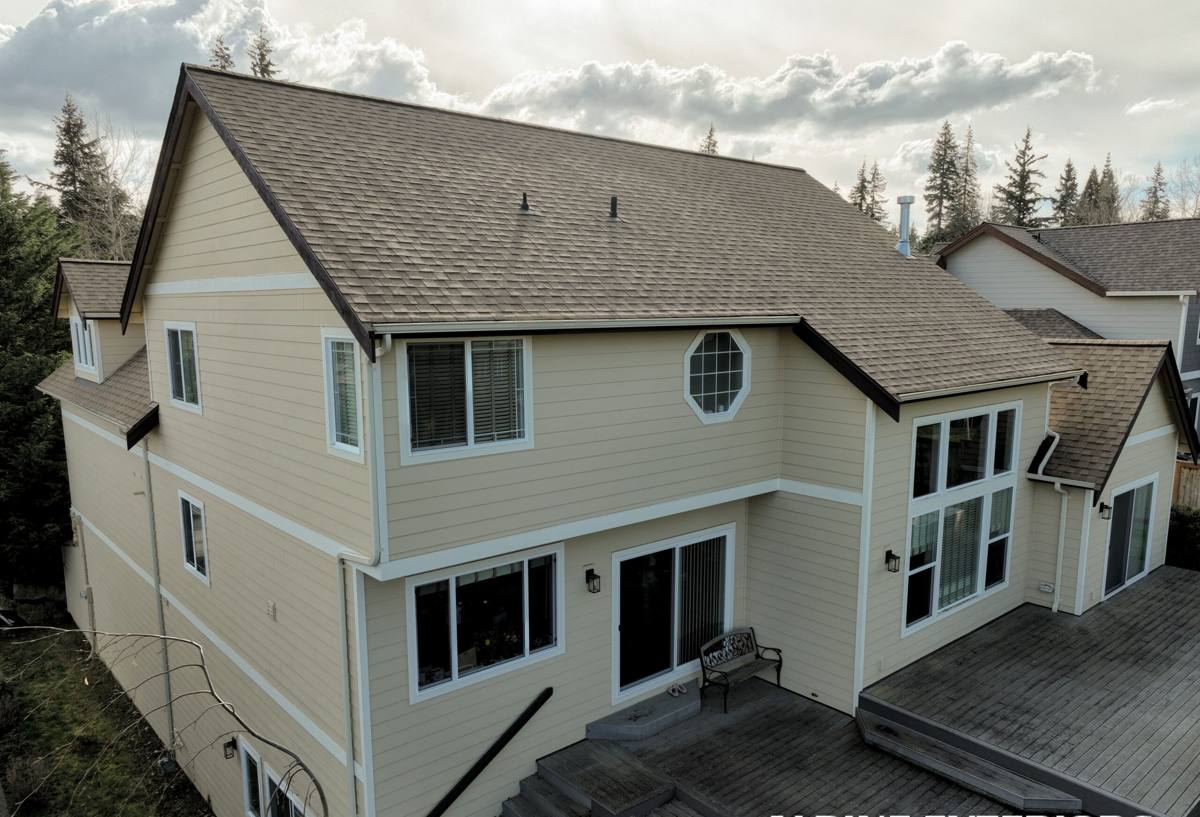
What Driving Rain, Salt Air, and Moss Actually Do to a Roof
These aren't abstract concerns — they're the specific failure points we look for on every inspection in this area.
Driving Rain
Wind-driven rain doesn't just fall straight down and run off; it gets pushed sideways and upward under laps, around penetrations, and into any gap in flashing. On a metal roof, that means seam design, panel overlap, and flashing detail at valleys and walls matter more than the panel material itself. A well-built standing seam roof handles this without issue. A poorly lapped or under-fastened exposed-fastener roof will eventually let water in at the weakest point.
Salt-Tinged Marine Air
Corrosion on metal roofing is almost always a coating or fastener problem, not a "metal roofs rust" problem. Bare galvanized steel, mismatched fastener metals, and worn-through paint systems are what actually corrode. The marine air common to Whatcom County makes coating quality and fastener selection a bigger deal here than it would be in a dry inland climate.
Long Moss Season
Moss needs shade and sustained moisture, and Lynden's tree cover and long wet season provide plenty of both. Moss on an asphalt shingle roof works its way under the shingle tabs and lifts them. On a metal roof, moss has almost nothing to grip — the smooth, hard surface and steep water flow make it far harder for spores to establish, especially compared to shingle or wood roofing nearby.
Standing Seam vs. Exposed Fastener: Which Fits Your Roof
Both are legitimate metal roofing systems, but they perform differently over time, and the right choice depends on the building, the budget, and how long you want to go before any maintenance is needed.
| Factor | Standing Seam | Exposed Fastener |
|---|---|---|
| Fasteners | Concealed under the seam | Visible screws through the panel face |
| Maintenance | Essentially none for decades | Fastener washers can dry out and need periodic replacement |
| Upfront cost | Higher | More affordable |
| Best use | Primary residence, long-term ownership | Shops, barns, outbuildings, budget-driven projects |
| Wind and rain resistance | Very high — no exposed penetrations | Good, but only as good as the fastener seal |
For a Lynden shop or barn where budget matters more than a 40-plus-year maintenance-free lifespan, exposed fastener panels are a sound, honest choice. For a house that will be lived in for decades, standing seam is worth the difference — no exposed screws means no washers to fail down the road.
The Details That Actually Determine How a Metal Roof Performs
The panel is the part everyone sees, but most metal roof failures we get called out to inspect trace back to what's underneath or around it, not the panel itself.
Underlayment and Ice/Water Protection
A synthetic underlayment rated for metal, with self-adhering ice-and-water membrane at eaves, valleys, and around every penetration, is non-negotiable in this climate. It's the backup layer that keeps a roof dry when wind-driven rain gets past the panel laps during a bad storm.
Ventilation
Metal roofs need proper intake and exhaust airflow underneath the panels just like any other roofing system. Get it wrong and you trap moisture against the underside of the deck, which leads to condensation and rot regardless of how good the metal itself is.
Fastener and Metal Compatibility
Mixing incompatible metals — say, the wrong fastener alloy against a steel or aluminum panel — sets up galvanic corrosion that eats through both pieces from the inside. This is a detail that's easy to get wrong and expensive to fix later, and it's one of the first things we check on any roof we didn't originally install.
Coating System
A PVDF (Kynar-type) coating holds color and resists chalking and fading far longer than a basic polyester paint system. It costs more upfront and is worth it on anything you expect to look good for 20-plus years.
Our Process on a Lynden Metal Roofing Job
- On-site inspection — we walk the roof deck, check for existing moisture damage, and measure pitch, span, and penetrations.
- Material and profile selection — we go over standing seam versus exposed fastener, gauge, and coating options based on the building and your budget.
- Tear-off and deck check — old roofing comes off, and we inspect the deck itself for soft spots or rot before anything new goes down.
- Underlayment and flashing — ice-and-water membrane at eaves, valleys, and penetrations; new flashing at every wall and chimney transition.
- Panel installation — panels run and fastened to spec, with attention to expansion allowance so the roof isn't fighting itself as temperatures swing.
- Final walk-through — we go over the finished roof with you, including what maintenance (if any) to expect.
What to Expect After Installation
One of the real advantages of metal roofing in a climate like this is how little it asks of you afterward. That said, "low maintenance" isn't "no maintenance," and a few habits go a long way toward getting the full lifespan out of the system.
- Clear debris and needles from valleys once or twice a year — trapped organic material holds moisture against the panel
- Keep gutters clear so water isn't backing up under the eave edge during heavy rain
- Check exposed fastener washers every few years if that's the system you have; they're an easy swap when caught early
- Trim back overhanging branches to reduce shade and debris, which slows moss and algae growth
- Have flashing and sealant at penetrations checked periodically, especially after major wind events
Cost Factors for a Lynden Metal Roof
Every roof is different, and the only accurate number comes from measuring your actual building, but these are the factors that move the price up or down.
| Factor | Effect on Cost |
|---|---|
| Standing seam vs. exposed fastener | Standing seam typically runs higher due to labor and specialized tooling |
| Roof complexity (valleys, dormers, penetrations) | More cuts, flashing, and labor time |
| Tear-off vs. install over existing roofing | Tear-off adds cost but is usually the right call on an older roof |
| Gauge and coating quality | Heavier gauge and PVDF coatings cost more but last longer |
| Outbuildings (barns, shops) done at the same time | Bundling work can reduce per-building setup costs |
As a broad range, exposed fastener metal roofing tends to land closer to what a good architectural asphalt shingle costs, while standing seam runs higher — the trade-off being decades less maintenance and a roof that isn't giving moss anywhere to grab.
Why It Matters That We Already Work in Lynden
A roof crew that only occasionally works this far out from Bellingham doesn't always have a feel for the specific conditions here — the mix of farmhouses and newer builds, the larger outbuildings, the wind exposure on open lots, and how the wet season actually behaves once you're away from the immediate coastline. Knowing that going in means we're not guessing at underlayment strategy or fastener spec for your specific property; we're applying what already holds up on similar buildings in the same area, in the same weather.
If you're weighing a metal roof for a house, shop, or barn in Lynden, we're happy to take a look and talk through what actually makes sense for your building — no pressure, no upsell. Use the form below to request a free estimate.