 Bellingham Siding
 Windows Built for Sudden Valley's Conditions
Sudden Valley sits in one of the more distinctive microclimates in Whatcom County. Homes here are tucked into heavy tree cover along Lake Whatcom, which means less direct sun on exterior walls, more standing shade, and a lot more ambient moisture than a house out in the open would ever see. Add in the marine air that moves inland off Bellingham Bay and the driving rain that defines a typical Pacific Northwest winter, and you get a set of conditions that are genuinely hard on windows. Wood sashes soften. Aluminum frames pit. Seals that would last two decades in a drier climate fail in twelve or fifteen years here instead.
None of that is a reason to panic about your windows — it's just the reason a window job in Sudden Valley needs to be done a little differently than the same job somewhere drier. That's what this page is about: what local homes actually need, what a correct installation involves, and why it matters to hire a crew that already understands this specific stretch of Whatcom County.
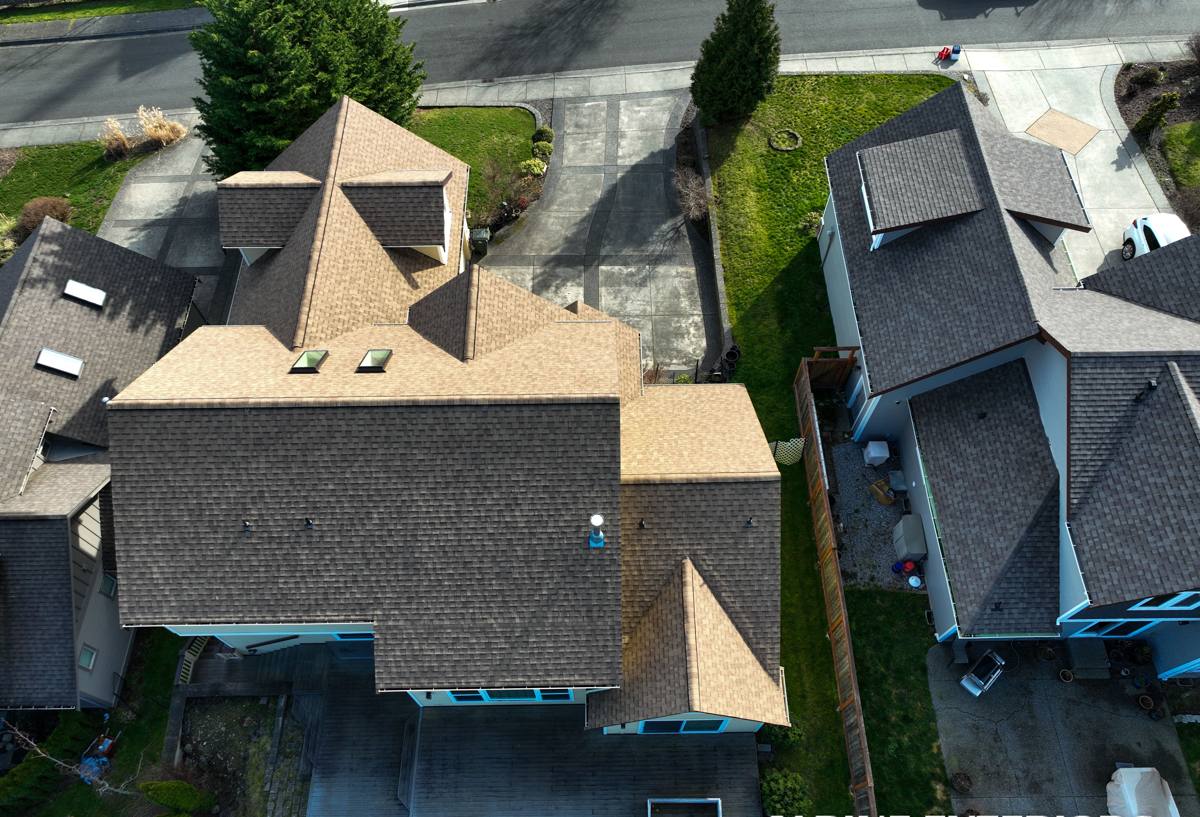
Why Shade, Moisture, and Moss Matter More Here Than Elsewhere
Tree Cover Changes the Drying Cycle
A window on a sunny, exposed wall gets wet, then dries out within a few hours. A window under a canopy of fir and cedar — which describes a large share of Sudden Valley lots — stays damp much longer after every rain. That extended damp cycle is exactly what allows moss, algae, and mildew to establish themselves on sills, frame corners, and any exposed wood trim. Over a long moss season, that low-level moisture exposure adds up in a way that a once-a-year power wash doesn't fully solve.
Driving Rain Finds the Weak Points
Whatcom County storms don't just fall straight down — wind-driven rain gets pushed sideways into wall assemblies, which is where flashing and sealant quality separate a window that lasts from one that doesn't. A window that's caulked in place without proper flashing can look fine for a few years and still be feeding water into the wall cavity behind it.
Marine Air Adds a Slow, Steady Wear Factor
Bellingham's proximity to Puget Sound means a fine salt-laden moisture reaches even inland communities like Sudden Valley. It's subtle compared to a beachfront property, but it still accelerates corrosion on hardware, hinges, and any lower-grade metal components over the life of a window.
Signs a Sudden Valley Home Needs Window Replacement
Not every window problem means full replacement — but these are the signals worth taking seriously, especially on a shaded, moisture-heavy lot:
- Fogging or a persistent haze between panes (a sign the seal has failed and the gas fill is gone)
- Soft, spongy, or discolored wood at the sill or lower frame corners
- Visible moss or dark algae staining on frames, sills, or trim that comes back soon after cleaning
- Windows that are difficult to open, close, or lock — often a sign the frame has swelled or warped
- Noticeable drafts or cold spots near the window even with it fully closed
- Condensation forming on the inside of the glass regularly, beyond normal winter humidity
- Original single-pane wood windows still in place on an older home
- A creeping heating bill with no other explanation
If you're seeing two or more of these, it's worth having someone look at the actual condition of the frame and sash — not just the glass — before deciding what to do.
What a Correct Window Replacement Job Actually Involves
Removal and Honest Inspection
The old window comes out and we look at what's behind it before anything goes back in. In a shaded, moisture-prone setting like Sudden Valley, this step matters more than usual — sheathing and framing that look fine from outside can be soft or water-stained underneath. Any rot gets cut out and replaced properly rather than covered over, because a new window installed over damaged framing fails early no matter how good the window itself is.
Flashing and Moisture Barrier Work
Proper flashing directs water that gets past the exterior cladding back out, rather than letting it pool at the sill. This is the single most common point where budget installations cut corners, and it's the one thing you can't see or judge once the trim goes back on. We integrate flashing with the existing weather-resistive barrier so the whole wall assembly sheds water the way it's supposed to.
Sealing and Insulation
The gap between the new window frame and the rough opening gets properly insulated and sealed — not just caulked around the visible edge. Done wrong, this is a common source of both drafts and hidden condensation inside the wall.
Trim, Finish, and Cleanup
Exterior and interior trim gets reinstalled or replaced to match, hardware is adjusted so the window operates smoothly, and the site is cleaned up — old windows, packaging, and debris hauled away, not left for the homeowner to deal with.
Choosing the Right Window Material for This Climate
Frame material matters as much as glass quality when a house sits under tree cover with limited direct sun exposure. Here's how the common options compare for a shaded, damp lot like most in Sudden Valley:
| Frame Material | Moisture/Rot Resistance | Maintenance Needed | Typical Lifespan |
|---|---|---|---|
| Vinyl | Very good — won't rot, resists moss adhesion better than wood | Low — occasional cleaning | 20–30 years |
| Fiberglass | Excellent — dimensionally stable in wet/dry cycles, holds paint well | Low to moderate | 30+ years |
| Wood or Wood-Clad | Good on the exterior clad face, but exposed wood elements need upkeep | Higher — periodic sealing/painting of any exposed wood | 20–30 years with maintenance |
| Aluminum | Fair — prone to condensation and pitting near marine air over time | Moderate | 15–25 years |
We don't push a single material on every home. A house with heavy tree shade and limited sun exposure is a different case than one on a more open, south-facing lot, even within the same neighborhood. Our job is to walk through the actual exposure your windows face and recommend what holds up there — not what's easiest to sell.
Our Process, Start to Finish
- Free on-site assessment — we look at your current windows, framing condition, and how your specific lot's shade and moisture exposure has affected them
- Honest recommendation — which windows make sense for your home, with real trade-offs explained, not just an upsell
- Clear estimate — scope, materials, and timeline in writing before any work starts
- Scheduled installation — most homes are done in one to a few days depending on the number of openings
- Inspection and walkthrough — every window operates correctly and every opening is properly sealed before we consider the job done
- Full cleanup — old windows and debris removed, site left the way we found it
Why Local Experience in Sudden Valley Matters
Sudden Valley isn't like a typical in-town Bellingham neighborhood. Lots are often wooded and set back from the road, driveways can be longer, and many homes were built or expanded in phases over the years — which means window openings aren't always standard sizes. A crew that's worked in the community before knows to expect this, measures carefully rather than assuming, and doesn't get caught off guard by a nonstandard rough opening or an access road that takes a little longer to navigate with a trailer full of materials.
If your property is part of an association with architectural guidelines on exterior appearance, color, or materials, we work within those requirements rather than treating them as an afterthought — it's easier to get it right the first time than to redo trim after the fact.
There's also a simple continuity benefit: a contractor who's already replaced windows on several Sudden Valley homes has a working sense of which parts of a house tend to show rot first, how the tree canopy on a given side of the lake affects drying time, and what actually holds up here versus what looks good on paper. That's knowledge you can't get from a national installer passing through once.
Energy Performance and Moisture Control
New windows are usually sold on energy savings, and that's real — but in a shaded, humid setting like Sudden Valley, moisture control matters just as much as the U-factor on the spec sheet. A well-sealed, properly flashed window keeps bulk water out of the wall assembly, which protects your framing and insulation over the long run, not just your heating bill. Low-E glass coatings also help reduce interior condensation on cold mornings, which is a common complaint in homes with a lot of shade and limited direct winter sun to help dry window surfaces out.
We size and spec windows based on the actual exposure of each wall — a shaded north-facing window and a more open south-facing one on the same house can reasonably call for different glass packages.
Keeping New Windows Performing Long-Term
A correctly installed window in this climate still benefits from a small amount of upkeep:
- Rinse frames and sills periodically to prevent moss or algae from establishing, especially on shaded elevations
- Check and clean weep holes on vinyl and fiberglass frames so water can drain as designed
- Keep nearby vegetation trimmed back to let a little more air and light reach the window surface
- Repaint or reseal any exposed wood trim on the schedule the manufacturer recommends
None of this is heavy maintenance — it's the difference between a window that looks and performs well for its full expected lifespan and one that needs early attention because moisture was left to sit.
If your windows are showing any of the signs above, or you're just planning ahead for a home in Sudden Valley, we're happy to come take a look. The estimate is free, there's no pressure to commit on the spot, and you'll get a straight answer about what your windows actually need — use the form below to get started.