 Bellingham Siding
 Why Birchwood Homes Need Siding Built for This Climate
Birchwood sits inside one of the wettest, dampest corners of Washington State, and the houses here show it. Whatcom County gets a long, gray rainy season that doesn't let up for months, and homes close enough to Bellingham Bay also deal with a steady dose of salt-laden air moving in off the water. Add in the shade from mature trees that many Birchwood lots have, and you get the third ingredient: moss and algae that thrive in cool, damp, low-sun conditions for a good chunk of the year.
None of that is unusual for this part of the Pacific Northwest. But it does mean siding here has a harder job than siding in a drier climate. It has to shed driving rain without letting moisture behind the surface, resist the slow corrosive effect of salt air on fasteners and finishes, and stand up to moss and mildew without rotting, swelling, or losing its paint. Whatever goes on a Birchwood house needs to be chosen and installed with that reality in mind, not just picked because it's the cheapest option on the shelf.
What Goes Wrong When Siding Isn't Right for This Weather
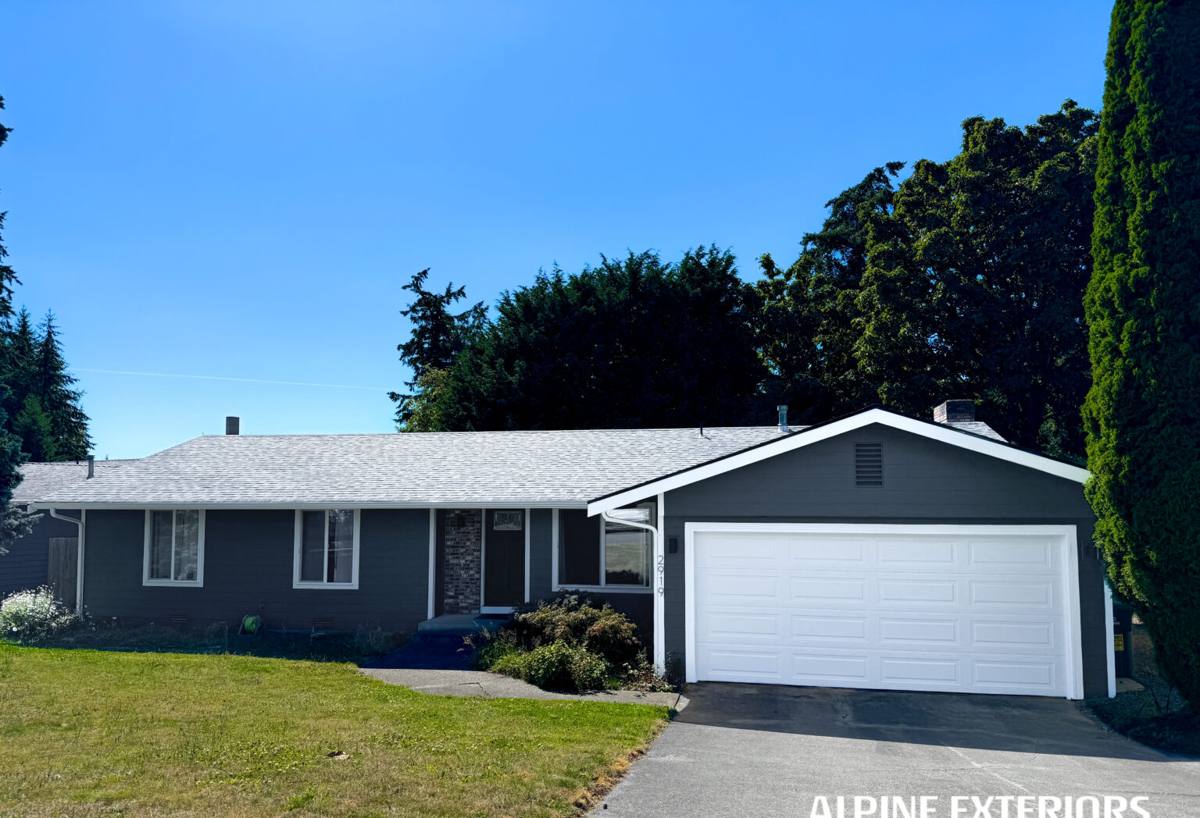
We get called out to a lot of homes where the siding itself, or the way it was installed, simply wasn't matched to Whatcom County conditions. The same handful of problems show up again and again:
- Wood-based siding (cedar, primed spruce, OSB-core products) absorbing moisture at cut edges and butt joints, then swelling, cupping, or rotting from the inside out
- Paint failing early on wood siding because the substrate keeps moving with humidity, pulling the finish apart at the seams
- Moss and algae taking hold on north- and shade-facing walls, holding moisture against the siding long after the rain has stopped
- Caulk and sealant joints breaking down faster than expected under constant damp-dry cycling
- Fasteners and trim hardware corroding faster near the water, especially where the wrong fastener metal was used
Most of these aren't one-time failures — they're the predictable result of a product or a installation detail that wasn't built for this exact climate. That's the standard we install to.
Why We Install James Hardie Fiber Cement — And Only That
We are a fiber cement siding contractor, specifically James Hardie, and we don't install vinyl, LP SmartSide, cedar, primed spruce, or other fiber cement brands like Cemplank or Allura. That's a deliberate standard, not a sales pitch, and it comes down to what actually holds up in a climate like Bellingham's.
Fiber cement is made from cement, sand, and cellulose fibers, which makes it dimensionally stable — it doesn't expand and contract with moisture the way wood-based products do, and it isn't fuel for moss and rot the way wood is. James Hardie backs its boards with a factory-applied ColorPlus finish baked on under controlled conditions, which holds color and resists cracking and peeling far better than field-applied paint on wood siding. Hardie also engineers specific product lines (its HZ5 climate zone formulation) for regions with the exact wet, humid conditions Western Washington deals with. That combination — a stable substrate, a factory finish, and a formulation built for this climate — is why we standardized on it rather than mixing in other brands or materials.
We're not going to tell you vinyl or cedar are junk. Vinyl is inexpensive and low-maintenance in the right setting; cedar has real character and a long tradition in this region. But vinyl can warp and fade under UV and temperature swings, and its seams and expansion joints give water a path in over time. Cedar and primed spruce need real, ongoing maintenance — re-caulking, repainting, spot repairs — to survive a Bellingham winter, and skipping that maintenance is exactly how rot gets started. We'd rather install one product very well than install several products with trade-offs we can't stand behind for this climate.
The Right Fiber Cement System for a Birchwood House
Product Lines That Make Sense Here
James Hardie's lineup gives us options depending on the look a homeowner wants and the exposure a particular wall faces:
- HardiePlank lap siding — the standard horizontal siding look, available in several textures and exposures
- HardieShingle — for homes wanting a shingle-style look without the maintenance burden of real wood shingles
- HardiePanel — vertical panel siding, often used for accent walls, gables, or a more modern look
- HardieTrim — matching trim boards so window and corner details hold up as long as the field siding does
Why HZ5 Formulation Matters Here
Whatcom County falls into James Hardie's HZ5 climate zone, which is engineered specifically for wetter, cooler regions like the Pacific Northwest. It's a formulation detail most homeowners never hear about, but it's the difference between siding that's generically weather-resistant and siding actually built for the number of wet days Bellingham sees in a typical year. We spec HZ5 product for Birchwood jobs as a matter of course, not as an upsell.
What a Correct Installation Actually Involves
Fiber cement siding is only as good as the installation behind it. A lot of the failures we get called to fix aren't material failures — they're installation shortcuts that let water get where it shouldn't. On every Birchwood job, that means:
- Correct water-resistive barrier and flashing at every window, door, and penetration before a single board goes up
- Proper rainscreen or drainage gap where the wall assembly calls for it, so moisture that does get behind the cladding can drain and dry
- Manufacturer-specified fastener placement, type, and spacing — not shortcuts that void the warranty or leave boards loose
- Correct minimum clearance from grade, decks, and roof lines so splashback and standing water don't sit against the bottom edge of the siding
- Factory-cut and factory-primed edges kept intact wherever possible, with field cuts properly sealed
- Caulking only where Hardie's install guide actually calls for it — over-caulking traps moisture just as badly as under-caulking lets it in
Skip any one of these and you can end up with a house wearing a premium siding product that still fails early. We follow Hardie's published installation instructions to the letter because that's also what keeps the manufacturer's warranty intact.
Fiber Cement vs. Other Siding Options in This Climate
| Factor | James Hardie Fiber Cement | Vinyl | Cedar / Primed Wood |
|---|---|---|---|
| Moisture stability | Dimensionally stable, resists swelling/rot | Doesn't rot, but seams can let water track behind panels | Absorbs moisture at cuts and joints, prone to swelling and rot |
| Moss/algae resistance | Non-organic substrate, factory finish sheds growth better | Can host mildew and algae in shaded, damp areas | Organic material, most susceptible to moss and rot |
| Finish durability | Factory-baked ColorPlus finish, long fade resistance | Color molded in but can fade and chalk over time | Field-applied paint, needs repainting on a maintenance cycle |
| Fire resistance | Non-combustible | Combustible, can melt/deform near heat sources | Combustible |
| Ongoing maintenance | Occasional wash, minimal upkeep | Low, but panel replacement can be tricky to color-match | Regular painting, caulking, and spot repair |
This isn't a claim that vinyl or cedar are bad products in every setting — it's why, given the specific combination of rain, salt air, and moss exposure in Whatcom County, we standardized on one system we can install correctly and stand behind.
Our Process, From Estimate to Finished Siding
A siding job on a Birchwood home usually follows the same sequence:
- On-site walk-through — we look at the existing siding, trim, flashing, and any moisture or moss issues wall by wall, not just from the curb
- Written estimate — product line, texture, color, and a clear scope of what's included, with no vague allowances
- Prep and tear-off — removing old siding, checking sheathing underneath for hidden rot or damage before anything new goes up
- Weather barrier and flashing — the part of the job that determines whether the house stays dry for the next 30+ years
- Installation — Hardie boards, trim, and accessories installed to manufacturer spec
- Final walk-through — checking joints, caulking, paint touch-ups on cut edges, and cleanup
We don't skip the sheathing check. In a climate this wet, hidden rot behind old siding is common enough that finding and fixing it before closing the wall back up matters more than almost anything else on the job.
Why a Crew That Already Works Birchwood Makes a Difference
Siding work isn't identical from region to region, and it isn't even identical from neighborhood to neighborhood within Bellingham. A crew that already works in and around Birchwood knows what the tree cover and shade patterns typically do to north walls, how close to the water a given block sits, and what kind of rot and moss patterns tend to show up on homes of a certain age here. That local pattern recognition speeds up diagnosis on a repair or replacement and helps set realistic expectations about maintenance going forward — instead of a generic answer, you get one shaped by houses we've actually worked on nearby.
It also means faster response if something needs a look after the job is done — no crew driving in from out of the area, no scheduling gap while someone gets oriented to local permitting or weather windows.
Before You Hire, Check For
- A written scope that names the exact Hardie product line, not just "fiber cement siding"
- Confirmation the crew follows Hardie's published fastener and flashing specs, not their own shortcuts
- Manufacturer certification or documented experience specifically with Hardie products
- A clear plan for water-resistive barrier and flashing detail, described before the tear-off starts
- Local references or completed work you can actually see in this area
If your Birchwood home's siding is showing moss, peeling paint, soft spots, or is simply due for replacement, we're happy to take a look and walk you through what a correct James Hardie fiber cement job would involve for your house — no pressure, no obligation. Use the form below to request a free estimate.