 Bellingham Siding
 Metal Roofing Built for Birchwood's Weather, Not Just the Catalog Photo
Birchwood sits inland enough from the water to feel a little sheltered, but not so far that Bellingham Bay's salt air and the region's near-constant winter drizzle stop mattering. Homes in this part of Whatcom County deal with a specific combination of stressors: moisture that lingers on roof surfaces for days at a time, wind-driven rain that finds every weak seam, and a moss season that can run from late fall through spring. A metal roof installed correctly can handle all of that for decades. A metal roof installed by a crew that treats it like any other job in any other climate will show problems within a few winters — streaking, fastener backout, moss colonization at the seams, and slow leaks that don't show up until the damage is already inside the attic.
This page is about metal roofing specifically for Birchwood homes, not a generic overview of the product. If you're comparing metal to asphalt shingles for a Bellingham home, or want the broader case for metal roofing in general, that's a separate conversation — here we're focused on what actually matters for a roof going on a Birchwood house this year.
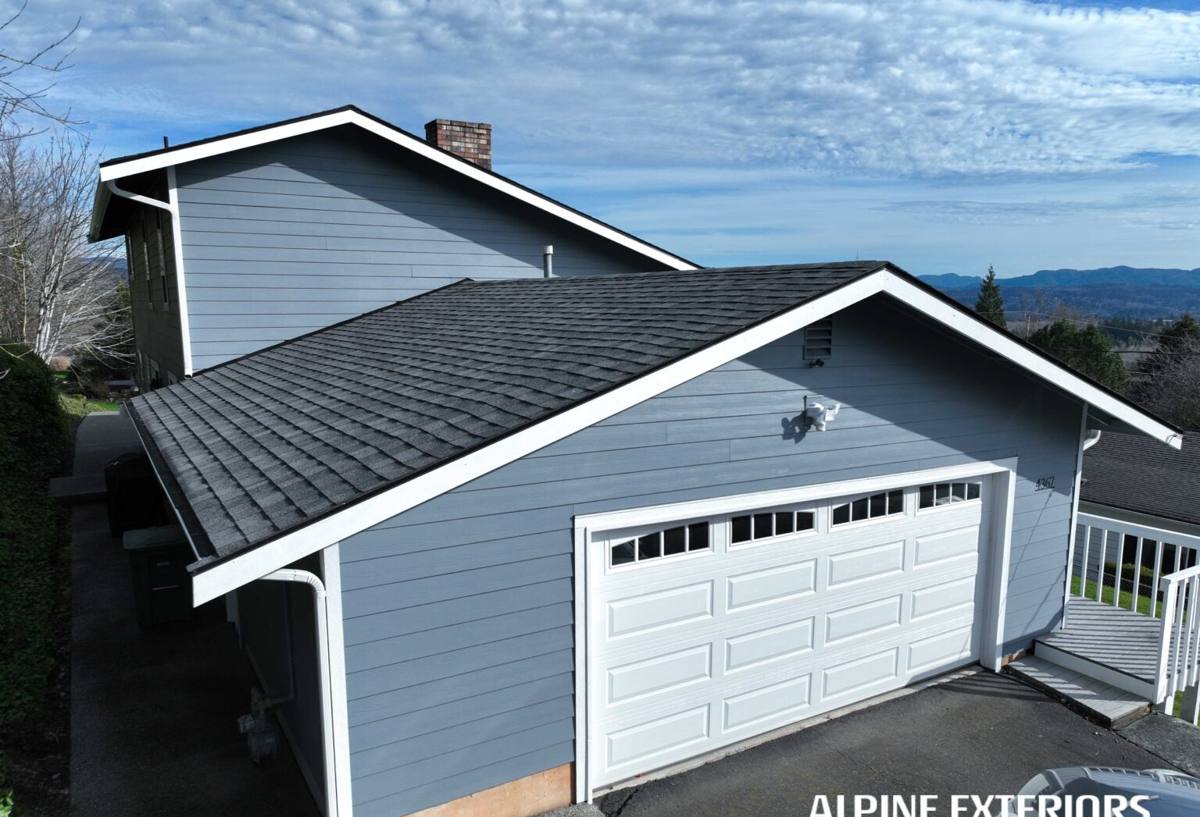
What Bellingham's Climate Actually Does to a Roof
Whatcom County doesn't get the extreme heat or hail that drives roofing decisions in other parts of the country. Instead, the wear here is slow, steady, and moisture-driven:
- Salt air: Proximity to Bellingham Bay means airborne salt reaches inland neighborhoods more than people expect, accelerating corrosion on the wrong metals and fasteners.
- Driving rain: Storms here often come with real wind behind them, pushing water sideways under poorly lapped panels or undersized flashing instead of letting it run straight down.
- Extended moss season: Shade, moisture, and mild temperatures create ideal conditions for moss and algae to establish on roof surfaces for much of the year, not just a few weeks.
- Freeze-thaw cycling: It's not the deep freezes of other regions, but Whatcom County does see enough freeze-thaw swings each winter to work at any gap, crack, or loose fastener already present.
None of these individually is dramatic. Together, over ten or twenty years, they punish roofs that were installed with shortcuts — and they're exactly why the installation details below matter more here than they would in a drier climate.
What a Correct Metal Roof Installation Actually Involves
Metal roofing has a reputation for lasting 40-plus years, but that number assumes the installation was done right. A metal roof is only as good as what's underneath it and how it's fastened, sealed, and flashed. For a Birchwood home, we pay particular attention to a few things that get skipped on rushed jobs:
Underlayment and Moisture Barrier
A synthetic, high-temperature-rated underlayment goes down first, with extra attention at eaves, valleys, and any low-slope sections where wind-driven rain is most likely to work its way backward under panels. In a region with this much sustained moisture, the underlayment is a real second line of defense, not a formality.
Fastener and Metal Compatibility
Mixing incompatible metals — the wrong fastener against the wrong panel alloy — sets up galvanic corrosion that shows up as rust streaks and weakened attachment points years down the road. Given the salt content in the air this close to the coast, we match fasteners and flashing metal to the panel system rather than treating hardware as interchangeable.
Seams, Laps, and Panel Overlap
How much panels overlap, and how those seams are sealed or mechanically locked, determines whether wind-driven rain stays out or gets pushed uphill under a panel edge. This is one of the most common failure points on metal roofs installed by crews unfamiliar with wetter, windier climates.
Flashing at Every Penetration
Chimneys, vents, skylights, and roof-to-wall transitions are where the vast majority of roof leaks actually start — not the open field of the roof. Properly formed and sealed flashing at each of these points matters as much as the panels themselves.
Ventilation
Metal roofs perform best over a properly ventilated attic or roof deck. Without balanced intake and exhaust ventilation, trapped moisture can condense against the underside of the deck, leading to rot that has nothing to do with the roof surface itself and everything to do with what's happening underneath it.
Choosing a Metal Roofing System for a Birchwood Home
Not every metal roofing product is the right fit for every house, budget, or roof pitch. The two main categories homeowners in this area choose between are standing seam panels and exposed-fastener (screw-down) panels.
| Factor | Standing Seam | Exposed Fastener |
|---|---|---|
| Fastener exposure | Concealed clips, no surface penetrations | Screws penetrate the panel face |
| Long-term maintenance | Minimal — no gaskets to inspect | Rubber washers under screws age and need periodic checks |
| Upfront cost | Higher | Lower |
| Best fit | Primary residences, longer ownership horizon | Outbuildings, shops, budget-driven projects |
| Performance in driving rain | Excellent — interlocking seams shed wind-driven water well | Good, but relies on washer condition over time |
For a primary home in a wet, salt-air-influenced neighborhood like Birchwood, standing seam is generally the stronger long-term choice because it has no exposed fasteners for salt air and freeze-thaw cycling to work against. Exposed-fastener panels are a legitimate, more affordable option, but they come with a maintenance commitment: those washer-sealed screws age faster in this climate than in a dry inland one, and they need to be checked periodically.
Moss, Debris, and What Homeowners Can Do Between Services
Even a well-installed metal roof isn't maintenance-free in Whatcom County — it's low-maintenance, which is a different thing. The biggest ongoing issue for homes in tree-covered neighborhoods like Birchwood is organic debris and moss buildup, particularly on north-facing slopes and any section shaded by mature trees.
Metal sheds moss more easily than asphalt shingles because there's no granulated surface for spores to grip, but debris still collects in valleys, at panel laps, and around penetrations if gutters and roof edges aren't kept clear. Left long enough, trapped organic matter holds moisture against the metal and can undermine even a correctly installed roof over time.
What we recommend homeowners do between professional checkups
- Keep overhanging branches trimmed back so shaded sections dry out between rain events
- Clear gutters and valleys of needles and leaves at least twice a year
- Watch for streaking or dark patches that indicate moss or algae getting established
- Never pressure-wash a metal roof — it can strip protective coatings and drive water under laps
- Have penetrations (vents, flashing) visually checked after any major windstorm
Our Process for a Birchwood Metal Roofing Project
Every property is different, but the sequence we follow stays consistent because it's built around avoiding the failure points described above:
- On-site assessment: We look at roof pitch, existing decking condition, ventilation, and any problem areas specific to your property — shade patterns, valleys, penetrations.
- System selection: Based on that assessment and your budget, we walk through standing seam versus exposed-fastener options honestly, including the maintenance trade-offs of each.
- Deck prep and underlayment: Any damaged or rotted decking gets addressed before anything else goes down. Underlayment is installed with extra care at eaves, valleys, and low-slope transitions.
- Panel installation: Panels and fasteners are installed to manufacturer spec, with compatible metals throughout to avoid galvanic corrosion down the road.
- Flashing and detail work: Every penetration and transition point is flashed and sealed individually — this is where most of the skill in a metal roof installation actually shows up.
- Final walkthrough: We go over the completed roof with you, including what routine maintenance looks like and what to watch for given your specific property's tree cover and exposure.
Warning Signs an Existing Metal Roof Needs Attention
If you're not starting from scratch but wondering whether an existing metal roof on a Birchwood home needs service or replacement, a few signs are worth taking seriously:
- Rust streaking at fastener heads or panel edges, especially on the side of the house facing prevailing weather
- Visible gaps or lifted panel edges after a windstorm
- Moss or algae established directly on the metal surface rather than just in adjacent gutters
- Water stains on interior ceilings near roof penetrations or valleys
- Soft spots or sagging when viewed from an attic, which points to deck moisture rather than the metal itself
Some of these are minor fixes — a re-sealed penetration or a handful of replaced fasteners. Others point to a deck or ventilation problem that a surface repair won't solve. It's worth having a roof looked at before assuming the worst or waiting until a leak shows up indoors.
What Affects the Cost of a Metal Roofing Project
Every property is quoted individually, but the main variables that move the price on a Birchwood metal roofing job are consistent enough to lay out honestly:
| Cost Factor | Why It Matters |
|---|---|
| Panel system chosen | Standing seam runs higher than exposed-fastener due to material and labor |
| Roof complexity | Valleys, dormers, and multiple penetrations add flashing and labor time |
| Existing deck condition | Rot or damage found during tear-off adds repair scope before panels go on |
| Roof pitch and access | Steeper or harder-to-access roofs take longer and require more safety setup |
| Ventilation upgrades | Adding or correcting intake/exhaust ventilation is sometimes needed alongside the roof |
We won't quote a firm number without seeing the roof — anyone who does, without walking the property, is guessing. What we can say is that the cost difference between doing it right and doing it cheaply is almost always smaller than the cost of fixing a poorly installed metal roof five or ten years in, once trapped moisture or corrosion has already done damage.
Why Hiring a Crew That Already Works Birchwood Matters
Metal roofing is a specialized trade — the techniques that work on asphalt shingles don't transfer directly, and mistakes are less forgiving because a poorly formed seam or mismatched fastener can take years to show its consequences. Beyond the general skill of metal roofing, there's real value in working with a crew that already understands this specific part of Bellingham: how shade and tree cover on a given lot affect moss growth, how exposed a property is to wind off the bay, and what the freeze-thaw pattern actually looks like on the ground here versus in a drier or colder region.
A crew that's worked other roofs in Whatcom County isn't guessing at underlayment specs or flashing details from a national average — they've seen what holds up in this exact climate and what doesn't, and they build accordingly.
Get an Honest Look at Your Roof
If you're weighing a new metal roof for a Birchwood home, or want a straight assessment of one that's already up there, we're happy to take a look. We'll walk the roof, explain what we see in plain terms, and put together a free, no-pressure estimate — use the form below to get started.