 Bellingham Siding
 Siding Built for Blaine's Waterfront Climate
Blaine sits right on the water at the northern edge of Whatcom County, and that location shapes everything about how siding performs there. Homes close to Boundary Bay and Drayton Harbor take on a different kind of weathering than houses ten miles inland — salt-laden air, near-constant marine humidity, and wind-driven rain that hits siding at an angle instead of falling straight down. Add in the shaded, damp conditions that let moss and algae take hold on north- and west-facing walls for much of the year, and you have a climate that is genuinely harder on exterior materials than most manufacturers' marketing accounts for. This page covers what that means for a siding job in Blaine specifically, what correct installation looks like in this environment, and why we install James Hardie fiber cement exclusively rather than offering a menu of cheaper alternatives.
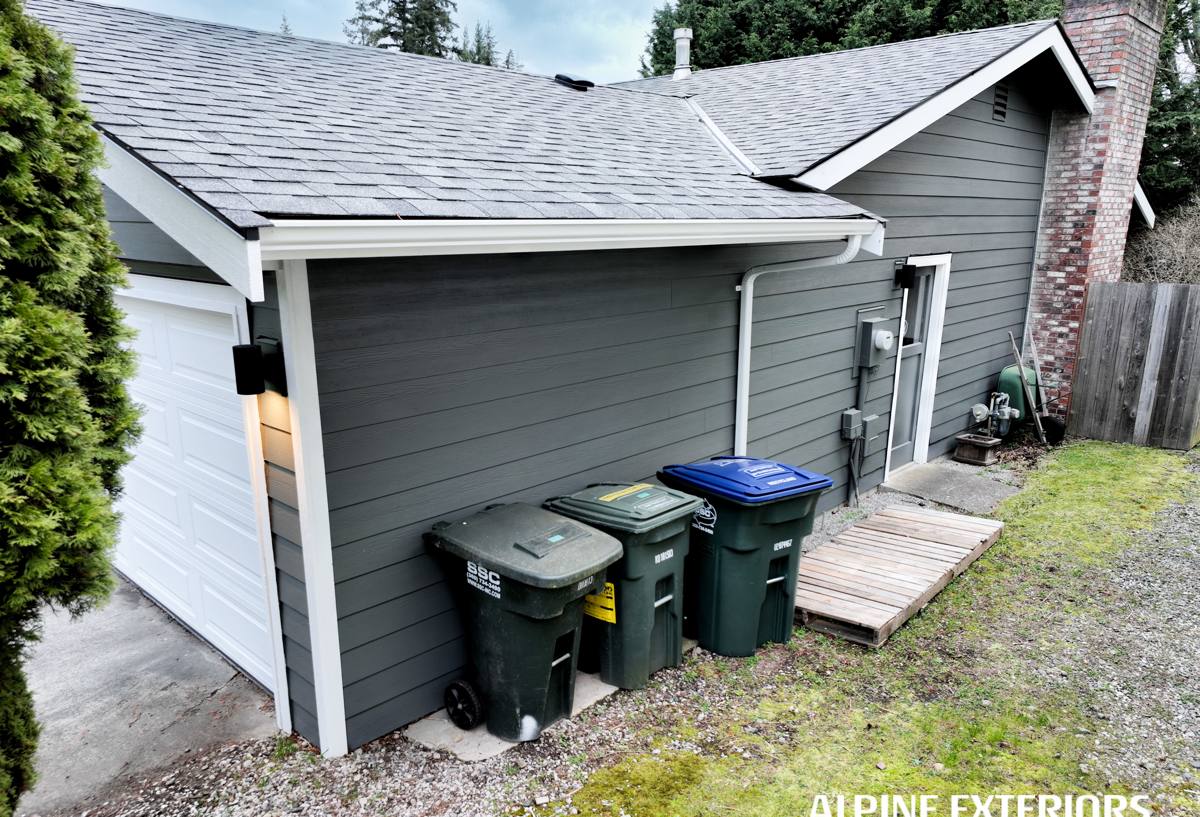
What Blaine's Climate Actually Does to Siding
Salt Air and Corrosion
Airborne salt from Boundary Bay doesn't just affect boats and hardware — it settles on exterior surfaces and accelerates the breakdown of paint films, caulking, and fasteners. Over years, salt exposure causes coatings to chalk and fade faster than the same product would inland, and it corrodes unprotected metal trim, nail heads, and flashing. Siding materials and fasteners that aren't rated for coastal exposure show this wear early, often within the first five to seven years.
Driving Rain
Blaine's exposure to wind off the Strait of Georgia means rain frequently arrives sideways rather than straight down. That matters enormously for siding because it drives water into seams, laps, and penetrations that would stay dry in a calmer climate. A siding system's water-shedding design — how the laps overlap, how the panels are flashed at windows and trim, how the field is sealed — has to be built for lateral water intrusion, not just gravity drainage.
Moss and Algae Season
Shaded walls, tree cover, and the region's long stretch of damp, mild weather create ideal conditions for moss and algae growth on siding, particularly on north-facing elevations and anywhere overhangs are shallow. Moss doesn't just look bad — it holds moisture against the siding surface, and on materials that aren't dimensionally stable, that sustained dampness accelerates rot, delamination, or paint failure underneath the growth.
Why We Install James Hardie Fiber Cement — Not the Alternatives
We install James Hardie exclusively. We don't offer vinyl, LP SmartSide, Cemplank, Allura, primed spruce, or cedar as options, and in a climate like Blaine's, that's not a marketing position — it's a practical one based on how each material actually behaves near salt water.
Vinyl siding is inexpensive and low-maintenance in mild inland climates, but it's a thin plastic product that expands and contracts significantly with temperature swings, and its seams and J-channels are more vulnerable to wind-driven rain intrusion than a properly lapped fiber cement system. Wood-based products — cedar, primed spruce, and engineered wood siding like LP SmartSide — depend on an intact factory or field-applied coating to keep moisture out. In a marine environment where salt air degrades coatings faster and moss holds dampness against the surface longer, any breach in that coating (a scratch, a poorly sealed cut edge, a nail pop) becomes an entry point for rot. These products can perform well with diligent maintenance, but that maintenance burden is real and it's higher on the water than it is twenty miles inland.
James Hardie fiber cement is cement, sand, and cellulose fiber — it doesn't rot, it isn't attractive to insects, and it's non-combustible, which matters given the region's increasing wildfire smoke seasons even this close to the Canadian border. Its ColorPlus factory finish is baked on under controlled conditions and holds up to UV and salt exposure noticeably better than field-applied paint, and it's backed by a real transferable warranty on both the substrate and the finish. It costs more up front than vinyl and is installed differently than wood siding, but for a coastal Whatcom County home, it's the product that matches the actual conditions it has to survive.
The HZ5 Product Line and Why It's the Right Call Here
James Hardie engineers its siding in region-specific formulations called HZ (HardieZone) products, and the Pacific Northwest — including all of Whatcom County — falls into the HZ5 zone, engineered specifically for wet, humid climates with significant moisture exposure. HZ5 products are formulated with moisture and freeze-thaw performance as the priority, which is exactly the profile Blaine's marine location demands. Using the correct HZ formulation isn't a minor spec detail; it's the difference between a siding system engineered for this exact climate and one that's simply been shipped here from a warmer, drier region's inventory.
Material Behavior in a Marine Climate: A Side-by-Side Look
| Material | Moisture Behavior | Salt Air Exposure | Maintenance Burden Near Water |
|---|---|---|---|
| James Hardie (HZ5 fiber cement) | Does not rot; dimensionally stable when wet | ColorPlus finish resists chalking and fading | Low — periodic cleaning, no repainting cycle |
| Vinyl | Sheds water but seams/J-channel are entry points under wind-driven rain | Can become brittle and discolor faster in coastal UV/salt exposure | Low, but early replacement common on exposed walls |
| Cedar | Absorbs moisture; needs intact coating to resist rot | Coatings degrade faster in salt air, exposing wood | High — recoating, caulking, and spot repair on a cycle |
| Primed spruce / engineered wood | Vulnerable at cut edges and fastener penetrations | Coating breakdown accelerates moisture entry | Moderate to high — coating and edge maintenance |
What a Correct Siding Job Looks Like on a Blaine Home
Fiber cement performs the way it's supposed to only when the underlying assembly is right. A lot of siding failures we get called out to inspect aren't material failures at all — they're installation shortcuts. On a coastal, high-wind-driven-rain site like Blaine, these details matter more than they would on a sheltered inland lot.
- Weather-resistive barrier installed and lapped correctly, with all penetrations sealed before siding goes on
- Proper rainscreen or drainage gap where conditions call for it, so any water that gets behind the siding can drain and dry
- Correct fastener type, spacing, and penetration depth — under- or over-driven nails are one of the most common causes of early failure
- Flashing at every window, door, and horizontal trim transition, not just caulk standing in for flashing
- Manufacturer-specified lap and clearance at the foundation, roofline, and any abutting surfaces
- Factory-cut and factory-primed edges used wherever possible; any field cuts sealed per Hardie's specifications
- Corrosion-resistant fasteners and trim hardware appropriate for coastal exposure
Skipping any one of these doesn't show up as a problem in year one. It shows up in year five or six, usually as a stain, a soft spot, or moss holding water against a wall that should have been draining it.
Our Process, Start to Finish
We start with an on-site inspection of the existing siding and the wall assembly underneath it, because what's behind the siding matters as much as what's going back on. From there we walk through the HZ5 product options, ColorPlus color selection, and trim details, and we give you a written estimate that spells out the scope — not just a per-square-foot number. During the job, that means proper tear-off and inspection of sheathing and weather barrier, correcting any rot or moisture damage we find before closing the wall back up, installing the drainage plane and flashing details correctly, and hanging and fastening the Hardie panels or lap siding to spec. We finish with trim, caulking at the points Hardie's install guide actually calls for (not everywhere, which traps moisture), and a final walkthrough so you know exactly what was done and why.
Cost Factors for a Blaine Siding Project
| Factor | Why It Affects Cost |
|---|---|
| Existing siding removal | Tear-off and disposal of old material adds labor before new siding can start |
| Sheathing or framing repair | Rot or moisture damage found during tear-off has to be corrected first — this is common on older waterfront homes |
| Wall complexity | Dormers, multiple gables, and cut-in trim take more time than a simple rectangular elevation |
| Product selection | Lap siding, panel siding, and shingle-style Hardie products differ in material and labor cost |
| Trim and accessory scope | Fascia, soffit, and corner trim replaced at the same time changes the total scope |
| Access and site conditions | Steep lots, limited staging area, or height affect scaffolding and labor time |
We don't give ballpark numbers without seeing the house — too many of these factors are specific to your walls, your access, and what condition the sheathing is in underneath the old siding. What we can tell you up front is that a correct install, done once, is nearly always cheaper over the life of the siding than a lower-cost job that needs early repair or replacement.
Why Hiring a Crew That Already Works Blaine Matters
Blaine isn't a large market, and it has its own permitting contacts, weather patterns, and building stock — older waterfront cottages, newer construction near the marina, and everything in between. A crew that already works this stretch of Whatcom County knows what to expect when tear-off starts on a forty-year-old wall near the water, knows which elevations in this area take the worst of the wind-driven rain, and isn't learning the local permitting process on your project. We work Bellingham and the surrounding Whatcom County communities, including Blaine, and we bring that local knowledge to every estimate rather than treating it as a one-off trip.
If you're weighing a siding replacement or repair on a Blaine home, we're happy to come take a look and give you a straightforward, no-pressure estimate — use the form below to get started.