 Bellingham Siding
 Why Ferndale Decks Face a Tougher Environment
Ferndale sits close enough to Bellingham Bay and the Strait of Georgia that salt-laden air is a real factor in how outdoor materials age here, and the Nooksack River corridor keeps humidity high through much of the year. Add Whatcom County's long stretch of gray, wet months and you get an environment that is genuinely harder on a deck than most manufacturers' warranty language assumes. A deck built here needs to handle standing moisture, organic growth, and metal fatigue from salt air all at once, not just one of those things occasionally.
That combination is why we treat composite decking in Ferndale as a different project than composite decking somewhere dry and inland. The board itself matters, but so does the substructure underneath it, the flashing behind it, and the fastening system holding it together. Get any one of those wrong and the deck will show it within a few wet seasons, regardless of how good the decking material is.
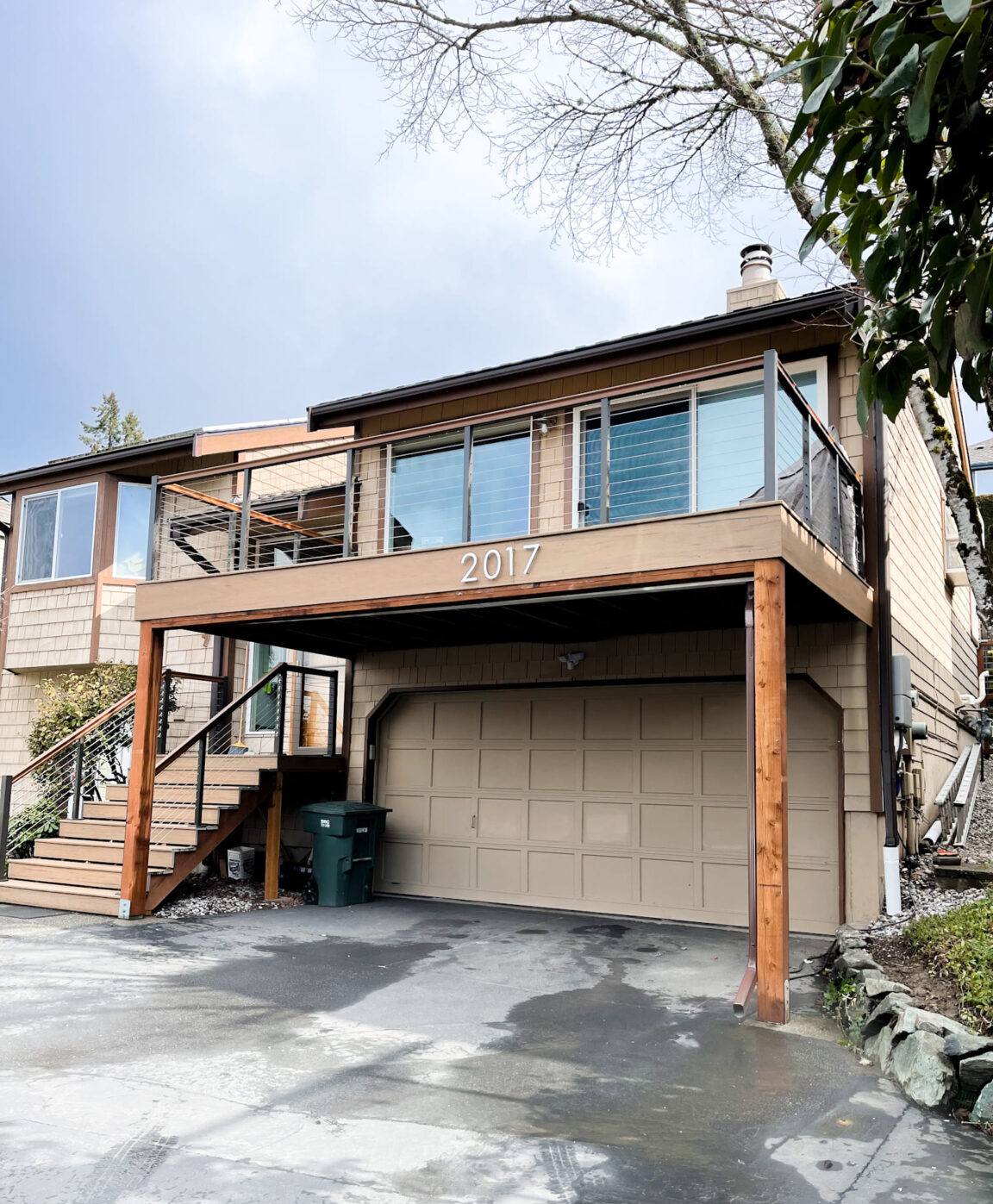
What Salt Air, Rain, and Moss Do to a Deck Over Time
Salt Air and Fasteners
Airborne salt accelerates corrosion on exposed metal — screws, joist hangers, structural brackets — faster than most homeowners expect, especially on decks with any western or bay-facing exposure. Standard zinc-coated hardware can start showing rust streaks and pitting well before the decking itself is due for attention. This is a structural concern, not a cosmetic one, since corroded hangers and fasteners are what actually hold the deck together.
Driving Rain and Moisture Intrusion
Rain in this part of Whatcom County doesn't just fall straight down — wind off the Sound pushes it sideways into ledger boards, stair stringers, and any gap where water can collect instead of shed. Over time, that driving rain finds its way into end grain, fastener holes, and the joint where a deck attaches to the house. Composite boards resist water absorption far better than wood, but the framing and connections underneath still need to be built to shed water, not just tolerate it.
The Long Moss Season
Whatcom County's wet season runs long, and shaded or low-sun sections of a deck can stay damp for weeks at a stretch. That's ideal growing conditions for moss and algae, which take hold on horizontal surfaces that don't dry out between rains. Once established, moss holds moisture against the board surface and turns a deck slick and slippery — a real safety issue on stairs and landings, not just an appearance problem.
Why Composite Decking Holds Up Better Here
Composite decking doesn't rot, split, or absorb water the way wood does, which directly addresses the biggest failure points we see on older Ferndale decks. A properly capped composite board has a protective shell on its exposed surfaces that resists moisture penetration, so it isn't feeding the kind of slow water absorption that lets algae and mold take hold in the wood grain itself. That doesn't mean composite decking is maintenance-free in this climate — nothing outdoors here is — but it removes staining, sealing, and re-sanding from the yearly task list, which matters when the rainy season only gives you a narrow window to do that kind of work anyway.
Composite also holds its color and structural integrity more consistently through repeated wet-dry cycles than wood does. Wood decking in a marine climate tends to gray, cup, and splinter unevenly depending on sun exposure; composite ages far more uniformly across the whole deck surface, which keeps it looking intentional rather than patchy for years longer.
What a Correct Composite Installation Involves
Substructure and Joist Spacing
Composite decking is heavier and behaves differently under load than wood, and most manufacturers require tighter joist spacing than a traditional wood deck — commonly 12 inches on center for angled or picture-frame layouts, versus the 16 inches typical for wood. Skipping this step is one of the most common corner-cutting mistakes we see: the deck looks fine on day one but develops bounce and board deflection within a couple of years.
Flashing and Ledger Attachment
Where the deck attaches to the house is the single most important moisture detail on the entire project. In a climate with this much driving rain, the ledger board needs proper flashing — ideally a self-adhering waterproof membrane behind it — to keep water from tracking behind the band board and into the rim joist. This is invisible once the deck is finished, which is exactly why it's the detail that gets skipped on rushed jobs and shows up as hidden rot five years later.
Fastening and Board Layout
Hidden fastener clip systems give a clean, screw-free surface and allow boards room to expand and contract with temperature and moisture changes, which matters through this region's freeze-thaw and wet-dry swings. Boards need consistent gapping, especially at butt joints and picture-frame borders, so water has somewhere to go instead of pooling against a tight seam.
Composite vs. Wood vs. PVC for a Marine Climate
Every decking material involves trade-offs. Here's how the three most common options actually compare for a home dealing with salt air, driving rain, and a long moss season:
| Factor | Wood | Composite | PVC / Cellular |
|---|---|---|---|
| Moisture resistance | Absorbs water; prone to rot and cupping | Resists absorption when properly capped | Fully water-resistant, no organic content |
| Annual maintenance | Staining or sealing most years | Periodic washing, no staining | Occasional washing, no staining |
| Moss and algae resistance | Low — porous surface holds moisture | Good — capped surface sheds growth more easily | Good to very good |
| Upfront material cost | Lowest | Mid-range | Highest |
| Expected lifespan | 10–15 years in this climate with upkeep | 25–30 years typical | 25–30+ years typical |
| Feel underfoot / appearance | Natural wood grain, warms over time | Wood-look, consistent color | Smoother, more uniform look |
We install composite for most Ferndale projects because it strikes the best balance of upfront cost, appearance, and long-term performance in this climate. PVC is a legitimate option too and we'll walk through it honestly if low weight or maximum moisture resistance is the priority — it's simply a different price point for a similar durability outcome.
Choosing the Right Composite Board for a Ferndale Home
Capping and Color
Not all composite boards are capped the same way — some are capped on all four sides, others only on the top and sides, leaving the underside more exposed. For a climate with this much sustained moisture, full capping is worth the difference, especially on lower decks with less airflow underneath. Color matters too: darker boards show heat and UV wear differently than lighter ones, and lighter, variegated colors tend to hide pollen, organic debris, and early moss growth better than solid dark tones.
Grooved Boards and Fastener Systems
Grooved-edge composite boards are built to pair with hidden fastener clips, which is what gives a finished deck its clean, screw-free surface. We match the fastener system to the specific board manufacturer's specification rather than using generic hardware, since mismatched systems are a common cause of squeaking, movement, or clip failure over time.
What Drives the Cost of a Ferndale Composite Deck Project
There's no honest single price for composite decking — the same square footage can vary significantly depending on what's actually involved. These are the factors that move the number most:
| Cost Factor | Why It Matters |
|---|---|
| Deck size and shape | Picture-framing, angles, and curves add labor beyond straight-line square footage |
| Existing substructure condition | Reusable framing lowers cost; rot or undersized joists require rebuilding first |
| Height and stairs | Elevated decks and stair runs add railing, structural, and code requirements |
| Railing style | Composite or metal railing systems cost more than basic wood or cable options |
| Demolition and haul-away | Removing an old wood deck adds labor and disposal cost before the new build starts |
| Permitting | Whatcom County and City of Ferndale permit requirements depend on deck height and attachment |
We break these out clearly in every estimate so you know what you're actually paying for, rather than a single lump number that hides where the cost is coming from.
Our Installation Process
- On-site assessment: We inspect the existing structure (if there is one), the ledger connection to the house, drainage under the deck footprint, and sun/shade exposure that affects moss risk.
- Design and material selection: We help you choose board capping, color, and railing style based on your home's exposure and how the space will actually be used.
- Permitting: We handle the permit application with the applicable local jurisdiction before any framing work begins.
- Substructure and framing: New or reinforced framing is built to the spacing the board manufacturer requires, with proper ledger flashing and corrosion-resistant hardware throughout.
- Decking installation: Boards are laid with correct gapping and hidden fastening, with attention to drainage at every seam.
- Final walkthrough: We go over care and cleaning specific to your board choice before we consider the job done.
Keeping a Composite Deck Clean Through Moss Season
Composite decking resists moss far better than wood, but "resists" isn't "immune" — a deck under trees or on the shaded side of a Ferndale home will still need periodic attention through the wet months. A simple seasonal routine keeps it looking right and, more importantly, keeps stairs and landings from getting slick:
- Sweep debris and standing leaves off the surface regularly through fall and winter so moisture doesn't sit trapped underneath organic material
- Wash the deck surface with a soft-bristle brush and a composite-safe cleaner a few times a year, more often in shaded areas
- Avoid pressure washing at close range or high PSI, which can damage the capped surface of most composite boards
- Check gaps between boards periodically and clear out compacted debris so water keeps draining as designed
- Inspect railing posts and stair connections once a year for any looseness, since these take the most direct weather exposure
A deck built correctly from the start — proper flashing, corrosion-resistant hardware, capped boards, and real drainage — needs far less of this than one where those details were skipped. A crew that already works in Ferndale knows which yards, which tree cover, and which exposures need extra attention before the moss even shows up, because we've seen the pattern repeat across the neighborhood. That local familiarity, combined with knowing the permit process at the city and county level, is a large part of why the deck ends up right the first time instead of needing early rework.
If you're weighing options for a deck project in Ferndale, we're glad to come take a look and walk you through what your specific site needs — no pressure, no obligation. Use the form below to request a free estimate.