 Bellingham Siding
 Why Puget's Climate Is Hard on Siding
Homes in the Puget area near Bellingham sit close enough to the water that salt-laden air is a constant factor, not an occasional one. Add Whatcom County's long wet season, driving rain that comes in sideways off Georgia Strait and Bellingham Bay, and a moss and algae season that can stretch for most of the year on shaded or north-facing walls, and you have a climate that punishes siding that isn't built for it. This isn't a place where "good enough" siding survives on luck. It's a place where the material, the installation details, and the ongoing care all have to work together.
Salt air accelerates corrosion on fasteners and trim hardware. Driving rain finds any gap in flashing or caulking and pushes water sideways and upward, not just down. Moss and algae take hold anywhere moisture sits on a surface for more than a day or two, which in this climate can be most of the year. Siding that isn't dimensionally stable, isn't properly sealed at the joints, or traps moisture behind it will show problems in Puget faster than it would in a drier inland climate.
What James Hardie Siding Is Built to Handle
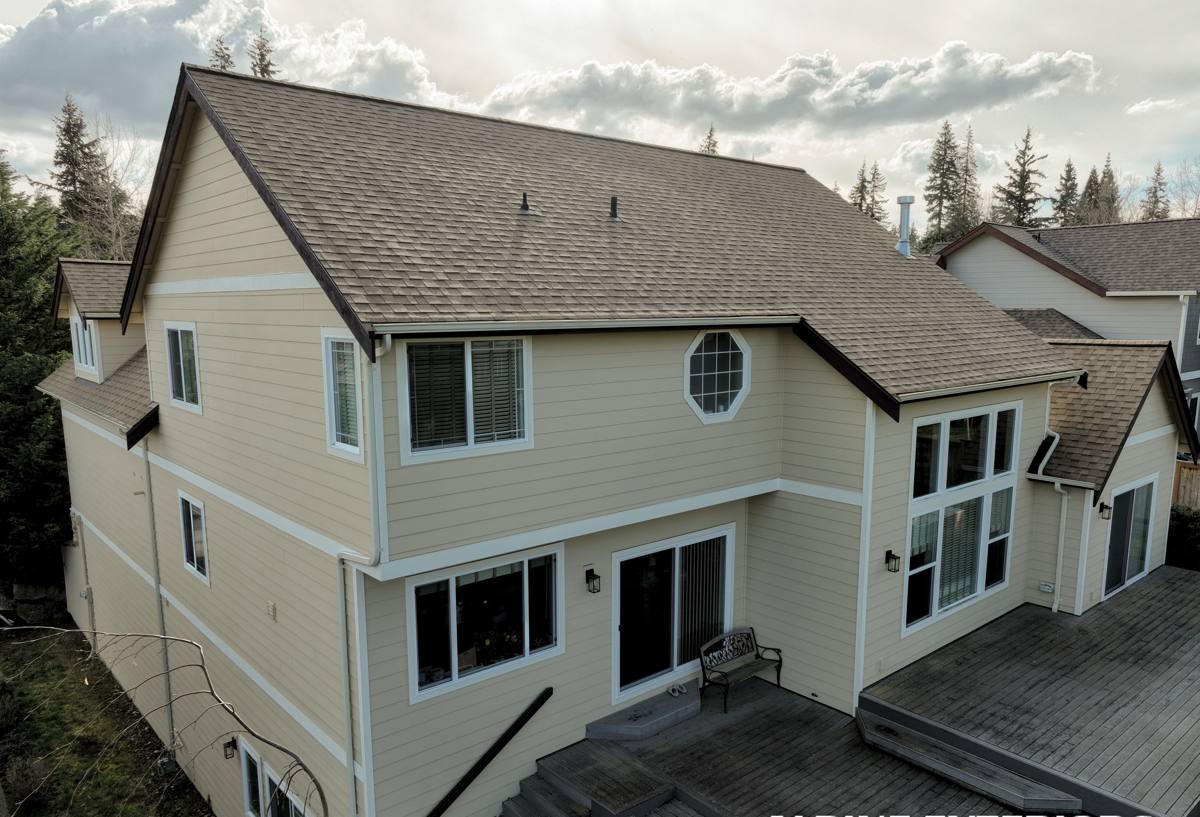
We install James Hardie fiber cement siding exclusively, and a coastal Whatcom County climate is exactly the kind of environment that product line was engineered for. Fiber cement is not affected by moisture absorption the way wood-based products are, it doesn't corrode, and it holds its shape and finish through repeated wet-dry cycles far better than materials that expand, contract, or degrade with sustained exposure to salt air and rain.
HZ5 Engineering for the Pacific Northwest
James Hardie manufactures its siding in climate-specific formulations called HZ (HardieZone) products. The Pacific Northwest, including Whatcom County, falls into the HZ5 zone, engineered specifically for regions with high moisture exposure and freeze-thaw cycling. HZ5 siding is formulated to resist moisture-related damage more effectively than a one-size-fits-all product, which matters a great deal in a neighborhood like Puget where wind-driven rain and sustained dampness are the norm rather than the exception.
ColorPlus Factory Finish
James Hardie's ColorPlus finish is baked on at the factory under controlled conditions, rather than field-applied with a brush or sprayer on site. That matters in a wet climate because factory-cured finishes bond more consistently and resist fading, chipping, and moisture intrusion at the surface better than paint applied in the field, where humidity and temperature during application are outside anyone's control. It also means color consistency across the whole house, including trim, without the streaking or blotching that field-applied paint can develop over a few wet seasons.
What a Correct Installation Looks Like in Puget
Good siding material installed poorly will still fail in this climate. Most of the siding problems we get called out to inspect in coastal Whatcom County homes trace back to installation shortcuts, not the material itself. A correct install accounts for where the water is actually going to go, not just where it's supposed to go.
Drainage and Rain-Screen Details
Fiber cement siding needs a drainage plane behind it, with a gap that lets any moisture that gets past the surface drain and dry out rather than sit against the sheathing. In a driving-rain climate this isn't optional detailing, it's the difference between siding that lasts decades and a wall assembly that rots from the inside out while the siding itself looks fine. We install house wrap and furring correctly the first time, so water has somewhere to go.
Fastening, Gaps, and Trim
James Hardie specifies exact fastener types, spacing, and clearances for a reason, and salt air makes following that spec even more important than it would be inland. We use corrosion-resistant fasteners rated for coastal exposure, maintain proper gaps at butt joints and trim so the material can move with temperature and moisture changes without cracking the caulk line, and flash every window, door, and penetration so driving rain can't work its way behind the panel. Skipping any one of these steps is how a wall that looks correct on installation day starts showing staining and soft spots within a few wet seasons.
How Common Siding Materials Hold Up in This Climate
We only install James Hardie, but homeowners in Puget often ask us to be straight with them about how it compares to other materials they've seen used in the area. Here's an honest breakdown.
| Material | Salt Air Exposure | Driving Rain / Moisture | Moss & Algae Resistance | Typical Maintenance |
|---|---|---|---|---|
| James Hardie Fiber Cement | Does not corrode; holds finish well | Dimensionally stable when installed with proper drainage | Dense, low-porosity surface resists growth better than wood | Periodic rinsing, occasional caulk checks |
| Vinyl Siding | Generally stable, but can become brittle over time | Prone to water intrusion at seams if not lapped correctly | Textured or matte finishes can hold moss and algae | Low, but panels are difficult to repair invisibly if damaged |
| Cedar / Wood | Untreated fasteners and hardware corrode faster | Absorbs moisture, prone to cupping and rot without diligent upkeep | Organic surface is highly hospitable to moss and mildew | Regular refinishing, sealing, and moisture monitoring |
| LP SmartSide (Engineered Wood) | Hardware corrosion risk similar to wood products | Edge swelling is a known risk if cut edges aren't sealed and maintained | Wood-based substrate can support growth if coatings fail | Ongoing edge sealing and coating inspection |
Every one of these materials has a place somewhere in residential construction. What made us standardize on James Hardie is that it holds up with the least ongoing maintenance burden specifically in a marine, high-moisture climate like Puget's, and it does that without the edge-swelling risk of engineered wood or the corrosion sensitivity of untreated wood siding.
Our Process for a Puget Home
Every project starts with a walk-around of the home's exposure: which walls face the prevailing wind and rain, which sides stay shaded and damp longest, and where the existing siding or sheathing shows signs of past moisture problems. That assessment shapes decisions on flashing details and drainage before a single board goes up.
- Assessment — we inspect existing siding, sheathing, and trim for hidden moisture damage before quoting the job, since problems behind old siding are common in homes that have gone years without a close look.
- Prep and drainage plane — house wrap, furring, and flashing are installed to manage water intentionally, not as an afterthought.
- Installation — James Hardie panels, fasteners, and trim are installed to manufacturer spec, with fastener spacing and clearances suited to coastal exposure.
- Sealing and finish check — joints, penetrations, and trim intersections are checked for proper caulking and finish consistency before we call the job done.
- Walkthrough — we go over care and warranty details with the homeowner so there are no surprises down the road.
Living With James Hardie Siding in a Wet, Mossy Climate
Correctly installed James Hardie siding is low-maintenance, but "low-maintenance" doesn't mean "no maintenance," especially in a climate where moss and algae season is nearly year-round. A little routine attention keeps the siding looking and performing the way it should for the long haul.
- Rinse siding periodically, especially on shaded or north-facing walls where moss and algae take hold first
- Keep gutters and downspouts clear so overflow doesn't run down the face of the siding
- Trim back shrubs and trees that keep siding in constant shade or block airflow along a wall
- Inspect caulk lines at trim, windows, and doors annually and touch up before gaps widen
- Watch for staining or soft spots near ground level, where splash-back and standing moisture are most common
- Avoid pressure-washing directly into seams or behind trim, which can force water where it doesn't belong
Why a Crew That Already Works in Puget Matters
Siding installation isn't one-size-fits-all, even within Whatcom County. A crew that's used to installing in drier inland conditions can do a technically fine job on paper and still miss the details that matter most near the water: extra attention to fastener corrosion resistance, drainage details tuned for sustained wind-driven rain, and an eye for how moss and shade patterns move across a specific lot through the seasons. A crew that already works in Puget has seen how homes in this specific microclimate age, which walls take the worst of the weather, and what installation shortcuts show up as problems two or three winters later. That local pattern recognition is hard to replace with a spec sheet alone.
If you're planning a siding project on a Puget-area home and want a straight assessment of what it needs, we're happy to take a look and talk through it. Reach out for a free, no-pressure estimate using the form below.