 Bellingham Siding
 Birchwood's Climate Reality: What Bellingham Weather Does to Siding
Birchwood sits inside the same weather system that shapes every neighborhood in Bellingham and Whatcom County: cool, wet winters, a short dry stretch in summer, and a lot of gray in between. That pattern is easy to shrug off until you look closely at what it does to the siding on an older home. Salt-tinged marine air moves inland off the Sound, driving rain pushes moisture sideways into seams and laps instead of straight down where gutters and overhangs can catch it, and moss gets a running start every fall that it doesn't fully lose until late spring. Siding here isn't just a weather barrier — it's under a slow, steady load almost year-round.
Salt Air and Slow Corrosion
Marine air carries fine salt content that settles on exterior surfaces, fasteners, and trim. On its own it's a minor nuisance. Combined with constant dampness, it accelerates corrosion on lower-grade fasteners and metal flashing, and it breaks down cheap paint films faster than inland climates would. Homes closer to open water feel this more, but no property in the Bellingham area is fully exempt from it.
Driving Rain and Wind-Driven Moisture
Storms off the Sound frequently bring wind-driven rain, which behaves differently than a straight downpour. It gets pushed up under laps, into butt joints, and behind poorly flashed trim and window returns. Siding systems that rely on caulk and paint alone to stay sealed — rather than proper flashing, drainage planes, and correct lap coverage — start failing in exactly these spots first.
Moss Season: Nine Months, Not Three
"Moss season" in Whatcom County isn't a tidy three-month window. Shaded lots, mature tree canopy, and north-facing walls that rarely see direct sun stay damp for most of the year, which is enough for moss and algae to establish and hold moisture directly against the siding surface. On wood-based products that moisture eventually reaches fibers that swell, soften, and rot. On fiber cement it mostly stays cosmetic — but only if the material and the finish were built to resist it in the first place.
Signs Your Birchwood Home Needs Full Siding Replacement, Not Just Repair
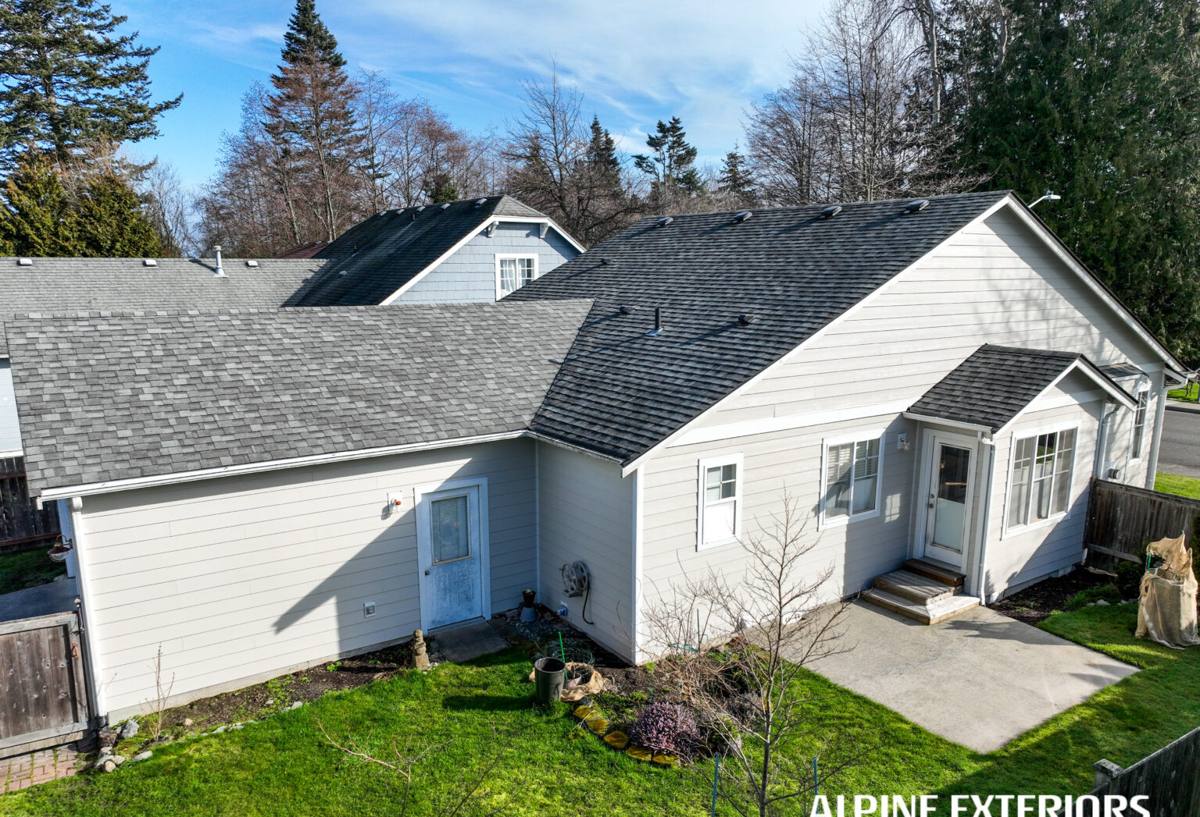
Not every siding problem calls for a full tear-off. Localized rot around one window or a section damaged by a fallen branch can often be repaired. Full replacement becomes the right call when the damage is systemic — spread across multiple walls or tied to how the original material was handling moisture over time. Signs worth taking seriously include:
- Boards that feel soft, spongy, or give slightly when pressed, especially near the bottom courses and around windows
- Paint that keeps failing within a couple of years no matter how often it's redone
- Moss or dark staining that returns within months of being cleaned off
- Visible cracking, bowing, or delamination along panel edges and seams
- Gaps opening up at trim, corner boards, or butt joints that weren't there a few years ago
- A noticeable rise in heating costs that points to compromised insulation behind the siding
- Musty odors or soft drywall on interior walls that back up to exterior siding
If more than one or two of these show up at once, it's usually a sign the underlying material or the original installation is losing the fight with the climate, not just cosmetic wear.
Comparing Siding Materials for Bellingham's Climate
Homeowners in Birchwood typically end up weighing the same handful of materials. Here's how they generally hold up against the specific conditions described above — salt-tinged air, wind-driven rain, and a long moss season.
| Material | Moisture Behavior | Moss/Algae Resistance | Maintenance Burden | Typical Lifespan Here |
|---|---|---|---|---|
| Vinyl | Sheds water but seams and J-channels trap moisture; can warp under heat/cold cycling | Moderate — moss grows on the surface film | Low, but cracks and fades over time; hard to color-match repairs | 15-25 years before fading/brittleness shows |
| Primed wood or cedar | Absorbs moisture readily; needs a sound paint film at all times to stay protected | Low — porous surface holds moss and algae against the wood | High — repainting and caulk maintenance on a recurring cycle | Highly variable, often shortened by PNW moisture |
| LP SmartSide (engineered wood) | Better than raw wood but still wood-based; edge and cut-end sealing is critical | Moderate — still an organic substrate | Moderate — finish upkeep matters more here than in drier climates | Depends heavily on installation quality and sealing |
| James Hardie fiber cement | Non-combustible, dimensionally stable; engineered for high-moisture regions | High — factory finish resists staining better than painted wood | Low — no repainting cycle with ColorPlus finish | Long service life when installed to spec |
No material is completely maintenance-free, and every one of them performs better or worse depending on how correctly it was installed. But the underlying substrate still sets the ceiling on how well a wall system copes with year-round dampness.
Why We Install James Hardie Fiber Cement Only
We made a decision as a company to install James Hardie fiber cement siding and nothing else — not vinyl, not LP SmartSide, not primed spruce or cedar. That's not a marketing angle; it's a standard we hold ourselves to because of what we see on wet-climate homes like the ones in Birchwood. Fiber cement is non-combustible, holds its shape and paint line far better than wood-based products in freeze-thaw and high-moisture conditions, and comes factory-finished with ColorPlus coating rather than relying on job-site paint that starts degrading the moment it's exposed to weather.
Hardie's product lines are also engineered by climate zone, which matters more in a region like ours than in milder, drier parts of the country. That's not a claim we make lightly — it's the reason we stopped installing alternatives that ask a homeowner to fight the local climate with maintenance instead of material.
What a Correct Siding Replacement Job Actually Involves
Tear-Off and Sheathing Inspection
Replacement starts with full removal of the old siding, not installing over it. That's the only way to actually see the sheathing underneath. In a wet climate, hidden rot behind old siding is common enough that we treat this step as non-negotiable — any soft or water-damaged sheathing gets identified and replaced before anything new goes up.
Weather-Resistive Barrier and Flashing
A correctly installed weather-resistive barrier (WRB), properly lapped and taped, along with flashing at every window, door, and horizontal transition, is what actually keeps wind-driven rain out of the wall assembly. The siding itself is the second line of defense, not the first — a detail that's easy to skip and hard to see once the job is finished.
Hardie Installation to Manufacturer Spec
James Hardie publishes specific fastener spacing, lap coverage, and clearance requirements — including minimum clearance from grade, roof lines, and decks — that are designed around moisture control. Installing to that spec, rather than "close enough," is what makes the difference between siding that performs for the long haul and siding that develops the same problems as what it replaced.
Trim, Caulking, and Finish Work
Final trim work and sealant placement at penetrations (hose bibs, vents, light fixtures) are often where corners get cut on a rushed job. Done right, these details are what keep water from finding its way in at the small gaps that don't show up until years later.
Our Process, Start to Finish
- Free, no-pressure estimate: We walk the exterior, check sheathing condition where accessible, and talk through what your home actually needs — not a generic package.
- Product and color selection: We help you choose the right Hardie product line and ColorPlus finish for the look you want and the exposure your walls get.
- Tear-off and inspection: Old siding comes off, sheathing gets inspected, and any necessary repairs are identified before move-forward.
- Installation to spec: WRB, flashing, and Hardie siding go on following manufacturer requirements, not shortcuts.
- Final walkthrough and cleanup: We review the finished work with you and clear the site of old material and debris.
What Siding Replacement Costs in Birchwood: The Real Factors
Every home is different, so we won't quote a number without seeing the property, but these are the factors that actually move the price up or down:
| Factor | Why It Matters |
|---|---|
| Home size and wall complexity | More square footage and more corners, gables, and dormers mean more labor and material |
| Condition of existing sheathing | Hidden rot found during tear-off adds repair work before new siding can go on |
| Number of stories and accessibility | Multi-story walls and tight lot access require more scaffolding and time |
| Trim and fascia scope | Replacing trim, fascia, and corner boards alongside siding adds material but improves the finished result |
| Product line and finish selection | Different Hardie profiles and ColorPlus finishes carry different material costs |
| Existing paint or coating removal | Old lead-based paint or heavy coatings on pre-existing surfaces can require extra handling |
A wall with hidden moisture damage will always cost more to do right than one where the sheathing is sound — which is exactly why the inspection during tear-off matters more than the estimate on paper.
Why a Crew That Already Works in Birchwood Matters
A crew that's worked other homes in and around Birchwood has already seen how the neighborhood's mix of mature trees, shaded lots, and older housing stock behaves under Bellingham's weather. That translates into knowing which walls are likely to have moss buildup before we even get on a ladder, what kind of sheathing condition to expect on homes of a certain age, and how to sequence a job around the wetter months without leaving a house exposed. It also means being familiar with City of Bellingham permitting expectations for exterior work, so the project moves without avoidable delays. Local experience doesn't replace doing the job to spec — but it does mean fewer surprises along the way.
Caring for Your New Siding in Whatcom County's Climate
One of the practical advantages of James Hardie's ColorPlus finish is that it removes the repainting cycle that wood and primed products require here. That said, a little ongoing attention keeps any siding performing well in this climate:
- Keep gutters clear so water isn't overflowing directly onto siding and trim
- Trim back tree limbs and shrubs that keep walls shaded and damp longer than necessary
- Rinse off moss or algae buildup on shaded walls before it has time to establish
- Check caulking at trim joints and penetrations every year or two and refresh as needed
- Address any impact damage or gaps promptly rather than letting moisture find a way in
If you're weighing a siding replacement for a home in Birchwood or elsewhere in Bellingham, we're happy to take a look and give you a straight, no-pressure estimate — no obligation, just an honest read on what your home actually needs.