 Bellingham Siding
 Why Composite Decking Makes Sense for Sehome
Sehome sits close enough to the water and to the wet, tree-covered pattern of Bellingham weather that decking here takes a different kind of beating than decking in a drier inland town. Salt-tinged air off Bellingham Bay works into fasteners and hardware. Driving rain off Puget Sound doesn't fall straight down — it gets pushed sideways under railings and against board ends. And the long stretch of gray, damp months every year means moss and algae have months to take hold on any surface that stays shaded and slow to dry. A deck built for a drier climate, or built without those specifics in mind, shows it within a few seasons: soft spots, green film, corroding screws, boards that cup or crown.
Composite decking exists specifically to resist that kind of wear better than wood, but "composite" isn't one product with one set of properties. How well it performs in Sehome depends heavily on the board type, the substructure underneath it, and whether the installer actually builds for drainage and airflow instead of just laying boards down. This page covers what that looks like in practice.
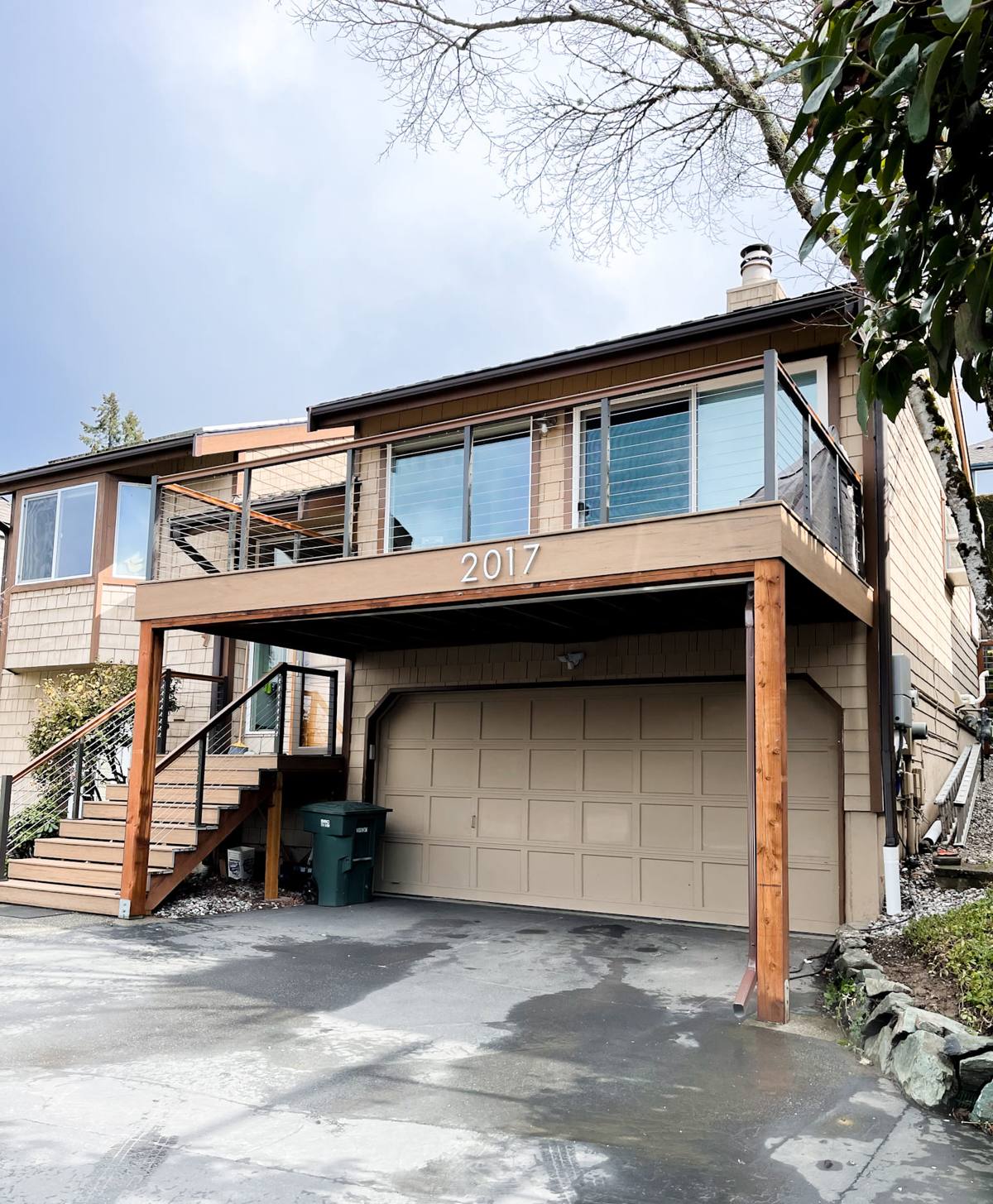
What a Correct Composite Deck Build Involves
Composite boards themselves are fairly forgiving compared to wood, but the parts of a deck you don't see — framing, fasteners, flashing, and airflow underneath — are what determine whether the deck holds up through Whatcom County winters or starts having problems in year three.
Framing and Joist Spacing
Composite boards flex more than solid wood under load, so most manufacturers call for tighter joist spacing than a traditional wood deck — commonly 16 inches on center, and often less at angles, stair treads, or diagonal patterns. Skipping this and reusing wood-deck joist spacing is one of the more common shortcuts we see, and it shows up later as bounce or sag between boards.
Fasteners and Hardware
In a marine-influenced climate, hardware matters as much as the decking material. Standard coated deck screws corrode faster with salt air in the mix, which is why we use fasteners and structural hardware rated for coastal exposure — stainless or heavy-duty coated, matched to what the board manufacturer specifies for warranty purposes. Mixing incompatible metals (aluminum flashing against the wrong fastener, for example) can accelerate corrosion right where you can't see it.
Ventilation and Drainage
Composite boards don't rot the way wood does, but the framing underneath them usually is still wood, and trapped moisture under a deck with poor airflow will rot joists and posts even while the decking on top looks fine. Correct builds leave clearance under the structure, slope ledger connections and flashing so water sheds away from the house, and avoid tight enclosures that trap damp air against framing — a real risk here given how many wet months Bellingham gets in a row.
Composite vs. Wood vs. PVC: Comparing Your Options
Homeowners in Sehome usually narrow it down to three realistic choices. Here's how they actually compare for a home in this climate, not in a showroom.
| Material | Upfront Cost | Maintenance | Behavior in Rain & Moss Season |
|---|---|---|---|
| Pressure-treated wood | Lowest | Regular sealing/staining, ongoing | Absorbs moisture, prone to splintering, cupping, and moss growth if not maintained |
| Composite (capped) | Mid to upper | Occasional washing, no sealing/staining | Resists moisture absorption well; surface can still grow algae/moss film if shaded and not cleaned |
| PVC | Highest | Low, similar to composite | Fully synthetic, very moisture-resistant, but can feel and flex differently underfoot; higher cost trade-off |
We install composite decking most often in this area because it strikes a reasonable balance: it doesn't need staining or sealing, it holds up to repeated wet-dry cycles better than untreated wood, and it costs less than full PVC systems while still carrying a strong manufacturer warranty. We're happy to walk through PVC or wood options too — the right call depends on your budget and how the deck will be used.
Our Installation Process
For a Sehome composite deck project, the process generally runs like this:
- On-site assessment — we look at the existing structure (if there is one), grade and drainage around the foundation, sun/shade exposure, and how the deck will be used.
- Structural plan — joist spacing, ledger attachment, footings, and flashing are specified to match the composite board manufacturer's requirements, not generic deck-building defaults.
- Permit handling — where the scope requires it, we handle the permit submission with the City of Bellingham or Whatcom County as applicable.
- Demo and framing — old decking removed if applicable, framing built or reinforced, hardware and fasteners selected for coastal exposure.
- Board installation — composite decking installed with correct fastening pattern, expansion gaps, and edge treatment per manufacturer spec.
- Railing, stairs, and trim — matched to the decking system and finished for a clean, consistent look.
- Final walkthrough — we go over care and cleaning specific to your board type before we consider the job done.
Maintaining Your Deck Through Bellingham's Moss Season
Composite decking is low-maintenance compared to wood, but "low-maintenance" doesn't mean "no maintenance," especially with the amount of shade, rain, and organic debris common around Sehome properties. A little seasonal attention prevents the surface film and staining that otherwise builds up over a wet winter.
- Sweep leaves and debris off the deck regularly in fall — trapped organic matter is what feeds moss and algae growth
- Rinse or wash the surface a couple of times a year with a deck cleaner safe for composite (avoid straight bleach or harsh solvents, which can affect the board's finish)
- Keep planters and furniture legs from sitting in standing water on the deck surface for long stretches
- Check railings, stair connections, and fasteners once a year for corrosion or loosening, especially if the deck is close to the water or gets direct salt-air exposure
- Trim back overhanging branches or shrubs that keep sections of the deck shaded and slow to dry
- Confirm gutters and downspouts near the deck are directing water away, not onto or under the decking
Mistakes We See on Older and DIY Decks in This Area
A lot of the repair and replacement calls we get in Sehome trace back to the same handful of issues, most of which are avoidable with the right build from the start.
Undersized or improperly spaced joists. Decks built to a generic wood-deck spec, then later topped with composite boards, often flex more than they should because the framing wasn't adjusted for composite span ratings.
Missing or poor flashing at the ledger board. Where the deck meets the house is the single most common point for water intrusion. Without proper flashing, water works behind the siding or into the rim joist over time — a slow problem that's expensive to fix once it's found.
No airflow underneath. Enclosed skirting or low clearance without vents traps moisture against the framing, which can lead to rot in the structural wood even though the composite decking on top still looks fine.
Wrong fasteners for the environment. Standard hardware corrodes faster this close to the water, and corroding fasteners eventually mean loose boards or railings.
Permits, Setbacks, and Whatcom County Considerations
Depending on the size, height, and location of the deck, a permit through the City of Bellingham or Whatcom County may be required, along with attention to property line setbacks and, in some cases, critical areas review if the property is near a shoreline or steep slope. Requirements vary by lot and project scope, so we check what applies to your specific address rather than assuming — this is part of what we handle during the planning stage so there are no surprises mid-project.
Why Hiring a Crew That Already Works in Sehome Matters
A deck built to a generic national spec sheet can still fall short in a spot like Sehome, where the combination of coastal air, sustained rain, and heavy shade from mature trees creates conditions that don't show up the same way everywhere. A crew that regularly works in this part of Bellingham has already seen which fastener choices hold up, which framing details actually keep water out at the ledger, and how much airflow a given deck layout really needs to avoid trapped moisture through a full wet season. That local pattern recognition is the difference between a deck that still looks and performs well in five years and one that needs early repairs.
If you're considering composite decking for your Sehome property, we're glad to take a look and talk through what your specific site needs — no pressure, no obligation. Use the form below to request a free estimate.