 Bellingham Siding
 Why Fairhaven Homes Wear Out Siding Faster Than You'd Expect
Fairhaven sits close to Bellingham Bay, and that proximity to open water shapes everything about how siding ages here. Salt-laden air moves off the bay and settles on exterior surfaces year-round, accelerating corrosion on fasteners, trim, and any material that isn't built to shrug off airborne moisture. Add Whatcom County's long wet season, where driving rain off the water hits west- and south-facing walls at an angle instead of falling straight down, and you get siding that takes on water in ways a drier climate never tests for.
Then there's shade. Fairhaven's mature tree cover and closely built lots mean plenty of north-facing and shaded wall sections that never fully dry out between storms. That's exactly the environment moss, algae, and mildew need to take hold, and once organic growth gets a foothold on siding, it holds moisture against the surface and speeds up whatever decay process is already underway. A siding system that isn't engineered for this combination — salt exposure, sideways rain, and a moss season that can run eight or nine months — will show its age faster in Fairhaven than it would twenty miles inland.
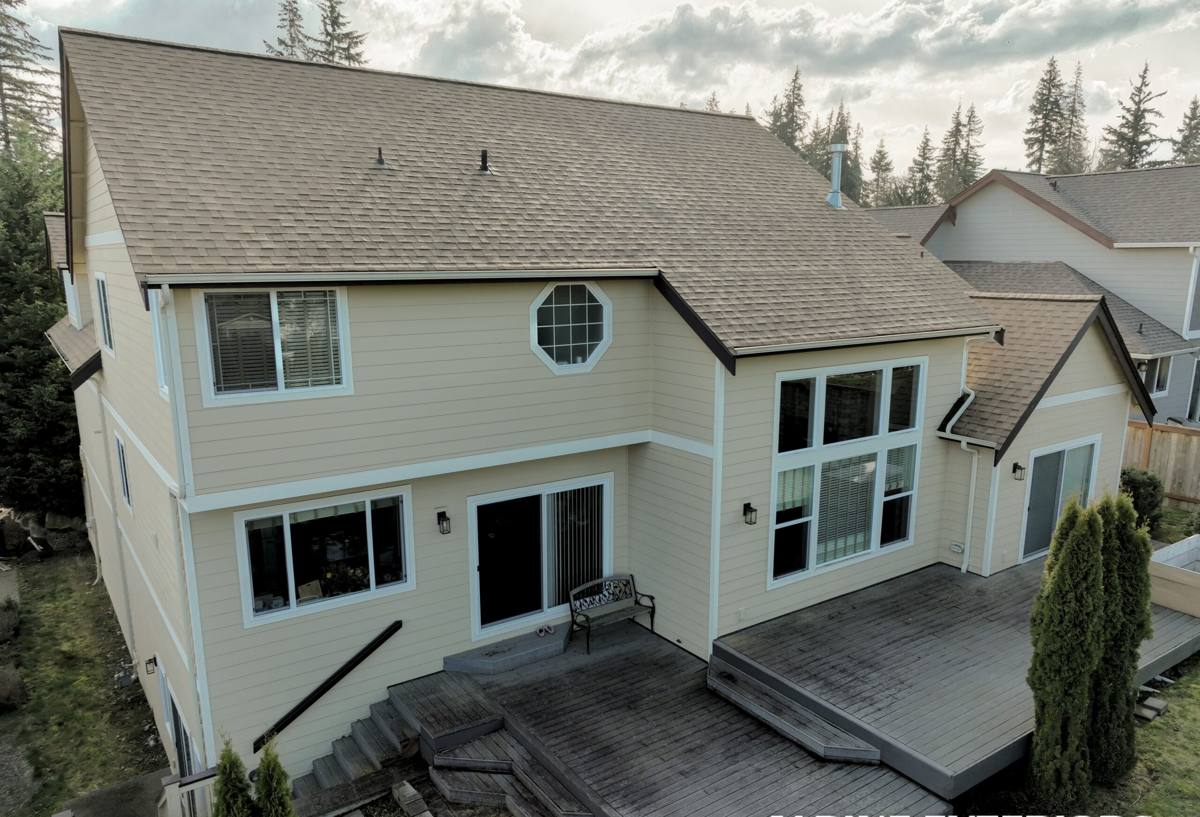
Signs Your Siding Has Reached the End of Its Service Life
Not every siding problem means a full replacement. But in a marine climate like Fairhaven's, certain signs tell you repair is just delaying the inevitable.
- Soft or spongy spots when you press on the siding, especially near the bottom courses and around window and door trim
- Paint that won't hold — you repaint and it bubbles, peels, or fails again within a year or two
- Persistent moss or algae staining that comes back within weeks of cleaning
- Visible gaps, warping, or cupping in individual boards or panels
- Rust streaks bleeding from fastener heads, a sign the fasteners themselves are corroding from salt exposure
- Soft trim boards or rot at inside corners, butt joints, and anywhere two pieces of siding meet
- Rising energy bills with no other explanation, which can point to a failing weather barrier behind the siding
If you're seeing two or more of these, especially rot at the bottom courses or trim, it's worth having someone look at the sheathing underneath before you spend money on another repaint or spot repair.
What a Correct Siding Replacement Actually Involves
It Starts Underneath the Old Siding
The siding itself is only part of the system. A proper replacement means removing the old material down to the sheathing, inspecting for rot or water damage, and repairing anything compromised before a single new board goes up. In a wet climate like Bellingham's, skipping this step is how homeowners end up paying to redo a job within a few years — new siding over damaged sheathing just hides the problem instead of fixing it.
The Weather-Resistive Barrier Matters as Much as the Siding
Behind the siding, a correctly installed weather-resistive barrier and properly lapped flashing around every window, door, and penetration is what actually keeps water out of the wall assembly. Siding sheds most of the rain, but it isn't the primary waterproofing layer — the barrier and flashing behind it are. This detail matters more in Fairhaven than in drier parts of the state, given how much water hits these walls over a typical Whatcom County winter.
Fastening and Clearances
Correct fastener type, spacing, and depth affect how well siding resists wind-driven rain and how long it lasts before fasteners start to fail. Ground clearance and proper flashing at the base of the wall also matter — siding installed too close to grade, decks, or hardscaping traps moisture against the bottom courses, which is one of the most common rot points we see on older homes in this area.
Why We Install James Hardie Fiber Cement — and Nothing Else
We made a deliberate decision to install only James Hardie fiber cement siding, and we don't install vinyl, LP SmartSide, Cemplank, Allura, primed spruce, or cedar. That's not a marketing position — it's a standard we settled on after weighing how different materials actually perform in a marine, high-moisture climate like Bellingham's.
Fiber cement is non-combustible, which matters for insurance and fire-safety considerations regardless of climate. But the bigger factor for Fairhaven specifically is moisture and dimensional stability. Wood-based siding products, including engineered wood options like LP SmartSide and untreated cedar or primed spruce, rely on coatings and sealed edges to keep water out; once that seal is compromised at a cut edge, fastener hole, or joint, moisture gets into the substrate and the material starts to break down from the inside. In a climate with this much sustained dampness and shade, that failure mode shows up faster than it would in a drier region.
Vinyl siding avoids the rot problem but brings its own trade-offs: it expands and contracts significantly with temperature swings, can become brittle and crack in cold snaps, and doesn't hold paint if a homeowner ever wants to change the color. James Hardie's ColorPlus factory finish is baked on and warrantied against fading and peeling, which removes repainting from the maintenance list — a real advantage in a climate where paint failure on other materials is common.
James Hardie also builds its HardieZone products specifically for regional climate conditions, with HZ5 and HZ10 formulations engineered for different moisture and freeze-thaw profiles across the country. That climate-specific engineering, combined with a strong transferable warranty and a long track record when installed to manufacturer spec, is why we standardized on it rather than offering multiple product lines.
How the Common Options Compare in a Marine Climate
| Material | Moisture Behavior | Maintenance | Finish Durability |
|---|---|---|---|
| James Hardie fiber cement | Non-combustible, engineered for regional moisture exposure; doesn't rot | Occasional washing; no repainting needed with ColorPlus finish | Factory-baked finish, warrantied against fading/peeling |
| Vinyl | Doesn't rot but can warp or crack with temperature swings | Low, but color can't be changed without replacement | Fades over time; no repainting option |
| LP SmartSide / engineered wood | Vulnerable at cut edges and joints once sealant fails | Requires ongoing sealant and paint upkeep | Paint-dependent; needs recoating over time |
| Cedar / primed spruce | Absorbs moisture readily; prone to rot in shaded, damp areas | Highest — regular sealing, staining, or painting | Finish breaks down fastest of the group |
Our Process, From Estimate to Finished Wall
We start with an on-site look at the home, not a phone estimate. That means checking the condition of the existing siding, probing for soft spots, and looking at how the house sits relative to shade, grade, and prevailing weather — all of which affect the scope of work in a way you can't judge from photos.
From there, the process generally follows the same sequence on every job:
- Removal of the existing siding and trim down to the sheathing
- Inspection and repair of any damaged sheathing or framing before moving forward
- Installation of a new weather-resistive barrier, correctly lapped and sealed
- Flashing at every window, door, and penetration point
- James Hardie fiber cement installation to manufacturer fastening and clearance specifications
- Trim, caulking at appropriate joints, and final cleanup
We don't skip the inspection step to move faster, and we don't shortcut fastening specs to save time — both are exactly where corners get cut on rushed jobs, and both are exactly what determines whether siding lasts 10 years or 40 in a climate like this one.
What Drives the Cost of a Siding Replacement in Fairhaven
Every home is different, but the main cost drivers on a project like this are fairly consistent. We won't quote a price without seeing the house, but here's what typically moves the number:
| Factor | Why It Matters |
|---|---|
| Extent of hidden rot or sheathing damage | Repairs found once old siding comes off add labor and material beyond the base scope |
| Home size and wall complexity | More corners, dormers, and trim detail mean more cutting, fitting, and flashing work |
| Number of stories and access | Second-story and hard-to-access walls take longer and may require additional equipment |
| Trim and accessory scope | Full trim replacement, fascia work, or accent details add to the total |
| Current siding removal difficulty | Some existing materials come off faster than others; multiple layers add time |
Because the biggest unknown is almost always what's hiding behind the old siding, we build inspection into the estimate process rather than guessing at a number and adjusting mid-project.
Why It Matters to Hire a Crew That Already Knows This Neighborhood
Siding installation isn't identical everywhere in Whatcom County. A crew used to working in drier, more sheltered inland areas may not think twice about details that matter a lot closer to Bellingham Bay — extra attention to flashing on wind-exposed walls, fastener choices that hold up to salt air, or recognizing which wall sections in a shaded Fairhaven lot are most at risk for moss and moisture buildup. None of that is exotic knowledge, but it's the difference between a crew executing a generic install and one that's actually accounting for the conditions your specific house faces.
We work throughout Bellingham and Whatcom County, and jobs in Fairhaven specifically mean factoring in the bay-adjacent exposure, the tree cover on many lots, and the age of housing stock in the surrounding residential streets. That local familiarity shows up in small decisions during the job — where to add extra flashing attention, which wall faces need the most careful moisture barrier work — that don't show up on a quote sheet but do show up in how the siding performs ten years later.
Caring for Your Siding After Installation
James Hardie fiber cement is low-maintenance, not no-maintenance. A yearly rinse with a garden hose or low-pressure wash helps keep salt residue and organic growth from building up, especially on shaded walls where moss is more likely to take hold. Keep an eye on caulking at trim joints over the years and have it touched up if it starts to crack or pull away, since caulking failure — not the siding itself — is usually the first thing to need attention on a well-installed job. Beyond that, correctly installed Hardie siding is designed to hold up to Fairhaven's climate with far less ongoing upkeep than wood-based alternatives.
If your siding is showing signs of wear, or you just want an honest read on whether repair or full replacement makes sense for your home, we're happy to take a look. Estimates are free, there's no pressure, and you'll get a straight answer about what your house actually needs — you can request one using the form below.