 Bellingham Siding
 Fiber Cement Siding, Installed for Sudden Valley's Actual Conditions
Sudden Valley is a wooded, hilly community on the south shore of Lake Whatcom, and its homes deal with a narrower, more specific set of exterior stresses than a house closer to downtown Bellingham. Salt-tinged air moving up from the Puget Sound region, driving rain that hits different elevations of a hillside lot at different angles, and a moss season that runs long under heavy tree cover all put real pressure on whatever material is on the wall. This page is about one thing: fiber cement siding, specifically James Hardie fiber cement, installed correctly on Sudden Valley homes. Not a general overview of every exterior product, and not a comparison page — just what this material needs to do here, what a correct installation actually involves, and why the crew doing it matters as much as the product itself.
We install James Hardie fiber cement exclusively. That's a professional standard, not a sales position, and it's built around what we've actually seen hold up on Whatcom County homes over time.
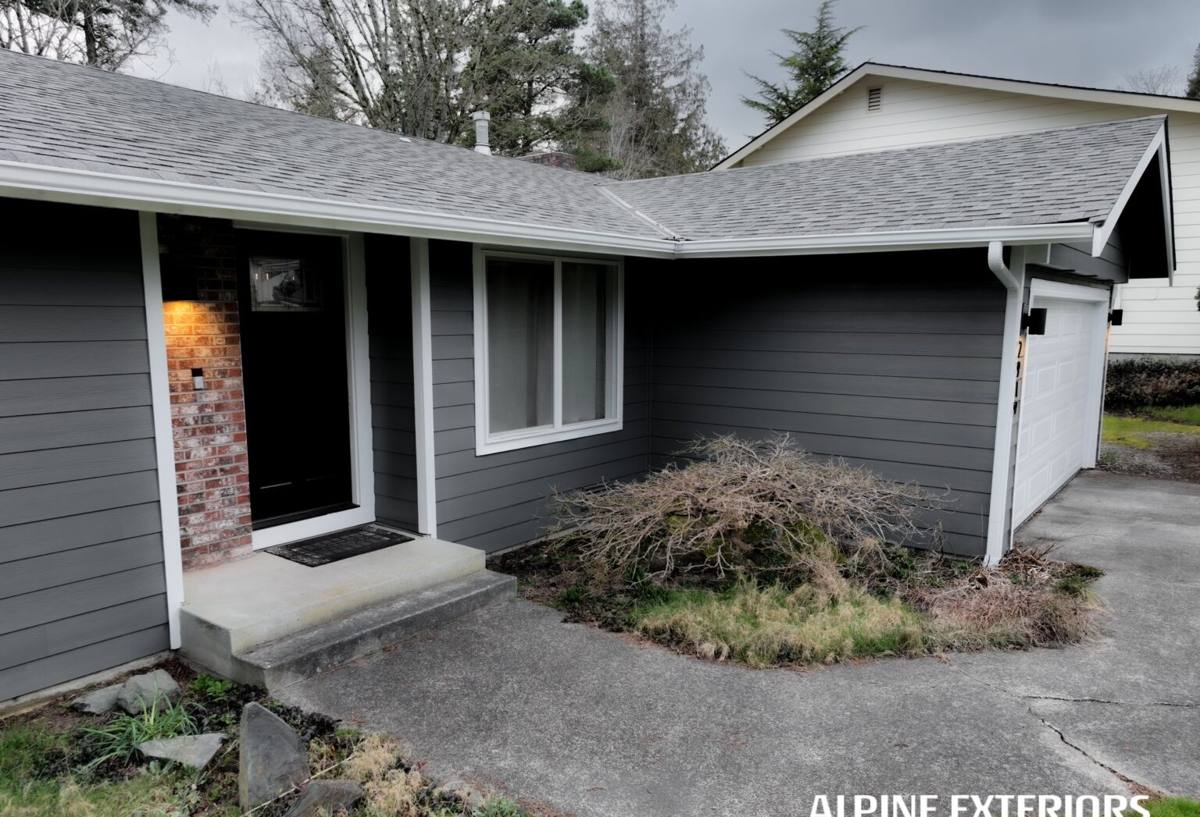
What Sudden Valley's Climate Asks of a Siding Material
Salt Air and Driving Rain
Homes in this part of Whatcom County get a steady dose of moisture-laden air, and Sudden Valley's exposed, hilly terrain means wind-driven rain doesn't hit every wall the same way. A lakefront-facing elevation can take a very different beating than a wall tucked behind trees on the same lot. Siding here needs to shed water reliably at every lap, joint, and penetration, not just on the walls that get an obvious soaking — because in this terrain, it's often hard to predict which wall that will be in any given storm.
A Long Moss Season
Shade from the surrounding second-growth forest, combined with mild temperatures and near-constant humidity, keeps moss and mildew active on exterior surfaces for most of the year in Sudden Valley. Roofs usually show it first, but siding that holds moisture at the surface — porous materials, or products with a finish that starts to break down — picks up the same growth, especially on north-facing walls that rarely see direct sun. A material that stays dry at the surface between rain events resists that growth far better than one that doesn't.
Constant Wet-Dry Cycling
What actually damages siding over the long run in this climate usually isn't one big storm — it's the repeated cycle of getting wet and never fully drying before the next rain arrives. That cycle is hardest on materials with a wood-based core, which can swell, cup, or delaminate over years of it. Fiber cement doesn't have that vulnerability, which is a large part of why it holds up on shaded, damp Sudden Valley lots better than the alternatives we used to install.
Why James Hardie Fiber Cement Is the Right Match Here
We narrowed our siding offering down to one product line after seeing, on repeated service calls and tear-offs around Lake Whatcom, which materials actually held up to this specific combination of moisture, shade, and terrain — and which ones quietly failed a few years past their warranty period.
- Non-combustible fiber cement core: It doesn't feed a fire the way wood-based siding can, which is a meaningful consideration for a community surrounded by forest and often relevant to insurance underwriting.
- Factory-applied ColorPlus finish: The color coat is baked on under controlled conditions rather than field-applied, and it resists fading, chalking, and moisture intrusion far longer than site-painted finishes — important on walls that stay damp longer than average.
- Climate-engineered HZ formulation: Hardie's HZ5 product line is built for regions with heavy moisture exposure and freeze-thaw cycling, which is a good match for Sudden Valley's lakeside, tree-shaded conditions.
- Dimensional stability: Fiber cement doesn't swell or warp the way engineered wood products can after repeated wetting cycles that never fully resolve on a shaded wall.
- A real, transferable warranty: Hardie backs its products with a substantial warranty, provided the installation follows their published specifications — which is where a lot of siding jobs actually fall short.
We don't install LP SmartSide, vinyl, Cemplank, Allura, primed spruce, or cedar. Each has its place in the broader market, and we're not going to tell a homeowner elsewhere that their siding is a mistake. But for a shaded, moisture-retentive property like a typical Sudden Valley lot, we made a professional call to stand behind one system rather than sell a cheaper option that shifts long-term maintenance risk onto the homeowner.
What a Correct Fiber Cement Installation Actually Involves
Fiber cement only performs the way Hardie engineers it to when the installation follows their published specifications closely. On a Sudden Valley property, where wall assemblies stay damp longer than they would on an open, sunny lot, these details matter more than they would somewhere drier.
The Details That Separate a Correct Install From a Rushed One
- Correct fastener type, size, and spacing — under- or over-driven nails are one of the most common causes of premature siding failure
- Proper clearance from grade, roof lines, decks, and other transitions so water has somewhere to go instead of wicking up into the panel edge
- A weather-resistive barrier and, where the wall assembly calls for it, a drainage or rain-screen gap behind the panels so moisture that does get behind the siding can escape
- Correctly lapped and sealed joints, especially at inside and outside corners and around window and door openings
- Factory-cut edges used wherever possible, with any field-cut edges properly sealed before installation
- Flashing integration at every penetration and wall-to-roof transition, since that's where most real-world leaks start regardless of the siding material
None of these are upgrades. They're the baseline that makes the difference between a Hardie installation that hits its full service life and one that develops moisture problems well before it should, no matter how good the underlying material is.
Fiber Cement Compared to What We Used to Install
| Material | Behavior in Lakeside Humidity | Moss and Mildew Resistance | Long-Term Maintenance |
|---|---|---|---|
| James Hardie fiber cement | Dimensionally stable; doesn't swell or warp | Factory finish resists surface growth and moisture staining | Low; repaint not required with ColorPlus finish |
| Vinyl siding | Can trap moisture behind panels in shaded, poorly ventilated walls | Moderate; seams and laps can hold moisture longer under canopy | Low upfront, but panels can warp or fade over time |
| LP SmartSide / engineered wood | Wood-fiber core is moisture-sensitive once the factory coating is compromised | Moderate; depends heavily on edge-sealing and caulk maintenance | Higher; cut edges and joints need regular inspection |
| Cedar / primed wood | Absorbs and releases moisture readily | Low without regular treatment; prone to growth in shade | High; needs periodic refinishing to hold up |
Why a Crew That Already Works Sudden Valley Matters
Sudden Valley is a private community with its own internal roads and a homeowners association, and a crew that's already worked here understands the practical side of that before the first panel goes up — how to plan access and scheduling, and how much the exposure changes from one lot to the next even within the same subdivision. That local familiarity translates directly into installation decisions: which elevations need extra drainage detailing because they rarely see sun, how flashing should be lapped on a steep, tree-shaded roof-to-wall transition, and which fastener spacing holds up best in a consistently damp microclimate. A crew seeing this terrain for the first time is guessing at some of those calls. A crew that already works here isn't.
What to Ask Before Hiring for Fiber Cement Siding in Sudden Valley
- Ask specifically whether they install to Hardie's published fastening and clearance specifications, not just "fiber cement in general"
- Confirm current Washington contractor licensing and active liability insurance
- Ask how they detail drainage and rain-screen gaps on shaded, north-facing walls
- Ask about experience working within HOA or private-road communities, including access and scheduling
- Get the manufacturer warranty terms in writing, along with a clear scope of work, before signing anything
Our Process for a Sudden Valley Siding Project
We start with an on-site walk of the existing siding, paying particular attention to how shade, tree cover, and lake humidity have affected different elevations of the home — that variation tends to be more pronounced here than on a typical open lot in town. From there, we put together a written scope covering panel profile, color, fastening approach, and any drainage detailing the wall assembly needs, along with a realistic timeline. During installation, correct flashing and moisture management aren't treated as optional add-ons; they're standard practice on every wall we touch in this climate.
If you're weighing a siding replacement for a Sudden Valley home, we're happy to walk the exterior with you and give a straight read on what it actually needs. Reach out below for a free, no-pressure estimate.