 Bellingham Siding
 Why Fairhaven Homes Need More From Their Siding
Fairhaven sits close to Bellingham Bay, which means homes here take on a combination of exposures that inland Whatcom County properties simply don't deal with year-round. Salt-laden air off the water accelerates corrosion on fasteners and metal trim. Driving rain off the Sound, pushed sideways by wind, tests every seam, joint, and piece of flashing on a wall. And the long, damp shoulder seasons that stretch from fall through spring create ideal conditions for moss, algae, and mildew to take hold on anything that stays wet for too long. Any siding product installed here has to hold up to all three at once, not just one.
We install exclusively James Hardie fiber cement siding, and Fairhaven's climate is a big part of why. This page walks through what that product needs to do in this specific setting, what a correct installation actually involves, and how we approach a project in this neighborhood from first estimate to final walkthrough.
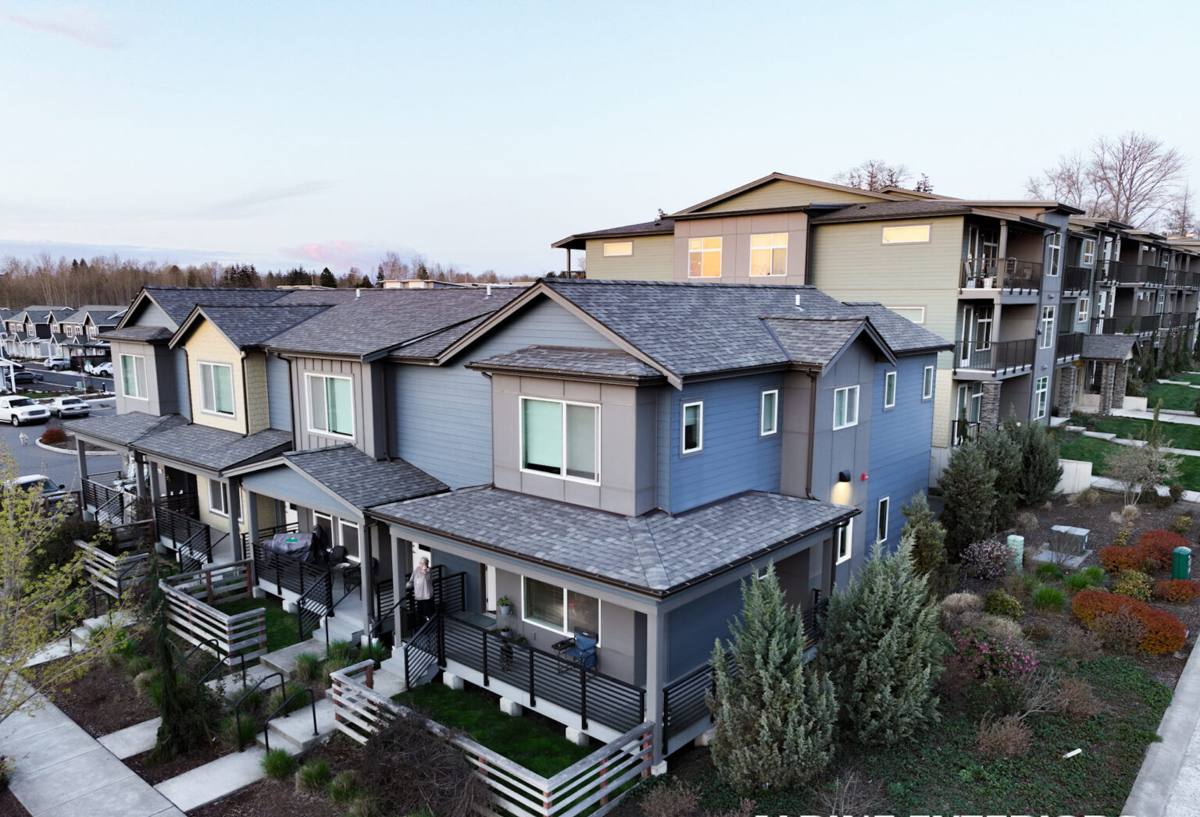
What Salt Air, Driving Rain, and Moss Actually Do to a Wall
It helps to understand the failure modes before talking about the fix. These aren't abstract climate talking points — they're the specific mechanisms that wear out siding systems over time in a place like Fairhaven.
- Salt air speeds up oxidation on exposed fasteners, staples, and light-gauge trim metal. Once a fastener starts rusting, it can bleed streaks down the face of the siding and eventually lose holding power.
- Driving rain doesn't just fall straight down — wind pushes it sideways and up under laps, into butt joints, and around window and door openings. A siding system depends on correct lap coverage, flashing, and a drainage path behind the cladding to manage that water, not just shed it off the face.
- Moss and algae need moisture and organic material to establish. Wood-based sidings and porous painted surfaces give spores something to grip. Once moss gets a foothold near ground level, under eaves, or on north-facing walls, it holds moisture against the substrate and accelerates rot.
A siding job that looks fine on a dry August afternoon can still be set up to fail during a wet Bellingham winter. The material matters, but the installation details matter just as much.
Why James Hardie Is the Product We Standardize On
James Hardie fiber cement is engineered from cement, sand, and cellulose fiber, which makes it non-combustible and dimensionally stable — it doesn't swell, cup, or rot the way wood-based products can when they take on repeated moisture. For a neighborhood with Fairhaven's exposure, that stability is the whole point.
James Hardie also makes climate-specific product lines, including HZ5 engineered for regions with the kind of freeze-thaw cycling, wind-driven rain, and moisture load the Pacific Northwest sees. That's the line we spec for this area rather than a generic, one-size-fits-all board. The factory-applied ColorPlus finish is baked on under controlled conditions and backed by its own finish warranty, which matters in a climate where field-applied paint has to fight moss growth and UV fading from day one.
We don't install LP SmartSide, vinyl, Cemplank, Allura, or primed wood siding. Each of those has a place in the market and reasonable people install them, but we made a deliberate call to standardize on one product system, install it correctly every time, and stand behind it — rather than juggling multiple products with different moisture behaviors, warranty terms, and installation requirements.
How Fiber Cement Compares on the Points That Matter Here
| Factor | James Hardie Fiber Cement | Wood-Based / Engineered Wood Siding | Vinyl |
|---|---|---|---|
| Moisture & rot resistance | Cement-based, does not rot; engineered for wet climates | Wood fiber core can swell or degrade if moisture reaches it | Doesn't rot itself, but traps moisture behind panels if installed poorly |
| Moss/algae resistance | Dense surface resists spore establishment better than porous substrates | Porous surface can hold moisture, inviting growth | Surface resists growth but seams and J-channel can trap debris and moisture |
| Fire resistance | Non-combustible | Combustible | Can melt/deform under heat exposure |
| Finish durability | Factory-baked ColorPlus finish, separate finish warranty | Field-applied paint/stain, needs recoating | Color molded through, but can fade and become brittle over time |
| Fastener/corrosion sensitivity | Requires corrosion-resistant fasteners near salt air, otherwise low sensitivity | Similar fastener requirements plus substrate moisture risk | Lower fastener exposure, but panels can warp with heat |
What a Correct Installation Involves
The product is only half the equation. Fiber cement siding fails prematurely almost exclusively because of installation shortcuts, not because the material itself gave out. In a climate that pushes water at a wall from every angle, these details aren't optional extras — they're the actual job.
Drainage Plane and Rain Screen Gap
Behind the siding, there needs to be a water-resistive barrier and, ideally, a drainage gap that lets any water that gets past the cladding drain and dry out instead of sitting against the sheathing. This is especially important on walls that take direct wind-driven rain, which describes a lot of Fairhaven's water-facing exposures.
Flashing at Every Penetration
Windows, doors, hose bibs, light fixtures, and vents all break the plane of the wall. Each one needs proper flashing integrated with the water-resistive barrier so water is directed out and down, never trapped behind the siding. This is where most leaks originate on any siding system, Hardie included, when it's rushed.
Fastening and Fastener Selection
James Hardie specifies fastener type, size, and placement for each product line and exposure category. In a salt-air environment, corrosion-resistant fasteners aren't a nice-to-have — using the wrong fastener is one of the fastest ways to get rust streaking and premature loosening.
Gaps, Caulking, and Butt Joints
Hardie's own installation guidance calls for specific gaps at trim and joints, sealed with the right sealant rather than caulked solid everywhere. Over-caulking can trap moisture; under-caulking lets it in. Butt joints need to be flashed or shingled correctly rather than just butted and caulked.
Clearance From Grade, Decks, and Roof Lines
Siding installed too close to grade, a deck surface, or a roofline wicks up moisture and stays wet longer — exactly the condition moss and algae need. Maintaining proper clearance is a small detail during installation that prevents a recurring maintenance headache later.
Common Issues We See on Older Homes in This Area
A lot of Fairhaven's housing stock is older, and older exterior work here often shows a consistent pattern of problems tied directly to the climate: moss buildup on north- and west-facing walls that hold shade and moisture longer, rust streaking below steel fasteners and flashing, soft or delaminating trim near ground contact, and caulk joints that have shrunk, cracked, or failed after repeated wet-dry cycles. None of this means the original material was necessarily bad — it usually means the installation details didn't account for how much water this location actually sees over a full year.
Our Process From Estimate to Finished Job
- On-site assessment. We look at current siding condition, moisture points, trim and flashing details, and any problem areas specific to the home's exposure.
- Written estimate. You get a clear scope covering product line, color, trim details, and what's included — no vague allowances.
- Prep and moisture check. Before old siding comes off, we check sheathing condition, since fiber cement performs best over a sound, dry substrate with a properly installed water-resistive barrier.
- Installation to spec. Drainage gap, flashing, fastener selection, and gap/caulk details are all done to James Hardie's published requirements for this climate zone, not shortcuts.
- Final walkthrough. We review the finished work with you, including trim, corners, and any penetrations, before calling the job complete.
Cost Factors for a Fairhaven James Hardie Project
Every home is different, and we don't quote broad numbers without seeing the property, but these are the factors that move a project's scope and price up or down:
| Factor | Why It Matters |
|---|---|
| Existing siding removal | Tear-off and disposal add labor versus a bare-sheathing new build |
| Sheathing/substrate repair | Rot or moisture damage found during tear-off needs to be fixed before new siding goes on |
| Product line and profile | Lap width, shingle-style panels, and trim board choices carry different material costs |
| Home complexity | Dormers, multiple gables, and lots of trim/penetrations take more time to flash and fit correctly |
| Color and finish | Factory ColorPlus finishes vary by line; custom field-painted finishes are also an option |
| Access and site conditions | Tight lots, slopes, or limited staging area affect scaffolding and logistics |
Maintaining James Hardie Siding in a Wet, Salty Climate
Fiber cement is low-maintenance compared to wood, but "low-maintenance" doesn't mean "no maintenance" in a place like Fairhaven. A little routine care keeps it looking right and prevents the moisture and moss problems that plague neglected exteriors near the water.
- Rinse the exterior annually with a garden hose (not a high-pressure washer aimed directly at seams) to clear salt residue, pollen, and early moss growth.
- Keep gutters clear so overflow doesn't run down the wall face repeatedly.
- Trim back vegetation and tree cover that keeps a wall section shaded and damp longer than the rest of the house.
- Check caulking at trim joints and penetrations every couple of years and have any cracked sealant redone before it lets water in.
- Watch for any rust streaking near fasteners or flashing and have it inspected — it's usually a quick fix if caught early.
Why It Matters That We Already Work This Neighborhood
A crew that regularly works Fairhaven and the broader Bellingham waterfront knows which wall orientations take the worst of the wind-driven rain, which older homes tend to have hidden moisture behind their trim, and how much clearance to build in for a moss season that can run several months. That familiarity shows up in fewer surprises during tear-off and a finished install that's built for the specific exposure of your lot, not a generic spec sheet. Whatcom County's coastal microclimates aren't uniform — a wall facing the bay behaves differently than one tucked behind a hill a few blocks inland — and that's the kind of judgment call that only comes from doing the work here repeatedly.
If you're weighing a siding replacement or want a straight answer on whether your current siding is holding up the way it should, we're glad to take a look. Reach out for a free, no-pressure estimate using the form below.