 Bellingham Siding
 Birchwood sits close enough to the water and the low, wooded terrain around it that siding here takes a different kind of beating than siding on a dry, open lot across town. Homes in this part of Bellingham deal with salt-laden air moving in off Bellingham Bay, driving rain that comes in sideways during winter storms, and long stretches of gray, damp weather where moss and algae get a real head start. If you've noticed cracked caulk lines, soft spots near the bottom of your walls, or dark streaking that won't scrub off, that's usually the siding telling you it's losing the fight with the local climate.
This page covers what siding repair actually looks like for a Birchwood home — what tends to go wrong, what a correct repair involves, and why it matters to hire a crew that already knows this neighborhood instead of a general handyman working from a truck.
Why Birchwood Siding Wears the Way It Does
Whatcom County's marine climate is generally mild, but "mild" doesn't mean easy on a house. Birchwood's proximity to the bay means salt air is a constant, low-grade stressor on anything metal or painted — fasteners corrode faster, paint chalks and fades sooner, and any exposed wood grain starts to lift at the surface. Add driving rain that gets pushed horizontally during a winter blow, and water finds its way into every gap, seam, and nail hole that wasn't sealed correctly the first time.
Then there's the moss and algae. Bellingham's long wet season, combined with tree cover and shaded north-facing walls common in Birchwood's older residential streets, gives moss months to establish itself on any siding surface that stays damp. Moss isn't just cosmetic — it holds moisture against the wall assembly, which is exactly the condition that leads to trapped water, soft substrate, and eventually rot.
The Three Failure Patterns We See Most
- Moisture intrusion at seams and penetrations — failed caulk around trim, window flashing, and hose bibs lets water track behind the siding.
- Moss and algae buildup on shaded elevations — north- and west-facing walls with limited sun exposure hold moisture longer and grow organic growth faster.
- Fastener and paint failure from salt exposure — corroding nails and staples work loose, and paint film breaks down faster than it would inland, exposing the substrate underneath.
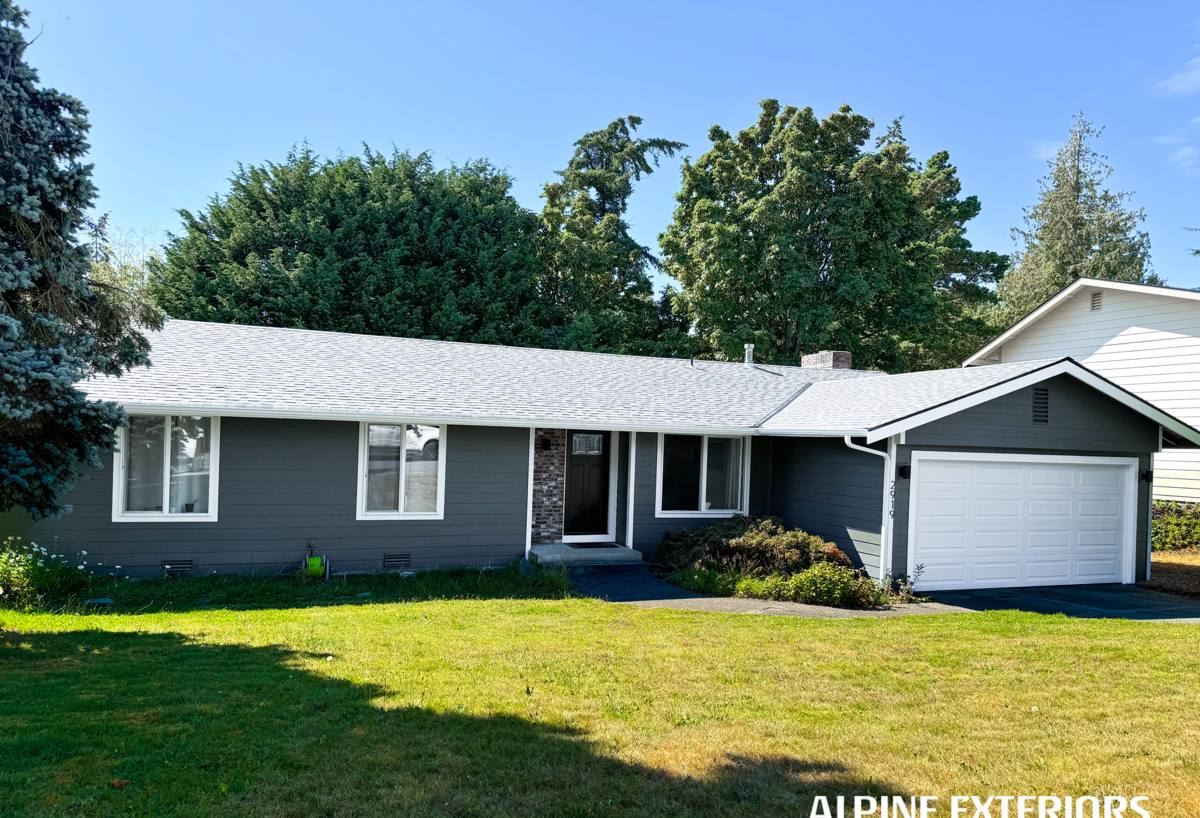
What "Correct" Siding Repair Actually Means
A lot of siding repair in this region is done wrong — not maliciously, just incompletely. Someone caulks over a crack, paints over a stain, or swaps one damaged board without checking what's happening behind it. That kind of patch job might look fine for a season, but it doesn't address the moisture source, and Birchwood's climate will find the same weak point again within a year or two.
A correct repair starts with figuring out why the damage happened, not just where it is. That means pulling back the affected siding to check the water-resistive barrier and flashing underneath, confirming there's no hidden rot in the sheathing, and only then deciding whether the fix is a board replacement, a flashing correction, or both.
What a Proper Repair Visit Includes
- Inspection of the damaged area and the surrounding wall — not just the spot you called about
- Checking flashing, caulk joints, and any penetrations (vents, lights, hose bibs) near the damage
- Pulling affected boards to inspect the sheathing and house wrap for moisture or soft spots
- Replacing damaged material with matching product — matched profile, matched color where possible
- Correct re-fastening and sealing to manufacturer spec, not just "close enough"
- A final check of drainage paths so water has somewhere to go besides behind your siding
Why We Repair With James Hardie — Not Whatever's on the Wall
We install and repair exclusively with James Hardie fiber cement siding. If your home already has Hardie siding, repairs are usually straightforward: matching boards, matching ColorPlus finishes, and a product line that's engineered for exactly the kind of wet, marine climate Birchwood sits in.
If your home currently has a different siding material — vinyl, LP SmartSide, cedar, or primed spruce — and it's failing in this climate, we'll be upfront with you: a small patch repair with the existing material is sometimes the practical short-term move, but if the damage is widespread or the material itself is the reason it's failing, we'll walk you through what a Hardie fiber cement replacement looks like instead of continuing to chase problems on a product that isn't suited to salt air and constant moisture. We won't install those other products ourselves, but we're not going to pretend a single-board patch fixes a systemic problem either.
Why Hardie Specifically Holds Up Here
| Concern in Birchwood's Climate | How Hardie Fiber Cement Handles It |
|---|---|
| Salt air and coastal moisture | Non-combustible cement composite doesn't corrode or absorb salt the way some materials degrade under it |
| Driving rain and wind-driven wetting | HZ5 product line is engineered for wet, freeze-thaw climates like the Pacific Northwest |
| Moss and algae in shaded areas | Factory ColorPlus finish resists the moisture penetration that lets organic growth take hold in the substrate |
| Long-term fading and chalking | Baked-on factory finish holds color longer than field-applied paint on wood-based products |
| Warranty on repaired sections | Transferable warranty coverage that follows the home, not just the original owner |
What Drives the Cost of a Repair
Every repair job is different, but the price generally comes down to a handful of factors. We'd rather explain what moves the number up or down than throw out a flat rate that doesn't hold up once we're actually on the wall.
| Factor | Why It Matters |
|---|---|
| Extent of hidden moisture damage | Sheathing or framing repair adds labor and material beyond the visible siding |
| Height and access | Second-story or steep-slope sections near tree cover take more time and equipment |
| Color and profile matching | Matching older Hardie runs or transitioning a full elevation costs more than a spot patch |
| Number of penetrations involved | Each vent, light fixture, or hose bib near the repair needs its own flashing check |
| Scope — patch vs. elevation replacement | Widespread moss or fastener failure across a wall often makes full-elevation replacement more cost-effective than repeated patching |
Signs a Birchwood Homeowner Shouldn't Ignore
- Soft or spongy siding when pressed near the bottom of a wall or below a window
- Dark streaking or green-black growth that returns quickly after cleaning
- Visible gaps or cracking in caulk joints around trim and penetrations
- Paint that's bubbling, peeling, or chalking heavily on one elevation but not others
- Warping or separation at board seams, especially on north- or west-facing walls
- A musty smell or visible staining on interior walls that back up to exterior siding
Why a Crew That Already Works Birchwood Matters
Repair work depends on reading the site correctly the first time. A crew that's worked other homes in Birchwood already knows which elevations tend to hold moisture, how the tree cover in this neighborhood affects drying time, and what the salt exposure off the bay does to fasteners and finishes over a few years. That's not something you get from a general handyman who repairs siding as one of a dozen unrelated jobs — it's the difference between a patch that solves the actual problem and one that looks fine until next winter's rain finds the same gap.
It also means faster, more accurate diagnosis. When we already understand how water tends to move on homes in this part of Bellingham, we spend less time guessing and more time confirming — which keeps the job efficient and the price honest.
Our Process for a Birchwood Repair Call
- Initial assessment — we look at the visible damage and ask about its history: when you noticed it, whether it's gotten worse, any interior signs
- On-site inspection — we check the damaged area and surrounding wall sections, including flashing and penetrations
- Written scope and estimate — you get a clear explanation of what we found and what we recommend, with no pressure to upsell into a full replacement you don't need
- Repair work — matched materials, correct fastening and sealing, and a cleanup that leaves the site as we found it
- Follow-up guidance — we'll tell you what to watch for and whether other areas of the home are worth monitoring
Maintenance That Extends the Life of a Repair
Once damaged siding is properly repaired, a little seasonal attention keeps Birchwood's climate from undoing that work. Rinse moss and algae off shaded walls before it establishes a foothold, keep gutters clear so overflow doesn't run down the siding face, and do a quick visual check of caulk joints each fall before the wet season sets in. None of this is intensive, but skipping it is exactly how a small issue in Bellingham's climate turns into a bigger one by spring.
If you're seeing signs of trouble on your Birchwood home's siding — or you just want a second opinion before a small problem turns into a bigger one — we're happy to take a look. Request a free, no-pressure estimate below and we'll give you an honest read on what your siding actually needs.