 Bellingham Siding
 Decking Built for How Silver Beach Actually Weathers
A deck in Silver Beach doesn't fail because the homeowner picked the wrong stain color or forgot to sweep it once a month. It fails because of what's underneath the boards — framing that never dries out, fasteners that weren't rated for a wet climate, or a layout that traps water instead of shedding it. Bellingham's mix of marine air, long stretches of rain, and shaded, moss-prone yards is hard on any outdoor structure, and decking takes more of that abuse than almost anything else on a house because it's horizontal, walked on, and exposed to standing moisture in a way siding and roofing aren't.
Composite decking has become the default choice for a lot of Whatcom County homeowners for good reason, but "composite" isn't one product — board quality, capping, and installation detail vary a lot, and in this climate those details decide whether a deck looks good for twenty years or starts showing problems in five.
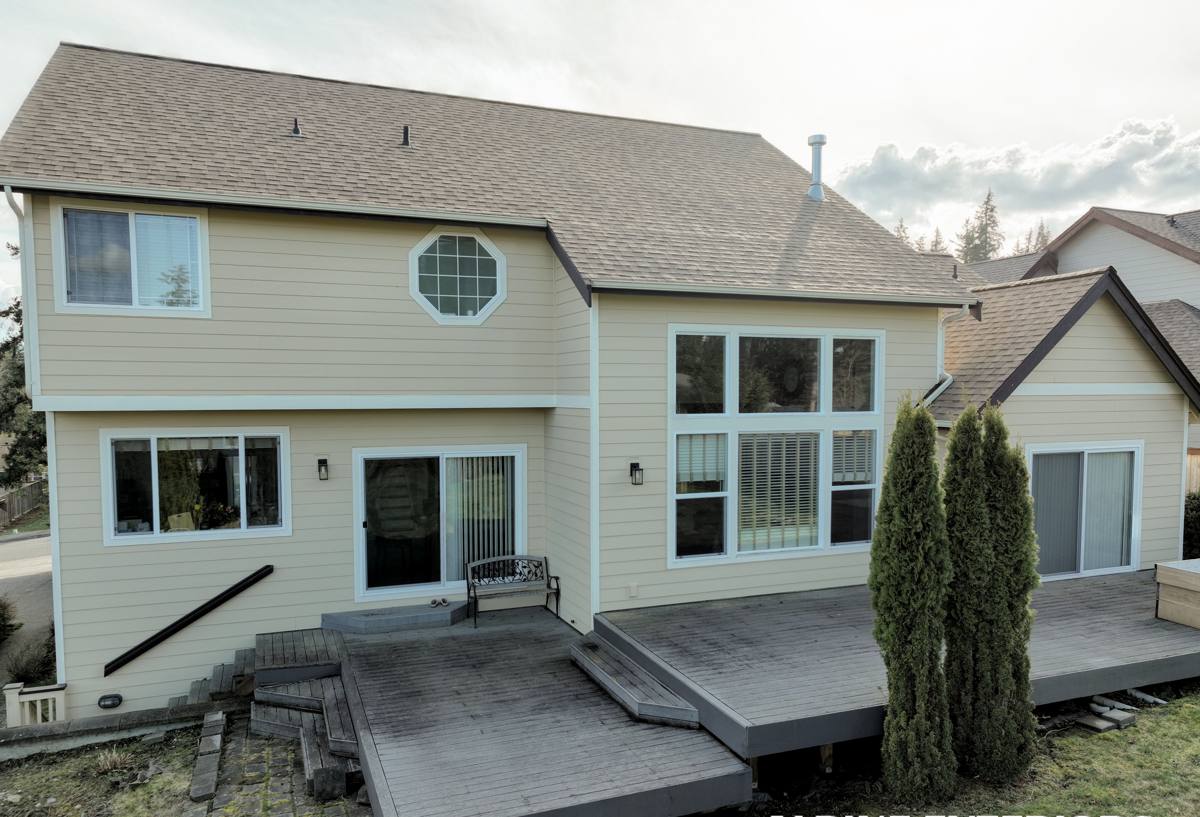
What Bellingham's Climate Does to an Outdoor Deck
A few things stack up against decking here that don't apply the same way in drier parts of the country:
- Persistent moisture. Long rainy stretches mean framing and board undersides often don't get a real chance to dry between storms, especially on shaded or north-facing decks.
- Salt-tinged marine air. Being close to the water means hardware and fasteners face more corrosion pressure than the same products would see further inland.
- Moss and algae growth. Cool, damp, and often shaded conditions are exactly what moss wants. Any deck surface that stays damp too long — because of poor drainage, tight board spacing, or overhanging trees — will grow it.
- Slow drying cycles. Even on dry days, low sun angles and marine humidity mean surfaces stay damp longer than homeowners expect, which matters for both slip safety and material longevity.
None of this makes a deck impossible to get right. It just means the build has to account for drainage, airflow, and material choice from the start, not patch it in after the fact.
Composite vs. Wood: A Straight Comparison for This Climate
We install both, and there's a legitimate case for either depending on budget and how much upkeep a homeowner actually wants to do. Here's how they compare under the conditions this region puts them through.
| Factor | Composite Decking | Pressure-Treated / Cedar Wood |
|---|---|---|
| Moisture resistance | Doesn't absorb water into the board itself; resists rot | Absorbs moisture; needs sealing to slow rot and warping |
| Moss and algae | Capped boards resist growth but still need occasional washing | More porous surface gives moss and mildew more to grip |
| Maintenance | Periodic cleaning; no staining or sealing required | Annual or biannual staining/sealing to hold up long-term |
| Typical lifespan | 25–30+ years with proper installation | 10–15 years before major boards need replacing |
| Upfront cost | Higher material cost | Lower material cost, higher lifetime maintenance cost |
| Appearance over time | Consistent color and grain, resists graying | Natural look but grays, splits, and splinters with age |
For a lot of Silver Beach homeowners, composite pencils out because the maintenance burden of wood — sealing every year or two in a climate that barely gives it a dry window to cure in — gets old fast. That's a trade-off call for the homeowner to make, not a knock on wood decking done right.
What a Correct Composite Deck Installation Actually Involves
Substructure and Ledger Attachment
Composite boards are only as good as what they're screwed into. That means properly sized joists on the right spacing for the board span (composite typically wants tighter joist spacing than wood), a ledger board flashed correctly where it meets the house, and joist tape or another moisture barrier on top of the framing so the joists themselves aren't sitting in standing water every winter.
Fasteners and Hardware
Given the marine air here, we use fasteners and structural hardware rated for corrosion resistance — not just because it's "better," but because standard hardware genuinely corrodes faster this close to the water. Hidden fastener systems also matter for composite specifically, since exposed screw heads are a common point where capped boards start to fail early.
Drainage and Airflow Under the Deck
This is the detail that gets skipped most often and causes the most problems later. A deck built tight to grade, or without gaps for airflow underneath, holds moisture against the framing indefinitely. We grade and vent the substructure so water has somewhere to go and air has a path to move through, which matters more here than in a drier climate.
Board Spacing and Edge Details
Board gapping has to account for composite's expansion and contraction with temperature and moisture, and end cuts need to be treated or capped per the manufacturer's spec so water doesn't wick into an exposed cut edge — one of the few places composite boards are actually vulnerable to moisture damage.
Our Process, Start to Finish
- On-site assessment. We look at the existing structure (if there is one), grading, sun exposure, and drainage path before quoting anything.
- Honest scope and estimate. We tell you what the site actually needs — sometimes that's a full tear-out and rebuild, sometimes the existing frame is solid and only the surface needs replacing.
- Material selection. We walk through board options, colors, and railing systems based on your budget and how the deck will be used.
- Framing and substructure work. This is where the corrosion-resistant hardware, moisture barriers, and proper joist spacing get built in — the part that doesn't show but determines how the deck ages.
- Board installation. Hidden fastener systems, correct gapping, and sealed edge cuts.
- Final walkthrough. We go over basic care so you know what the deck needs (and doesn't need) going forward.
Choosing Boards and Colors for a Whatcom County Home
Darker composite colors show less staining from moss and organic debris but run hotter underfoot on the rare sunny day; lighter colors show dirt streaks faster but stay cooler. Neither is "right" — it depends on how shaded the deck is and how much sun exposure it actually gets, which in a place like Silver Beach can vary a lot from one yard to the next depending on tree cover. We'll walk the site with you and talk through what actually makes sense for your specific exposure rather than pushing a color because it's popular.
Railing matters too — aluminum and composite railing systems hold up better against the same marine air and moisture that affects the decking itself, and we'll spec railing hardware the same way we spec the deck's structural hardware.
Composite Still Needs Some Care
"Low-maintenance" doesn't mean "no-maintenance." Composite decking done right cuts out staining and sealing, but it still needs basic upkeep to look and perform the way it should in this climate:
- Sweep off leaves, needles, and organic debris regularly — left to sit, they hold moisture against the board surface and feed moss growth.
- Wash the deck surface once or twice a year with mild soap and water (or a composite-safe cleaner) to clear early moss and algae before it takes hold.
- Keep gutters and downspouts near the deck clear so runoff isn't dumping extra water onto or under the deck surface.
- Trim back overhanging branches where possible to cut down on shade and debris load.
- Check railing and fastener hardware periodically for early signs of corrosion, especially on decks closer to the water.
- Avoid pressure-washing at close range or high pressure, which can damage the cap layer on composite boards.
Why a Crew That Already Works Silver Beach Matters
A lot of decking problems we get called out to fix started with a crew that built the deck the same way they'd build one in a dry climate — because that's the only way they know how to build one. In Bellingham, that shows up a few years later as spongy framing under boards that still look fine on top, moss taking over a surface that was never graded to drain, or hardware rusting out faster than it should have. A crew that works this area regularly builds drainage, airflow, and corrosion-resistant hardware into the plan from the start, because we've seen what happens when it's skipped.
That local experience also means we're not guessing about what holds up around Bellingham Bay and Whatcom County's rain and moss season — we're building to what we've actually seen work and fail over repeated jobs in this specific climate.
If you're planning a new deck or replacing one that's showing its age, we're happy to come take a look and give you a straightforward, no-pressure estimate — just use the form below to get started.