 Bellingham Siding
 Why Silver Beach Siding Wears Differently Than the Rest of Bellingham
Silver Beach sits close to Lake Whatcom, under a heavy canopy of mature evergreens that most of the neighborhood's original builders left standing when the lots were developed. That combination — proximity to open water, shade, and limited direct sun on large sections of most homes — creates a microclimate that's noticeably damper than a lot two miles away in an open subdivision. Add in the broader Whatcom County weather pattern of a long, wet fall-to-spring stretch and salt-tinged marine air drifting in off Bellingham Bay and Puget Sound, and you get siding that's under near-constant moisture load for a large part of the year.
None of that means Silver Beach homes are doomed to siding problems. It means the siding has to actually be suited to the exposure, installed correctly the first time, and repaired promptly and correctly when something does go wrong. Small mistakes that would be cosmetic in a drier, sunnier part of the county tend to compound faster here, because the wall assembly rarely gets a long dry stretch to recover.
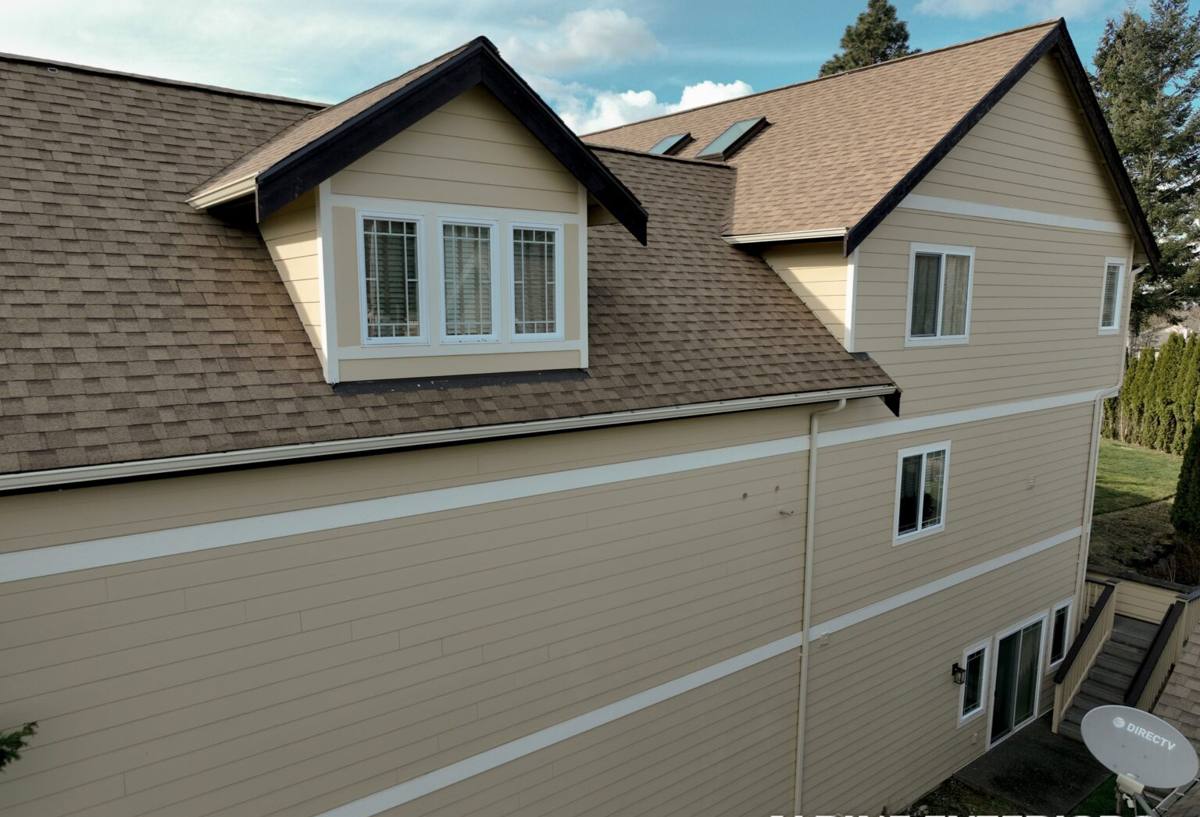
What Driving Rain, Shade, and Moss Actually Do to Siding
It helps to understand the specific failure paths, because they determine what a correct repair has to address — not just patch over.
Driving rain and wind-driven moisture
Storms moving through Whatcom County often carry enough wind to push rain sideways into wall surfaces rather than letting it run straight down. That matters at every horizontal joint, every window and door trim intersection, and every spot where old caulk has started to crack. Water doesn't need a big gap to get behind siding — a hairline seam is enough over repeated storms.
Shade and slow drying
Sun exposure is what dries siding out between rain events. On shaded elevations — common throughout Silver Beach given the tree cover — that drying cycle is slower or sometimes doesn't happen at all for weeks at a stretch. Wood-based products swell, hold water, and eventually rot in these conditions even when installed reasonably well. Fiber cement handles this far better because it doesn't absorb and swell the way wood-based or wood-fiber composite siding does.
Moss, algae, and organic growth
Shaded, damp siding is exactly what moss and algae need to establish. Beyond the cosmetic green-black staining, sustained organic growth holds moisture against the siding surface longer, which accelerates whatever underlying moisture damage is already happening at joints and fastener points.
Salt-laden marine air
Even away from the immediate waterfront, Whatcom County's marine air carries enough salt content to accelerate corrosion on exposed steel fasteners, uncoated flashing, and lower-grade hardware. Corroding fasteners lose their grip on siding panels, which is one of the more common root causes behind loose or popped boards that homeowners assume is just "old age."
Signs a Silver Beach Home Needs Siding Repair
Not every mark on your siding means a problem, but these are the signs worth acting on before they become bigger, more expensive repairs:
- Soft, spongy, or crumbling spots when you press on the siding, especially near the bottom courses or below windows
- Visible gaps, cracks, or separation at butt joints and trim intersections
- Persistent moss or dark staining that comes back quickly after cleaning
- Bubbling, peeling, or discolored paint concentrated in one section rather than the whole house
- Boards that have warped, cupped, or pulled away from the wall slightly
- Rusty streaking below nail heads or fastener locations
- A musty smell or visible staining on interior walls that back up to an exterior wall with siding issues
- Woodpecker damage or insect activity concentrated in one area — often a sign the wood underneath is already softened
Any one of these on its own might be minor. Several showing up in the same section of wall usually means water has been getting behind the siding for a while, not just sitting on the surface.
What a Correct Siding Repair Actually Involves
A repair that's done right is not just cutting out a bad board and nailing in a new one. It's diagnosing and fixing the reason that section failed in the first place, then making sure the repair matches the surrounding material and performs the same way going forward.
Finding the real source, not just the visible damage
Damaged siding is usually a symptom. Before any board comes off, the cause needs to be identified — failed caulk, missing or damaged flashing, a clogged gutter dumping water onto a wall, poor grading pushing splashback onto lower courses, or a original installation gap that's been letting water in since day one. Replacing the board without fixing the cause just buys a few more years before the same spot fails again.
Checking what's behind the siding
Once a section is opened up, the housewrap or building paper, sheathing, and framing underneath need to be inspected. If moisture has reached the sheathing or framing, that has to be addressed — dried out, repaired, or in some cases replaced — before new siding goes back on. Covering up wet sheathing with new siding just hides the problem for a while.
Correct flashing and water management
Every horizontal transition, window, door, and penetration needs proper flashing and correctly lapped housewrap so water sheds outward and down instead of finding a path inward. This is the step that's easiest to shortcut and the most important one to get right, especially on a home that sees the amount of wind-driven rain a Silver Beach lot typically does.
Matching material and finish
If the home already has James Hardie siding, a proper repair uses matching Hardie product — same plank exposure, same profile, same ColorPlus finish where possible — so the repair blends in and performs identically to the rest of the wall rather than becoming a weak point of mismatched material.
Repair or Replace? A Practical Comparison
Homeowners often aren't sure whether a problem area calls for a targeted repair or signals it's time to think about full re-siding. Here's how we walk through that decision:
| Situation | Usually a Repair | Usually Points to Replacement |
|---|---|---|
| Extent of damage | Isolated to one or two sections/elevations | Recurring across multiple walls |
| Underlying sheathing | Sound once dried out | Rotted or compromised in several areas |
| Age and material | Newer siding, one identifiable failure point | Old wood-based or composite siding nearing end of service life |
| Cause | A fixable local issue (flashing, caulk, gutter) | Systemic issue like a widespread original installation defect |
| Cost over time | Lower cost now, addresses the specific problem | Higher upfront cost, resets the clock on the whole exterior |
A short, honest inspection is usually enough to tell which category a home falls into. We'll tell you plainly if a repair is the right call — we don't push replacement on homes that don't need it.
Why We Repair With James Hardie Fiber Cement, Not Other Materials
We install James Hardie fiber cement exclusively, and that includes repair work. There's a practical reason beyond preference: fiber cement doesn't absorb water and swell the way wood, primed spruce, or wood-fiber composite siding does, which means it holds up far better through Silver Beach's extended shaded, damp stretches. It's also non-combustible, resists pests, and — critically for a repair — Hardie's HZ5 product line is engineered for the freeze-thaw and moisture cycling typical of the Pacific Northwest.
Practically speaking, this also means if your home already has Hardie siding, a repair is straightforward to match. If your home has vinyl, LP SmartSide, cedar, or another product, we'll still repair it honestly and correctly — but we'll also give you a clear-eyed read on how much longer that material is likely to hold up in this climate, and what moving to Hardie during a future project would look like, without any pressure to decide right away.
Our Process for a Silver Beach Repair Call
- Inspection. We look at the damaged area and the surrounding sections, check for moisture intrusion, and identify the root cause — not just the symptom.
- Honest assessment. We tell you plainly whether it's a repair, a larger repair, or something that's better handled as a partial or full re-side, and why.
- Written scope and estimate. You get a clear explanation of what's being fixed, what material will be used, and what it costs — no vague line items.
- Removal and inspection behind the siding. Damaged material comes off, and we check sheathing, framing, and existing flashing before anything goes back on.
- Correct water management. Flashing, housewrap laps, and sealant details are corrected as part of the repair, not skipped to save time.
- Matching installation. New material is installed to match existing exposure, fastening pattern, and finish so the repair isn't visually or structurally a weak point.
- Final walk-through. We show you what was found, what was fixed, and what — if anything — is worth keeping an eye on going forward.
Why Working With a Crew That Already Knows Silver Beach Matters
A contractor who's worked this neighborhood before already understands the shaded-lot moisture pattern, the moss cycle, and how Whatcom County's rain and marine air interact with different siding materials over time. That's not a marketing point — it changes what gets checked during an inspection and what gets flagged as a priority versus something that can wait. A crew unfamiliar with lakeside, tree-covered lots might miss that a shaded north wall is the actual moisture source for a problem showing up somewhere else on the house.
It also means straightforward logistics — material matching, scheduling around this area's wetter months, and knowing which repairs genuinely need attention before the next rainy season versus which ones can be monitored.
What Happens If Siding Damage Gets Ignored
Deferred siding repair rarely stays the same size. Here's the general pattern we see:
| Timeframe | Typical Progression |
|---|---|
| Early stage | Localized soft spot, hairline gap, or persistent moss patch |
| Left 1-2 seasons | Moisture reaches sheathing; damage spreads along the same wall section |
| Left multiple seasons | Framing exposure, potential interior wall or insulation damage, higher repair cost |
Catching it early is almost always the cheaper, simpler path. If you're not sure whether what you're seeing is urgent, that's exactly the kind of question worth a quick look rather than guessing.
If you're noticing damaged, soft, or moss-covered siding on a Silver Beach home, we're happy to take a look and give you a straight answer about what it needs. Reach out for a free, no-pressure estimate using the form below.