 Bellingham Siding
 Why South Hill Roofs Wear Differently Than Roofs Inland
South Hill sits up on the bluff above downtown Bellingham, with a lot of homes catching open views of Bellingham Bay and the Strait beyond. That view comes with a trade-off: the same wind that carries the view also carries salt air off the water, and it hits south- and west-facing roof planes hardest. Add Whatcom County's long, wet fall-through-spring stretch of driving rain, plus the shade and moisture that mature trees throw over a lot of South Hill's older lots, and you get a roof environment that ages faster than what you'd see on a newer development further inland.
Asphalt shingles in this kind of exposure tend to show granule loss, moss colonization, and edge curling well before their rated lifespan is up. Metal roofing was built for exactly this combination of problems — it doesn't absorb water, it sheds moss more easily than a shingle roof does, and a properly coated panel resists the corrosive effect of salt-laden air far better than bare steel or a cheap finish would. That's the whole case for metal roofing on a South Hill house, and it's worth understanding in more detail before you commit to it.
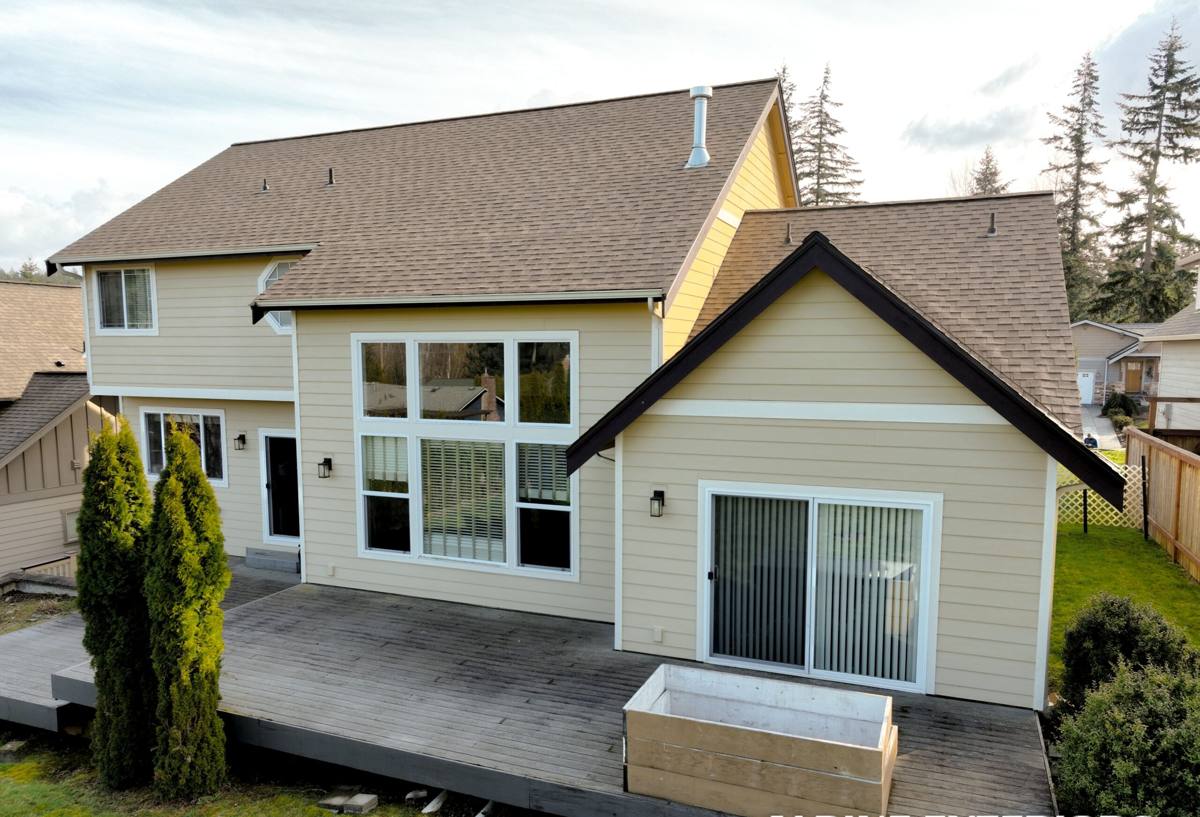
What Salt Air, Rain, and Moss Actually Do to a Roof
Salt Air
Airborne salt is corrosive to unprotected or poorly coated metal fasteners and flashing. It's not usually a dealbreaker for a well-specified metal roof, but it does mean the coating system and fastener grade matter more here than they would twenty miles inland. This is a spec decision, not a brand decision — we'll get into that below.
Driving Rain
Bellingham doesn't get the heaviest rainfall totals in the state, but wind-driven rain off the Strait pushes water sideways into laps, valleys, and wall-to-roof transitions in a way that straight-down rain doesn't. Every seam, valley, and penetration on a South Hill roof needs to be detailed for wind-driven water, not just gravity drainage.
Moss Season
Whatcom County's moss season runs long — realistically, conditions favor moss growth most of the year on a shaded, north-facing, or tree-covered roof plane. Moss holds moisture against roofing material, and on shingles that moisture works its way under tabs and granules over time. Metal panels give moss far less to hold onto, and a smooth, properly sloped metal roof sheds spores and debris much more readily during Bellingham's frequent rain events, which do the rinsing for you.
Metal Roofing Options for a South Hill House
Not every metal roofing product is a good fit for every house style, and South Hill has a real mix — craftsman bungalows, mid-century ramblers, and newer infill construction. Here's how the common options stack up for this specific climate and neighborhood:
| Type | Best For | Coastal/Rain Performance | Notes |
|---|---|---|---|
| Standing seam steel | Most South Hill roof pitches and styles | Excellent — concealed fasteners, raised seams shed wind-driven rain well | Our default recommendation for full re-roofs in this exposure |
| Exposed-fastener panel (screw-down) | Outbuildings, budget-conscious re-roofs | Good, but exposed fasteners need periodic re-torquing and are the first thing salt air attacks | Lower upfront cost, higher long-term maintenance |
| Stone-coated steel | Homes wanting a shingle or tile look | Very good — coating adds an extra corrosion barrier | Heavier and pricier; good option where HOA or historic look matters |
| Aluminum panel | Homes with the most direct bay exposure | Excellent — aluminum doesn't rust like steel can | Costs more than steel; worth it on the most exposed South Hill lots |
For most South Hill projects, a Kynar/PVDF-coated standing seam steel system is our default recommendation — it's the best balance of corrosion resistance, water-shedding detail, and cost for this specific climate. On lots with unobstructed bay exposure, we'll talk through aluminum with you honestly, since the extra cost sometimes pays for itself in reduced long-term maintenance.
What a Correct Metal Roof Installation Involves
Metal roofing fails early almost exclusively because of installation shortcuts, not the material itself. A correct job on a South Hill house includes:
- Full tear-off and deck inspection — we don't install metal over deteriorated or spongy decking, ever
- Ice-and-water or synthetic underlayment at eaves, valleys, and penetrations, sized for wind-driven rain exposure
- Panel layout planned around the actual roof geometry, not a one-size-fits-all run
- Fastener spacing and clip type matched to the coastal wind exposure, not just standard code minimum
- Properly formed and sealed flashing at every wall transition, chimney, skylight, and vent — this is where most leaks actually start
- Ridge and hip ventilation detailed to keep moisture from condensing under the panels in our humid winters
- A clean site — old roofing material and fasteners fully cleared, since stray screws under a new panel system cause long-term corrosion spots
Every one of those steps takes more time than a rushed exposed-fastener install, and it's where the real cost of a "cheap" metal roof quote usually gets found later.
Moss, Trees, and Maintenance Specific to South Hill Lots
A lot of South Hill properties have mature trees close to the roofline — nice for shade and privacy, but it means more debris, more shade, and more moisture sitting on the roof than a wide-open lot would see. Metal roofing doesn't eliminate the need for maintenance, it just changes what maintenance looks like:
- Clear gutters and valleys of needles and leaf litter at least twice a year — clogged valleys are the most common cause of water backing up under panel laps
- Rinse moss and organic buildup off shaded roof planes rather than waiting for it to establish — metal sheds it easily when it's addressed early
- Check sealant at penetrations (vent boots, skylights) every few years — sealant ages faster than the metal itself
- Never pressure-wash a metal roof at high pressure directly into seams or fastener heads
- Keep overhanging branches trimmed back where practical, both for debris and for reducing prolonged shade on north-facing planes
None of this is heavy work compared to what a shingle roof in the same spot would need, but it's not zero-maintenance either — anyone who tells you a roof of any material is maintenance-free in this climate isn't being straight with you.
How We Work With South Hill Homeowners
We work Bellingham neighborhoods regularly enough to know how South Hill's older housing stock and lot layouts typically go together — narrow driveways, mature landscaping, and roof pitches that vary block to block. That matters for staging material, protecting yards during tear-off, and giving you an honest timeline before we start, not after.
Our process on a South Hill re-roof is straightforward:
- On-site assessment — we get on the actual roof, check the decking condition, note existing flashing and ventilation issues, and take real measurements rather than estimating from the ground or a satellite photo
- Written proposal — panel type, coating, underlayment spec, and a firm price, explained in plain terms so you know exactly what you're paying for
- Scheduling around weather — we plan tear-off and dry-in around Whatcom County's rain patterns to minimize the days your home is exposed
- Installation — full crew on-site, daily cleanup, and site protection for landscaping and walkways
- Final walkthrough — we go over the finished roof with you, including what maintenance to expect and when
What Drives the Cost of a Metal Roof Here
Metal roofing costs more upfront than asphalt shingles, and the honest answer to "why" is a mix of material and labor factors specific to your roof — not a flat per-square-foot number anyone can quote sight unseen. The main variables:
| Factor | Why It Matters |
|---|---|
| Roof complexity (valleys, dormers, transitions) | More cuts, more flashing detail, more labor hours |
| Panel and coating choice | Aluminum and premium coatings cost more than standard steel finishes |
| Deck condition | Rotted or soft decking found during tear-off adds repair cost before panels go on |
| Access and staging | Steep pitches or tight South Hill lots can add time for safety setup and material handling |
| Existing layers to remove | Tear-off of old shingle layers adds disposal and labor cost versus a bare deck |
We won't give you a number over the phone that means anything — we'll give you one after we've actually looked at your roof, because that's the only way it's accurate.
Signs Your Current Roof Is Telling You It's Time
- Granules collecting in gutters or at downspout outlets
- Moss established in patches rather than just a light surface film
- Curling, cupping, or missing shingle tabs, especially on south- or west-facing slopes
- Daylight visible through the attic decking, or damp insulation after a storm
- Flashing that's visibly rusted, lifted, or separated at chimneys and walls
- A roof already past 15-20 years old in this coastal exposure, even if it looks okay from the street
If you're seeing more than one of these, it's worth having someone actually get up there before the next storm season rather than waiting for a leak to force the decision.
Why a Crew That Already Works South Hill Is Worth It
Metal roofing is unforgiving of guesswork — a flashing detail that works fine in a dry climate can leak within a season in Bellingham's wind-driven rain. Hiring a crew that already works this specific neighborhood means we're not learning your roof's quirks on your dime: we know what South Hill's tree cover, pitch variety, and bay exposure typically demand, and we spec the job accordingly instead of applying a generic template.
If you're weighing a metal roof for a South Hill home, we're glad to come take a look and give you a straight, no-pressure estimate — no obligation, just an honest read on what your roof actually needs. Use the form below to get started.