 Bellingham Siding
 Building Decks for Sudden Valley's Setting
Sudden Valley sits in a wooded, lake-adjacent pocket of Whatcom County, and that setting shapes almost every decision that goes into a deck out here. Tree cover means shade and moisture linger on deck boards longer than they would on an open lot. Proximity to Lake Whatcom and the surrounding forest means more standing organic debris — leaves, needles, pollen — settling into board gaps and fastener heads. A deck built with generic, one-size-fits-all specs from a big-box plan set will show its age here faster than the same deck built two hours inland. We build decks specifically for this environment, not a national average.
This page is about one job: new deck construction and major rebuilds for homes in and around Sudden Valley. It's not a general overview of every service we offer — it's what we've learned building and repairing decks in this specific corner of Bellingham, and what we think you should know before you sign a contract with anyone.
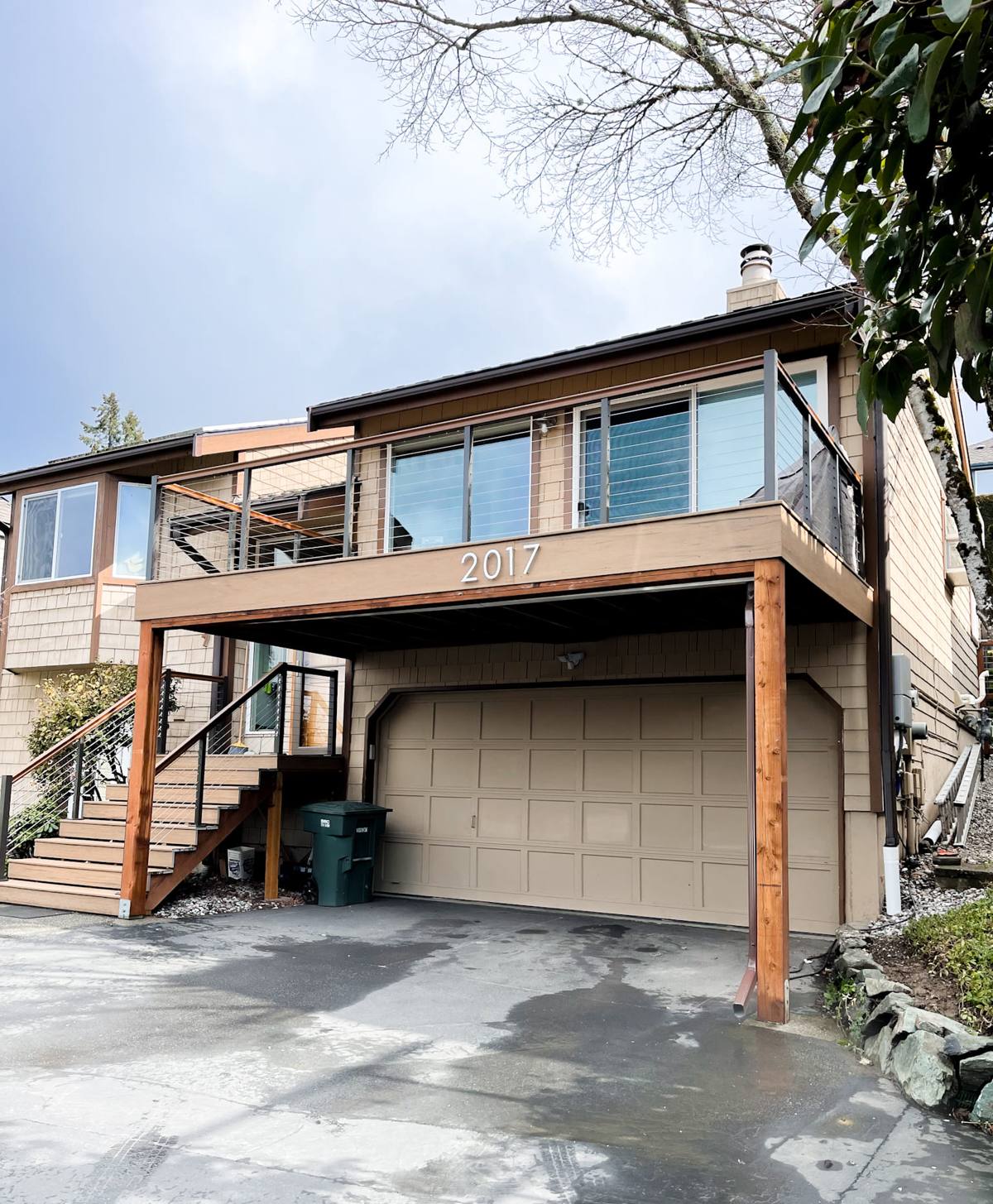
What Whatcom County's Climate Does to a Deck
Bellingham and Whatcom County get a long, wet, mild winter followed by a shoulder season that never fully dries out. On top of that baseline, Sudden Valley's tree canopy and lake-effect humidity add their own pressures:
- Moss and algae: Shaded, north-facing decks in wooded lots can grow moss within a single wet season if boards aren't ventilated properly underneath.
- Driving rain: Wind-driven rain off the lake basin pushes water sideways under railings and into ledger connections, not just straight down onto the surface.
- Salt-tinged air: Marine air moving inland from Bellingham Bay accelerates corrosion on unprotected fasteners, brackets, and hardware — even well inland of the immediate coastline.
- Freeze-thaw cycling: Whatcom County doesn't get deep freezes often, but the repeated freeze-thaw swings we do get will work water into any crack in a footing, post base, or board end that wasn't sealed correctly.
None of this makes deck building here harder than anywhere else — it just means the details matter more, and the details are exactly what get skipped by crews that don't build in this region regularly.
Choosing the Right Decking Material
There's no universally "correct" decking material — there's a correct material for a given budget, sun exposure, and maintenance appetite. Here's how the common options actually perform in a shaded, wet, Whatcom County lot like Sudden Valley:
| Material | Upfront Cost | Maintenance | Behavior in Shade/Moisture | Typical Lifespan |
|---|---|---|---|---|
| Pressure-treated wood | Lowest | Annual cleaning, re-staining every 2-3 years | Prone to moss and graying if not sealed; needs airflow underneath | 15-20 years with upkeep |
| Cedar | Moderate | Regular oiling/sealing to hold color and resist moss | Naturally rot-resistant but still needs sealing in shaded spots | 15-25 years with upkeep |
| Composite decking | Higher | Occasional washing, no staining or sealing | Resists rot and moss growth far better than wood; can still get slick when shaded and wet | 25-30+ years |
| PVC/capped polymer | Highest | Lowest — wash as needed | Fully sealed cell structure handles standing moisture and shade the best | 30+ years |
For shaded Sudden Valley lots, we lean toward steering homeowners away from bare pressure-treated wood on decks that get little direct sun, simply because it demands the most upkeep in exactly the conditions where moss and moisture are worst. That's a maintenance-burden call, not a knock on wood as a material — plenty of well-maintained wood decks in this area look great for decades. It comes down to how much annual maintenance you actually want to put in.
Railings and Fasteners
Whatever decking material you choose, we match it with stainless or coated corrosion-resistant fasteners and hardware rated for the moisture and marine-influenced air common around Bellingham. Cheap galvanized fasteners can start staining and weakening within a few years out here — the fastener spec matters as much as the board spec.
Framing and Structure: What's Underneath Matters Most
A deck's surface material gets all the attention, but the framing underneath is what determines whether the deck is safe and long-lived. This is also where corner-cutting is hardest for a homeowner to spot after the fact, because it's covered up.
Footings and Posts
Footings need to sit below frost depth and bear on undisturbed or properly compacted soil — not the loose fill common on newer-graded lots. On sloped or wooded Sudden Valley parcels, we evaluate drainage around each footing location individually rather than assuming a flat, uniform grade.
Ledger Attachment
The ledger board — where the deck attaches to the house — is the single most common failure point in Pacific Northwest deck construction. It has to be properly flashed and lag-bolted or through-bolted to the house framing, with flashing that sheds water away from the house sheathing rather than trapping it against the wall. We treat ledger flashing as non-negotiable, not an upsell.
Beams and Joists
Joist spacing and beam sizing depend on the decking material, the span, and expected loads — a heavier composite or a hot tub load needs different engineering than a light cedar deck. We size framing to the actual job, not a generic minimum.
Drainage and Moisture Management
Given how much water Whatcom County sees, drainage isn't a finishing touch — it's a structural decision made early in the build. Key elements we build into every deck:
- Proper board spacing and slope so water sheds off the surface instead of pooling
- Ventilation gaps under the deck frame so ground moisture and shade-trapped humidity can escape
- Flashing at every point the deck meets the house — ledger, stairs, any attached structure
- Post bases that keep wood posts elevated off concrete or soil contact, where water collects first
- Grading and gravel or drainage stone under low-clearance decks to keep standing water away from footings
Skipping any one of these is usually invisible on installation day and expensive two or three winters later, once moss, rot, or a soft ledger connection shows up.
Permits and Working Within Sudden Valley
New decks and major rebuilds typically require a building permit through Whatcom County, with requirements that shift based on the deck's height, size, and attachment to the house. If your property is part of a planned community like Sudden Valley, there may also be an architectural or community review step for exterior projects — homeowners should check their own governing documents, since we don't assume rules that can change or vary by section. We handle the county permitting process as part of the job and can point you toward what to check on the community side, but we don't guess at HOA specifics we haven't confirmed for your address.
Our Deck Building Process
Every project follows the same sequence, whether it's a full rebuild or new construction:
- On-site assessment: We look at sun exposure, tree cover, slope, and the existing structure (if any) before recommending materials.
- Design and material selection: We walk through the cost, maintenance, and durability trade-offs for your specific lot — not a generic pitch.
- Permitting: We handle the Whatcom County permit application and any required inspections.
- Demo (if rebuilding): Removal of the old structure, with a check of the ledger and any framing that will be reused.
- Framing and footings: Built to the load and span the design actually calls for, not the code minimum.
- Decking, railing, and finish work: Installed with fastener systems and flashing details matched to the material and site.
- Final walkthrough: We go over maintenance expectations for the specific material you chose before we call the job done.
Deck Maintenance Checklist for Whatcom County Homes
A well-built deck still needs seasonal attention in this climate. This is the routine we recommend to Sudden Valley homeowners regardless of who built the deck:
- Sweep leaves and needles off the surface and out of board gaps regularly during fall
- Rinse or wash the deck at least once or twice a year to slow moss and algae buildup, especially on shaded sections
- Check railings and stair connections annually for loosening — freeze-thaw cycling works fasteners loose over time
- Inspect the ledger flashing area where the deck meets the house for any signs of staining or soft wood
- Re-stain or re-oil wood decking on the manufacturer's recommended schedule, not just when it looks faded
- Clear ventilation gaps underneath the deck of leaves, debris, and plant growth so airflow keeps working
Why a Crew That Already Works Sudden Valley Matters
Deck-building fundamentals don't change from town to town, but the judgment calls do — how much ventilation a shaded lot needs, which fastener spec is worth the extra cost, whether a given slope needs extra drainage stone. Those calls get better with repetition in the same conditions. A crew that regularly works wooded, lake-adjacent Whatcom County lots has already made those calls dozens of times and knows which shortcuts cause problems here specifically.
If you're planning a new deck or need to replace one that's showing its age, we're happy to come take a look and give you a straightforward, no-pressure estimate — including an honest read on whether your current structure can be partially reused or needs a full rebuild. Use the form below to get started.