 Bellingham Siding
 South Hill's Siding Problem Isn't Like Most Neighborhoods
South Hill sits above Bellingham Bay, and that elevation cuts both ways. Homes up here get some of the best views in Whatcom County, but they also catch weather that lower, more sheltered neighborhoods don't see as directly. Wind off the bay carries salt air onto siding, trim, and fascia. Winter storms push rain sideways against exposed walls instead of letting it fall straight down. And the long, wet shoulder seasons that define this part of the Pacific Northwest give moss and algae months at a time to gain a foothold on anything that stays damp.
None of that is unique to any one house on South Hill — it's a function of the terrain and the marine climate that Whatcom County lives with nine months of the year. But it does mean siding choices that work fine in a drier inland climate, or even in a more protected part of Bellingham, can underperform up here. We install James Hardie fiber cement siding specifically because it holds up to this combination of salt exposure, driving rain, and constant moisture — and we've done enough work on this hill to know which details actually matter.
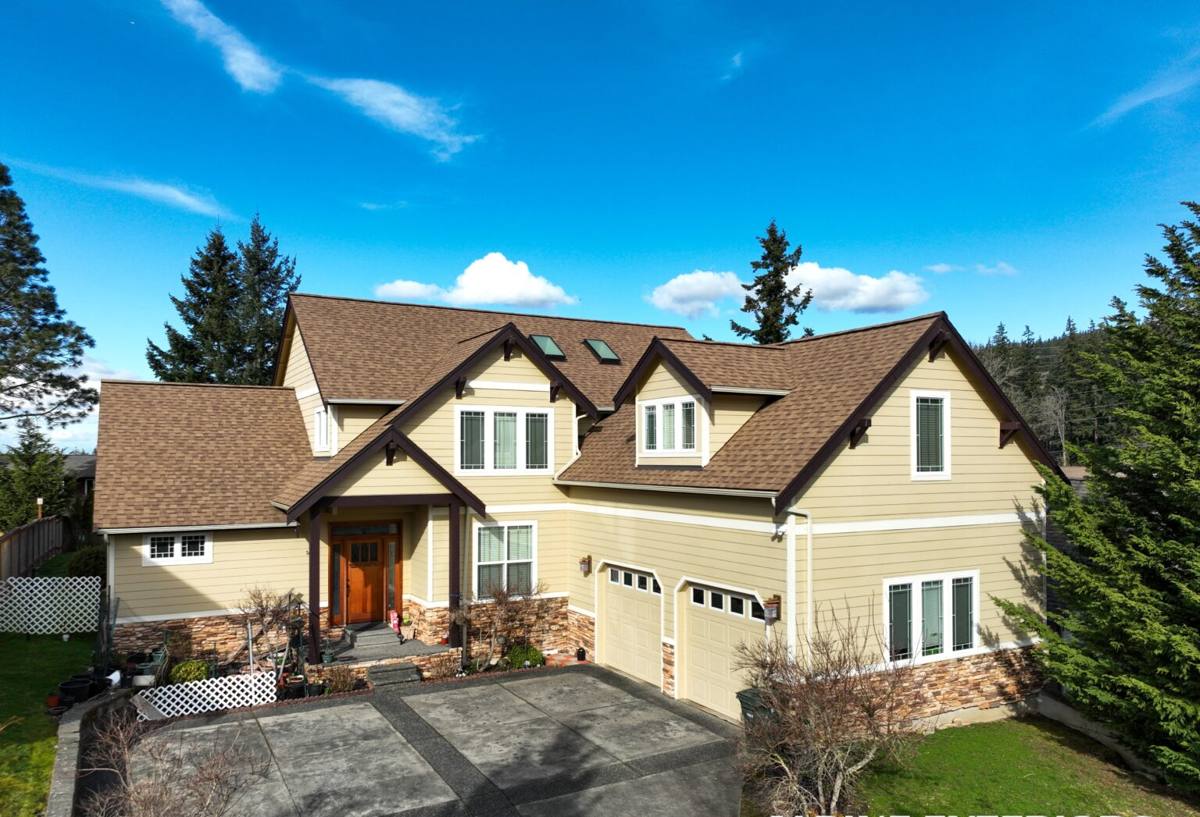
Why Fiber Cement Makes Sense for This Climate
Fiber cement is made from cellulose fiber, sand, and Portland cement, pressed and cured into a dense, stable board. That composition gives it three properties that matter directly for a hillside, bay-facing neighborhood like South Hill:
- It doesn't absorb and swell with moisture the way wood-based products can, which matters when a wall face stays wet for days during a fall storm system.
- It's dimensionally stable across temperature swings, so it doesn't expand and contract enough to open up seams and fastener holes the way some other materials do.
- It's non-combustible, which is a real consideration anywhere in the western Whatcom foothills during dry summer stretches, even though our summers are shorter and milder than most of the state.
Older Homes and Mixed Building Stock
South Hill has a mix of older, character-driven homes alongside newer construction, and that matters for siding work. Older homes often have siding profiles, trim details, and wall assemblies from an earlier era, and matching or upgrading them correctly takes more judgment than just nailing up new boards. Fiber cement comes in enough plank widths and textures that we can usually match an existing look while upgrading the material underneath it — instead of forcing a house into a profile it was never designed around.
Wind-Driven Rain on Exposed Walls
On a slope, some walls of a house take weather that others never see. The uphill or bay-facing side of a South Hill home can get driving rain at an angle that pushes water up under laps and around penetrations far more aggressively than a sheltered wall. That's a water-management problem before it's a material problem — which is why the installation details below matter as much as the siding brand itself.
What a Correct Installation Actually Involves
Fiber cement is only as good as the water management behind it. A huge share of the siding failures we get called out to inspect — on South Hill and elsewhere in Bellingham — trace back to installation shortcuts, not the material itself. A correct job includes:
- A weather-resistive barrier installed and lapped correctly, with all seams taped or shingled to shed water downward
- Proper flashing at every window, door, and roof-to-wall transition, integrated with the barrier so water can't get behind the siding at these joints
- Correct fastener type, placement, and depth — over-driven or under-driven nails are one of the most common causes of early failure
- Manufacturer-specified clearances: siding held up off roof lines, decks, and grade, and gapped from concrete or masonry
- Caulking only where the manufacturer calls for it, with the right sealant — over-caulking traps moisture instead of shedding it
- Field-cut edges primed or sealed before installation, since factory finish only protects the face and factory edges
Why the Instructions Are Non-Negotiable
James Hardie publishes detailed, climate-specific installation instructions, and following them is what keeps the warranty valid — not just good practice. In a marine climate with the rainfall totals Whatcom County sees, skipping a step like proper starter strip installation or flashing tape at a window head isn't a cosmetic shortcut. It's the difference between siding that sheds water for decades and siding that traps it behind the wall where nobody can see the damage until it's expensive.
The James Hardie System We Install
We install James Hardie exclusively — no vinyl, no LP SmartSide, no other fiber cement brands, no primed wood. That's a deliberate standard, not a lack of options. Hardie's ColorPlus factory finish is baked on and warranted separately from the substrate, which matters in a climate where UV exposure is lower but constant moisture and salt air are higher. For homes on South Hill, we typically work with:
- HardiePlank lap siding — the most common choice, available in several textures and exposure widths to match existing or traditional Pacific Northwest home styles
- HardiePanel vertical siding — used for accent sections, gables, or homes with a more modern design
- HardieTrim — for corners, fascia, and window surrounds, so the whole exterior envelope is consistent, non-combustible material rather than mixing in wood trim that will weather differently
Hardie also engineers products by climate zone (HZ5 for northern, wetter regions like ours versus HZ10 for hot, dry climates), which affects the exact formulation used. This isn't marketing — it changes how the board performs against the moisture load a place like Bellingham puts on a wall system year-round.
Our Process, Start to Finish
The work itself follows the same sequence on every South Hill project:
- On-site assessment — we look at existing siding, trim condition, and any signs of moisture intrusion before quoting anything
- Tear-off and sheathing check — old siding comes off and we inspect the sheathing underneath for rot or damage before it gets covered back up
- Weather barrier and flashing — new house wrap or barrier, with flashing at every penetration and transition
- Siding installation — planks, panels, and trim installed to Hardie's fastening and clearance specifications
- Caulking and touch-up — sealant only where specified, cut edges sealed, and a final walk-through
We also flag anything we find during tear-off — soft sheathing, old flashing that was never properly integrated, evidence of past water intrusion — before we cover it back up, so there are no surprises later.
Living with Fiber Cement in a Moss-Prone, Salty Climate
Correctly installed Hardie siding is genuinely low-maintenance compared to wood or engineered wood alternatives, but "low-maintenance" doesn't mean "no maintenance" anywhere in this climate. A short annual routine keeps siding performing the way it's supposed to:
- Rinse siding once or twice a year to clear salt residue and organic buildup, especially on bay-facing walls
- Keep gutters clear so overflow doesn't run down the siding face and feed moss growth at the top of walls
- Trim back vegetation and tree branches that shade siding and keep it damp longer than open walls
- Check caulking at trim and penetrations every year or two and re-seal only where it has failed
- Look at the bottom courses near grade and decks periodically, since these areas hold moisture longest
None of this is heavy labor — it's the kind of upkeep that takes an afternoon and prevents the moss and algae staining that's common on shaded, north-facing walls throughout Bellingham.
What Drives Cost on a South Hill Project
Every project is different, but the same factors tend to move the price up or down on hillside homes in this area:
| Factor | Why It Matters |
|---|---|
| Sheathing condition | Rot found during tear-off means repair before new siding can go on |
| Home access and slope | Steep lots and limited staging area add labor time and scaffolding needs |
| Number of stories and gables | More wall area, corners, and roof-to-wall transitions means more flashing detail work |
| Trim scope | Full trim replacement adds cost but keeps the whole envelope consistent |
| Existing siding removal | Full tear-off versus siding over an existing layer changes both price and long-term performance |
| Color and texture selection | ColorPlus finishes and certain textures carry different material costs |
We walk through these factors on-site rather than quoting blind, because a hillside lot and a flat lot with the same square footage can have very different labor requirements.
Why a Local Crew Matters on This Hill
A crew that has already worked on South Hill knows the practical realities before they show up: how the slope affects staging and scaffolding, which sides of a house typically take the worst weather, and how salt air and prolonged dampness show up in older siding and trim. That's not something you can fully substitute with a generic install checklist — it comes from having actually done the work in this specific setting, on homes dealing with the same bay exposure and moss season as yours.
It also means we're a known quantity locally, not a crew that installs siding here once and moves on. Whatcom County's permitting and inspection requirements, the realities of scheduling around our wet season, and the specifics of hillside access are all things we've already worked through repeatedly on this side of Bellingham.
If you're weighing a siding replacement or repair on South Hill, we're happy to take a look and talk through what your home actually needs — no pressure, no obligation. Use the form below to request a free estimate.